


- WIADOMOŚCI
- WYWIADY
„NATO's theory of conventional victory is not enough” [INTERVIEW Defence24]

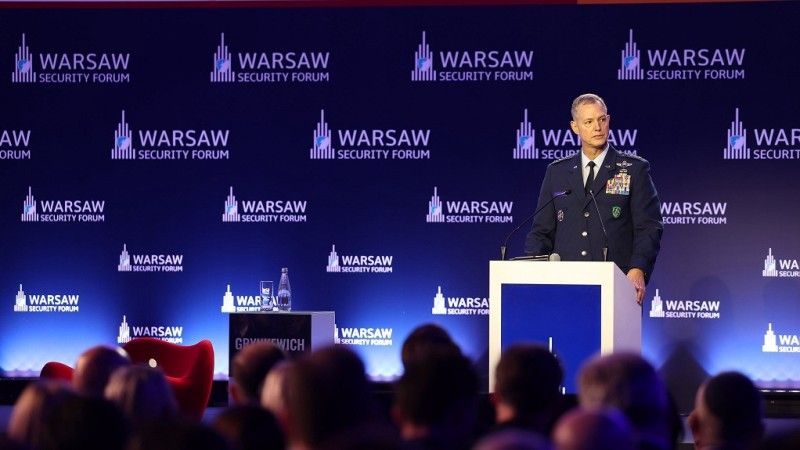
Photo. NATO/X
„We must remember that NATO is both a military and a political alliance, and its functioning relies on the capability of credible deterrence. If the belief in this capability disappears, Russia will manage to undermine it without launching a conventional attack. This is precisely what we must start thinking seriously about,” says Harry Nedelcu of Rasmussen Global in an interview with Defence24.
Great statements regarding countering a conventional attack are not enough to defend against Russian hybrid attacks, believes Harry Nedelcu. Does NATO need a „theory of victory” in the hybrid domain as well? What condition is the North Atlantic Alliance in? Doesn’t the reduction in the number of US troops in Europe contradict the theory presented in Warsaw by Gen. Alexus Grynkewich? We invite you to read the interview.

Michał Górski, Defence24: How do you assess the „theory of winning” outlined by General Grynkewich at the Warsaw Security Forum?
Harry Nedelcu, Senior Director for Geopolitics in Rasmussen Global: In terms of deterrence and reassurance, it was very good. In particular, his message that he can sleep well at night, but that his job is to keep others awake, was spot on. That is exactly what you want to hear from someone in his position as Supreme Allied Commander Europe, or SACEUR. His remarks on countering a conventional attack were also very good.
However, how confident are we that Russia would launch a conventional attack against us? From what we have seen so far, that seems very unlikely.
Russia would probably try instead to undermine us from within, using various forms of hybrid activity below the threshold of Article 5 to test our resilience and amplify divisions within our societies. We saw that with the protests in France, where we suspect Russia played a role in amplifying them.
Of course, you could say that the general’s remit was to discuss conventional attacks and Article 5, rather than those issues. But as an Alliance, and as the West, we need to ask ourselves how confident we are in our ability to defend against the full range of hybrid threats.
In a way, this stands in sharp contrast to the Cold War, when the situation was reversed. We were very active and effective in using the media. Think of Radio Free Europe and all the other tools at our disposal, including our societies themselves. That did not necessarily involve deliberate action: in economic terms, in quality of life, democracy and so on, it was evident that what we offered was the better option.
We were on the offensive when it came to winning the hearts and minds of people in the Soviet Union and the communist societies under its umbrella.
Today, the ideological divisions may not be as deep, but my impression is that they are on the offensive and we are on the defensive. We are not trying to reach into their societies and amplify the divisions that may exist there.
They are doing that to us. Of course, it is our responsibility to manage divisions within our own societies. But we also need to begin by recognizing that we are in the opposite position to the one we occupied during the Cold War.
Could part of the problem be that we now have social media and multiple sources of disinformation? That is a significant difference between today and the Cold War…
Of course. We have different communication tools and live in a different era. I am not suggesting a direct equivalence between the two periods. But I cannot help noticing that our position is strikingly different—and, I would say, the reverse of our position during the Cold War.
You asked about General Grynkewich’s speech. On conventional defense, it was spot on. But it does not address the full range of threats Russia can pose. We need to consider those separately and take them very seriously.
Returning to General Grynkewich „theory of winning,” should such a concept include more specific responses—for example, telling Russia that a particular action would trigger a particular countermeasure? Or is a more general message better for deterrence?
Within the scope of his remarks, which concerned conventional attacks, this is what you want to do. You want to deter the adversary and make clear that any attempt would be futile, so it should not even be made.
That is at the core of NATO’s purpose: to deter, to reassure its own populations that it can do so, and to convince the adversary that it should not attempt an attack. From that perspective, the message was very clear. My point is that if the Russians hear this and know that we are collectively stronger than they are, they will not attempt a conventional attack. They will seek to undermine us—and our very ability to deter—through other means. They will try to weaken us internally and amplify the rifts already emerging across the Atlantic.
That would make the Alliance as a whole less credible. We must remember that NATO is both a military and a political alliance, and it relies on its ability to deter convincingly. If confidence in that ability is lost, Russia will already have undermined it without having to launch a conventional attack. That is what we need to start thinking about seriously.
Does NATO therefore need an additional „theory of winning” for hybrid warfare?
Yes, absolutely. We need to broaden our understanding of warfare. Whether we do that within NATO or primarily among Europeans, we definitely need to think beyond conventional warfare.
You are affiliated with a foundation associated with a former NATO secretary general. How would you assess NATO’s position in 2026? Is it a stronger alliance than it was five, seven or ten years ago?
Let me pick up where I left off. We must remember that NATO is both a military and a political alliance. It depends on the allies« ability to act together on the United States being fully engaged, and on its willingness to back its European allies.
I would not say NATO is dead, but its standing and its ability to deter effectively are certainly being undermined by what we see coming out of the United States. This also includes developments outside NATO itself, such as Trump’s latest moves on Russia and the „diesel deal” \[wording to be checked against the recording\] he concluded with Russia behind Ukraine’s back. That undermines the Ukrainians and leaves them feeling that they have been thrown under the bus. It sends the wrong signal.
So, when you ask about NATO’s position, I would say it is somewhat unclear under this administration. Fundamentally, Russia must know that the United States will honor its Article 5 commitments fully and without equivocation. Otherwise, NATO’s very credibility is undermined.
The second issue is the US pivot toward the Indo-Pacific. We all understand that this is happening. We are entering an era of „NATO 3.0,” in which the United States would provide key enabling capabilities and perform the essential functions for which it is needed, including nuclear deterrence, while responsibility for conventional defense would fall to the Europeans. That is all well and good.
However, the way this is happening is adding considerable confusion and chaos. This process was going to happen anyway, but the current US administration is accelerating it through growing friction originating in Washington, rather than through cooperation and coordination.
That is the first problem: the process is emerging from an increasingly strained relationship between the United States and Europe, including the pressure Washington is applying and the way it deals with its European partners. The second problem follows from the first. Because the process is being accelerated and handled so chaotically, Europeans are being asked to assume greater responsibility before they have the military capacity to do so. They face shortages in critical enabling capabilities. For example, they do not have all the airborne intelligence and surveillance capabilities, long-range precision-strike capabilities, or air defenses needed to take over that responsibility from the Americans.
That also contributes to the uncertainty surrounding NATO’s position today.
You have already touched on my next question about NATO 3.0. Would a likely reduction in the number of US troops in Europe contradict the „theory of winning”?
As I said, the issue is more about how this is happening than the fact that it is happening at all.
It would be one thing if there were an orderly transition, with several years of working alongside each other so that Europeans could catch up and develop those enabling capabilities as the United States withdrew some of its conventional forces. But that is not what is happening, and that is where the problem lies.


