












- ANALIZA
- WIADOMOŚCI
Putin sends nuclear warning to the West. Ukraine is only one front

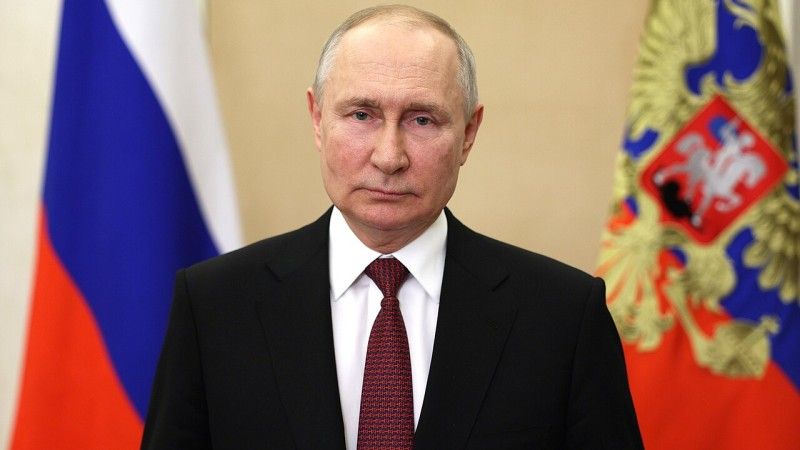
Vladimir Putin used his Valdai speech to show that the Kremlin no longer wants the war against Ukraine to be read only through Ukraine. In his narrative, Kyiv is one field of a much broader confrontation with the West, while nuclear weapons, artificial intelligence and Kaliningrad are being used to remind NATO that Russia wants to decide where the limits of escalation are drawn.
Vladimir Putin did not present a new proposal to end the war. He did not soften Russia’s position, nor did he move away from the main lines of Kremlin propaganda. The annual Valdai speech was instead another attempt to organise the Russian view of the world around one central argument: Russia is not attacking, Russia is responding. This has been Moscow’s main explanation for years, but now it is being placed in a much wider framework. Ukraine remains important, but in Putin’s message, it is no longer the only issue. It becomes part of a larger struggle over Europe’s security order and Russia’s place in it.
The Russian president returned to the collapse of the Soviet Union, accusing late Soviet leaders of excessive trust in the West. He argued that this had played a destructive role in global stability and that after 1991 Western states tried to use Russia’s weakness for their own benefit. However, Putin’s own words were more complex than a simple claim that the West destroyed the USSR. He also admitted that the Soviet Union fell because of internal problems: mistakes by successive leaders, ideological rigidity, incompetence and the long-term refusal to face growing weaknesses. This is important, because it shows how Putin builds the argument. First, he recognises internal collapse. Then he turns that collapse into a story about Western exploitation.
This is the logic that runs through the whole speech. Russia is presented as a state that wanted to become part of the West, but was rejected, weakened and pushed into confrontation. In this version, Moscow does not choose war; it is forced into it. Such a construction is useful for the Kremlin, because it turns aggression into defence and expansion into reaction. It also allows Russia to explain the war against Ukraine not as a decision taken in the Kremlin, but as the result of a long process allegedly imposed by the West.
The nuclear element was the strongest part of the address. Putin said that no one can guarantee that weapons capable of catastrophic destruction will never be used. He used the metaphor of Chekhov’s gun, warning that if a gun is hanging on the wall at the beginning of a play, it must eventually fire. Formally, he said that such a scenario had to be avoided. Politically, however, the message was different. Russia was again reminding Western states that every further step in support of Ukraine can be presented by Moscow as part of a wider escalation.
The issue became sharper when Putin spoke about Kaliningrad. He warned that in the event of a direct attack on Russian territory, including the Kaliningrad region, the use of all types of weapons available to Russia would inevitably be placed on the table. This followed the Russian Foreign Ministry’s recent warning that any attempt to isolate the exclave could trigger a response with all available means. Putin then insisted that Moscow was not trying to intimidate anyone and claimed that the ministry’s note did not mention nuclear weapons. This is precisely where the contradiction appears. According to Reuters, the note did refer to the use of Russia’s full arsenal, including nuclear weapons.

This is not an accident in Russian communication. The Kremlin often denies that it is threatening anyone, while making sure that the threat remains visible. It avoids one precise red line and instead creates a space of uncertainty. This allows Moscow to adjust its response later, depending on the political situation. It also forces NATO governments to think not only about what they are doing, but about how Russia may decide to define those actions. That is the purpose of this kind of signalling: not to announce a direct strike, but to make the West calculate risk under pressure.
Putin’s words also fit the broader evolution of Russia’s nuclear doctrine. In November 2024 Moscow widened the declared circumstances in which it could consider the use of nuclear weapons. The updated doctrine included aggression by a non-nuclear state acting with the support of a nuclear power, as well as certain forms of large-scale conventional attack crossing Russia’s borders. It also extended the logic of Russian deterrence to Belarus. The Valdai speech therefore did not create a new Russian approach. It confirmed that nuclear rhetoric remains part of Moscow’s political pressure on the West.
Ukraine was again presented as a victim not of Russia, but of Western policy. Putin repeated that Russia had not wanted the war and had not started it. According to him, the war was started against Russia, which was then forced to defend itself with weapons. He also accused the West of supporting nationalism and Russophobia in Ukraine in order to turn the country into an instrument against Moscow. NATO, in his version, was preparing to entrench itself militarily on Ukrainian territory. These claims are not new, but their function is changing. They now serve to move attention away from Russian aggression and towards a supposed conflict between Russia and the entire Western bloc.
This is why the speech should not be read only as another attack on Kyiv. Putin is building a narrative in which Ukraine is one front, not the source of the conflict. The source, in his version, is the West’s refusal to accept Russia’s sphere of influence. This is a crucial distinction. If the war is only about Ukraine, then a settlement concerns Ukraine. If the war is about Russia’s place in Europe, then the Kremlin can demand much more than territory. It can demand a new security order.

The artificial intelligence part of the speech also served this wider argument. Putin recalled the case of Stanislav Petrov, the Soviet officer who in 1983 judged a warning of incoming American missiles to be false. Petrov did not personally decide whether the Soviet Union would launch nuclear weapons, but his judgement is widely seen as having helped prevent a dangerous escalation. Putin used this case to warn that machines may in future take on greater responsibility in the most sensitive decision-making processes. His point was not only technical; it was political and he suggested that a world dependent on algorithms may lose the human judgement that once helped avoid catastrophe.
Putin also spoke about the danger of digital totalitarianism and the need for technological sovereignty. This placed artificial intelligence in the same narrative as nuclear weapons. Both were presented as forces that can reduce the time for decision-making and increase the danger of uncontrolled escalation. For the Kremlin, this is useful language. It allows Russia to present itself not as a source of instability, but as a state warning against a dangerous future allegedly created by others.
There was one more important element. Putin claimed that Russia does not intend to attack European states. At the same time, he warned that an attack on Russian territory, including Kaliningrad, would bring the entire arsenal into consideration. This combination is characteristic. Moscow denies aggressive intent, but leaves itself wide space to define what counts as an attack, provocation or threat. In practice, Russia wants to decide which Western actions are defensive and which are escalatory.
The speech was therefore addressed to several audiences at once. For Russians, it reinforced the story that the country is defending itself against the West. For Ukraine, it repeated the argument that Kyiv is not an independent actor, but a tool of NATO. For Europe and the United States, it was a warning that support for Ukraine will continue to be framed by Moscow as part of a wider confrontation. And for countries outside the West, it presented Russia as a power resisting a system allegedly dominated by others.

The most important conclusion is that Putin is trying to move the centre of the war narrative away from Ukraine. The Kremlin still uses older arguments about protecting Russians, resisting NATO and responding to alleged Ukrainian nationalism. But the stronger message from Valdai was different. Russia wants the war to be seen as a struggle over influence, security and the future balance of power in Europe. Ukraine is the battlefield, but not the whole story. That is why the nuclear warning, the Kaliningrad issue and the remarks about artificial intelligence were placed in the same speech. They all served one purpose – and it is quite obvious – to show that Moscow believes the confrontation with the West is long-term, dangerous and larger than Ukraine itself.


