












- WIADOMOŚCI
- WYWIADY
Canada at MSPO 2026: From a buyer-supplier relationship to a true defence-industrial partnership [INTERVIEW]

As Lead Nation at MSPO 2026, Canada wants to transform its close military ties with Poland into a long-term defence-industrial partnership. Ottawa is bringing its largest-ever defence trade mission to Kielce, with a focus on joint production, technology development, integrated supply chains and exports to European and third-country markets.
Canada will be the Lead Nation at MSPO 2026. What does this status mean for Polish-Canadian relations?
Canada’s participation as Lead Nation at MSPO reflects the strength of our strategic partnership with Poland.
For more than a century, Canada and Poland have worked together to defend our shared security. From the First World War, through World War II, up to Canada ratifying Poland’s accession to NATO as the first country of the Alliance, our relationship has been built not only on shared interests, but on shared sacrifice and a common commitment to freedom and security.
In 2014, Canada began Operation REASSURANCE, supporting NATO deterrence and defence efforts in Europe following Russia’s actions in Ukraine. The first deployment under Operation REASSURANCE was a task force based in Poland. Operation REASSURANCE is now the Canadian Armed Forces’ largest expeditionary mission, and Canada serves as the framework nation for the NATO multinational brigade in Latvia. Poland stands alongside Canada in that brigade, contributing a mechanized infantry company, specialized troops, and headquarters staff.
Canada’s status as Lead Nation at MSPO also signals the reciprocity of the partnership. This year Poland was designated with “Spotlight Partner” status at CANSEC, Canada’s largest annual global defence and security trade show. At the event, both our Ministers of National Defence signed a Letter of Intent and agreed to pursue opportunities for greater cooperation between Canadian and Polish defence industries.
What does Canada want to demonstrate during the trade show in Kielce? Which Canadian companies and technologies will be the main focus in Kielce?
Canada wants to demonstrate the depth of our commitment to Poland, to NATO’s eastern flank, and to defence industrial cooperation with Poland, Ukraine and other Allied nations. MSPO 2026 is Canada’s largest-ever defence trade mission and the largest Canadian business delegation ever to visit Poland.
We want to showcase not only innovative technologies, but also opportunities for partnership, investment, joint production and participation in Canadian and North American supply chains. We recognize that Poland increasingly looks beyond equipment purchases and focuses on industrial cooperation, technology development and export opportunities. That approach aligns closely with Canada’s Defence Industrial Strategy and its Build-Partner-Buy framework, which place a strong emphasis on partnerships with trusted allies.
One message we hope Polish industry takes away from MSPO is that Canada is open for partnership. This includes not only the government and companies, but also provinces, municipalities and economic development organisations, which will also have an important role to play at MSPO.
For Canada, success is measured not only by what we sell, but by what Canadian and Polish companies can build, produce, use and export together.

Photo. Embassy of Canada to Poland
Which Canadian technologies could best address the current modernisation needs of the Polish Armed Forces?
Poland already has one of Europe’s most impressive and rapidly growing defence industries. The real opportunity is where Canadian and Polish strengths can be combined to deliver even stronger solutions for the Polish Armed Forces, NATO and allied partners. Canada’s defence industry offers technologies and solutions that complement Poland’s growing manufacturing and defence industrial base.
One example is CAE, a global leader in military training and simulation with 300+ employees in Poland. As Poland expands its helicopter fleet and prepares future generations of pilots, advanced training becomes increasingly important. CAE’s proposal combines aircraft, simulators, training infrastructure, sustainment and industrial cooperation in Poland.
For intelligence, surveillance and reconnaissance, WESCAM produces some of the world’s leading electro-optical and infrared sensor systems, and recently opened a facility in Katowice and selected Poland as its European hub. By 2027, most WESCAM orders for Europe, the Middle East and Africa are expected to be fulfilled from Poland, creating opportunities for Polish workers, suppliers and exports.
Canada also has important capabilities in many other sectors. In the space and communications domain there is Telesat Lightspeed, already working with a Polish partner. In maritime security, companies such as OSI Maritime Systems and Kraken Robotics, through partnerships with PGZ, support Poland’s naval modernisation. In aerospace, Bombardier aircraft provide the foundation for advanced airborne early warning and surveillance platforms such as the GlobalEye and Aeris-X, and can also be used for VIP transport and missions. In tactical communications, Marconi Technologies is partnering with Enamor International and PGZ company CTM on radios, maritime security and situational awareness systems. Finally, Top Aces provides advanced fighter pilot training services to many allied air forces. As Poland expands its F-16 and F-35 fleets, capabilities such as adversary air training, Joint Terminal Attack Controller training and pilot development can help accelerate readiness while reducing pressure on operational squadrons.
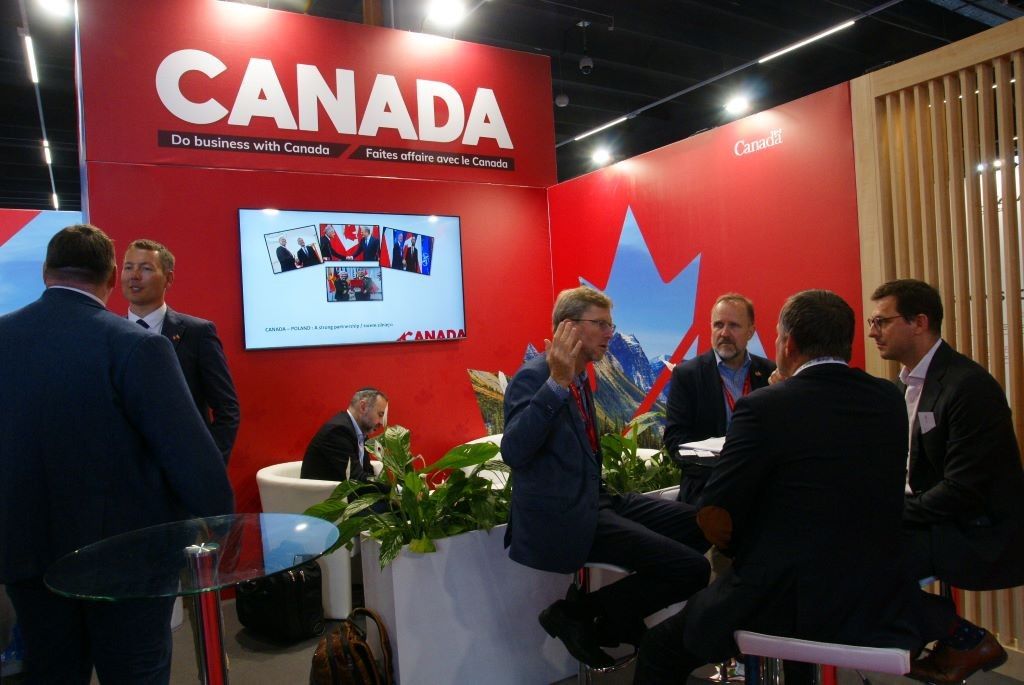
The Polish government expects not only to purchase equipment but also to receive technology transfers, joint projects and production. How does Canada respond to that?
Canada understands this expectation very well because we have many of the same expectations ourselves. We want companies seeking business in Canada to partner with Canadian industry, contribute to our industrial base, create jobs, invest in innovation and strengthen Canada’s economic and national security. In that respect, Canada and Poland are remarkably aligned. We both want defence procurement to strengthen our domestic industrial capabilities and increase resilience.
We are already seeing examples of reciprocal cooperation. Galvion manufactures advanced combat helmets in Poland, including equipment used by Poland’s GROM special forces. Helmets produced at the company’s facility in Gdańsk are also being supplied for Canada’s Dismounted Infantry Capability Enhancement (DICE) programme, providing a concrete example of Polish production supporting Canadian defence capabilities.
The strongest model for future cooperation is not simply “Made in Canada” or “Made in Poland”. It is increasingly: “Made by Poland and Canada working together”.
That approach creates jobs and opportunities in both countries, strengthens NATO supply chains and helps ensure that both Canada and Poland are more secure and more resilient.

Photo. Embassy of Canada to Poland
In which areas could Polish defence companies become attractive partners for Canadian industry, and potentially for the Canadian Armed Forces?
Polish defence companies are not just potential partners for Canadian industry. They are already important partners today. In 2025, Canada-Poland goods trade increased by 33%, the strongest growth among Poland’s top 50 trading partners according to Eurostat. Poland also enjoys a significant trade surplus with Canada, particularly in aerospace and defence.
Looking ahead, unmanned systems are one of the most promising areas for cooperation. Ammunition and explosives are another natural area for partnership. Canadian ammunition production already relies on TNT supplied by Poland’s Nitro-Chem, and both countries have expressed interest in exploring deeper cooperation across ammunition and explosives supply chains.
More broadly, Polish companies have developed impressive capabilities in defence manufacturing, military electronics, communications systems and land systems. These strengths complement Canada’s own priorities as we undertake a historic rebuilding of the Canadian Armed Forces and implement Canada’s Defence Industrial Strategy.
We have already met NATO’s 2% of GDP defence spending benchmark, but that is not the end state. Over the next decade, Canada plans to invest approximately CAD $500 billion in defence, putting the country on a clear path to meeting the NATO Defence Investment pledge of 5% of GDP by 2035, and creating significant opportunities for trusted partners.
Canada offers a combination of advantages that can be difficult to find elsewhere: space for testing and training, secure access to natural resources and critical minerals, world-class talent, and a strong industrial base. Together, these strengths make Canada an attractive location for Polish companies looking to invest, grow production, develop new technologies and access North American supply chains.

Canada is the first non-European country to join the SAFE project (Security Action for Europe), which requires joint procurements. In which areas do you see potential for joint procurement involving both the Canadian and Polish industries?
First, Canada is thankful to Poland for the strong and consistent support it provided for our inclusion in SAFE. The project has already opened a tremendous number of opportunities for cooperation between Canadian and Polish industry, encouraging companies to think less in terms of traditional buyer-seller relationships and more in terms of joint capability development, industrial partnerships and integrated supply chains. In fact, Canada’s first contract under SAFE was the Marconi-Enamor agreement to supply ORION X650 radios for Poland’s Cyber Command.
Looking ahead, Canada is actively engaging with the European Commission regarding future participation in joint procurement initiatives and broader European defence-industrial cooperation mechanisms. We see SAFE as an important first step, not the final destination. Our objective is to become an even more integrated and reliable partner in strengthening transatlantic defence supply chains, industrial resilience and collective security.
Ultimately, success will be measured not by how much Canada sells to Europe or how much Europe sells to Canada, but by how much Canadian and European companies, including Polish companies, can build, develop and export together. For Canada, SAFE is helping accelerate a broader shift toward a genuine Canada-Poland defence-industrial partnership.

Photo. Embassy of Canada to Poland
And do you see a possibility to promote joint exports for the countries in the region and beyond?
Absolutely. In fact, we believe this is one of the most promising areas for future Canada-Poland defence cooperation. We already have successful examples, such as the earlier mentioned Galvion and WESCAM. This is exactly the model we would like to see more of: complementarity between Canadian and Polish technologies and industrial capacity, and exports to Europe and third-country markets.
What also makes Canada an attractive partner is that we have government tools specifically designed to support exports.
The first is the Canadian Commercial Corporation (CCC), Canada’s government-to-government contracting organisation. CCC can act as the prime contractor between governments, provide a Government of Canada-backed performance guarantee and support government-to-government procurement arrangements. Jointly developed Canadian-Polish solutions could potentially be exported to other markets through a government-backed framework. The second is Export Development Canada (EDC), Canada’s export credit agency, similar in many respects to Poland’s KUKE. EDC is expanding its presence in Europe, including through a planned office in Poland, and can provide financing solutions that support international buyers and major projects.
This is an important distinction. In many countries, government contracting and export financing tools are primarily focused on domestic procurement. Canada’s approach is broader. CCC and EDC can help support not only Canadian exports, but also Canadian-Polish partnerships seeking opportunities in markets such as Ukraine, the Baltics, Europe, the Middle East and beyond.
MSPO is focused on economy and industry but Poland and Canada have also military-to-military cooperation, including in Latvia. How can we expand this cooperation and build on this towards a broader partnership, both defence- and military-focused, as well as economic- and industry-focused?
Canada and Poland have worked together to defend our shared security through military-to-military cooperation for over a century. Canada and Poland are actively renewing the 2023 Defence Cooperation Agreement Memorandum of Understanding (DCA MOU) and the Action Plan, which outlines over 50 points of significant and meaningful cooperation between the armed forces of our nations, from leadership education at staff colleges to attendance at exercises like OP NANOOK, where Poland is planning to send almost 100 troops in 2027. This DCA MOU is planned to be renewed between the Canadian and Polish Ministers of National Defence at MSPO.

What concrete results does Canada expect from its Lead Nation role at MSPO 2026?
Canada’s role as Lead Nation gives us a unique opportunity to bring together governments, armed forces and companies from across Canada, Poland and the broader region. We want to use that platform to accelerate concrete cooperation in areas such as aerospace, training, communications, space, maritime security, advanced manufacturing and defence supply chains.
We will emphasize once again that we see Poland as one of Europe’s most important defence and industrial partners. Poland has built one of the most dynamic defence industries in Europe and Canadian companies increasingly want to partner with that industry, invest in it and integrate it into global supply chains.
Ultimately, if people look back at MSPO 2026 and say it was the event where Canada and Poland moved from a traditional buyer-supplier relationship to a true defence industrial partnership, that would be a success.
Sponsored article


