












- WIADOMOŚCI
- ANALIZA
Assad’s chemical legacy: Disarmament as a test of the new Syria’s credibility

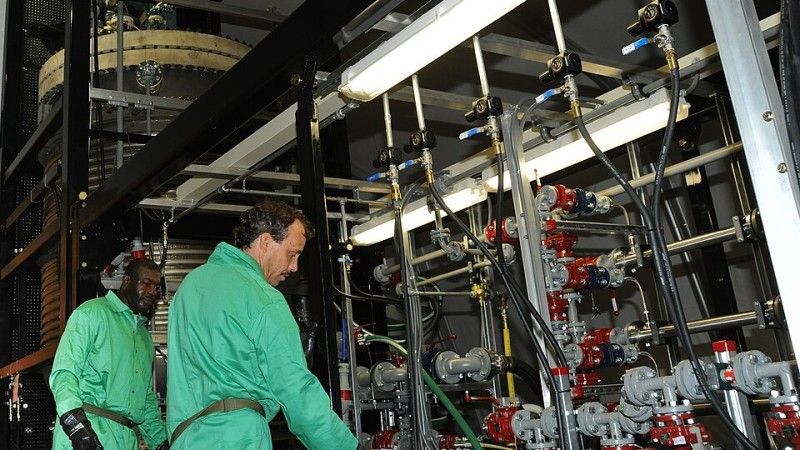
Photo. U.S. Army / Wikimedia Commons
In August 2026, the Organisation for the Prohibition of Chemical Weapons (OPCW) verified the irreversible destruction of 42 Syrian aerial bombs. This was the first OPCW-confirmed destruction of chemical munitions in Syria since 2014. It did not, however, involve 42 bombs filled with sarin. These were Category 3 chemical weapons: unfilled munitions and devices designed for the delivery of chemical agents.
The significance of the operation nevertheless extends beyond the number of weapons destroyed. For the first time since the fall of Bashar al-Assad’s regime, the new authorities moved from declarations of cooperation to an operation conducted under international verification. At the same time, the OPCW still does not consider Syria’s initial declaration accurate and complete. Of the 26 outstanding issues reported since 2014, seven have been resolved. The remaining 19 may involve substantial quantities of undeclared or unverified chemical warfare agents and munitions.
Damascus’s credibility therefore cannot be measured by a single operation. The outcome of the process will depend on four indicators: the completeness of subsequent declarations, the inspectors’ level of access, the pace of the verified destruction of all identified elements of the programme, and progress in proceedings against those responsible for its operation and use. Only progress across all four will demonstrate that Syria is dismantling not only an arsenal, but also the mechanisms through which the state concealed responsibility.
A disarmament process that was supposed to close the file
Syria acceded to the Chemical Weapons Convention on 14 September 2013, several weeks after the sarin attack in Eastern Ghouta. It declared approximately 1,300 tonnes of chemical agents. All declared chemicals removed from the country in 2014 were subsequently destroyed, but the process did not establish the full scale of the programme.
Later findings showed that the declaration did not cover every facility, material or type of munition. The OPCW established that regime forces had used sarin and chlorine, while the so-called Islamic State had used sulphur mustard. By January 2026, the OPCW Investigation and Identification Team had issued five reports identifying the perpetrators of seven cases in which toxic chemicals were used as weapons in Syria. In 2021, some of the country’s rights and privileges under the Convention were suspended.
In light of these later findings, the process launched in 2013 reduced international pressure but failed to deliver full transparency. Officially declared stockpiles were destroyed while part of the programme remained outside international oversight. This is the central lesson for the present authorities: submitting a declaration does not close the file if its contents cannot be independently verified.

New sites, old questions
After the change of government in December 2024, the OPCW gained opportunities to operate that it had previously been denied. Since November 2025, the Organisation has maintained a continuous presence in Syria to support the inventory, destruction and verification of the programme’s remnants.
The key development came in May 2026. OPCW experts found dozens of previously undeclared aerial bombs and rockets, as well as materials, equipment and documentation. Syria’s permanent representative to the OPCW, Mohammed Katoub, reported the recovery of more than 70 rockets and aerial bombs, raw ingredients for sarin production, hexamine, and equipment used to mix and store chemicals. This figure is based on information supplied by the Syrian side; the OPCW’s findings independently confirm the discovery of previously undeclared munitions and materials.
In June, Damascus submitted three amendments to its initial declaration. It declared an additional chemical weapons production facility, a newly discovered chemical used in the production of nerve agents, empty chemical munitions, and two storage facilities. In July, the OPCW Executive Council approved agreements governing the systematic verification of the facilities at Al-Qutayfah and Homs, as well as a plan for the destruction of the Category 3 aerial bombs.
These discoveries do not prove that the entire programme has now been identified. They demonstrate the opposite: the earlier declaration was incomplete, while the true scale of Assad’s chemical legacy remains unresolved. According to OPCW experts, as many as 100 locations may require inspection, ranging from military bases and laboratories to administrative facilities.

Disarmament and the rebuilding of international trust
The new authorities present their cooperation with the OPCW as a break with the practices of the former regime. In July 2026, the Organisation’s Executive Council reinstated Syria’s rights and privileges, which had been suspended five years earlier. The decision was co-sponsored by 67 states and adopted by consensus. It represented political recognition of progress, not certification that disarmament had been completed.
In March, Damascus announced the “Breath of Freedom” initiative, intended to locate, secure and verifiably destroy the programme’s remaining elements. The United States, Germany, the United Kingdom, Canada, France, Qatar and Türkiye were among the countries that declared their support, with activities to be conducted under OPCW supervision. At this stage, however, the launch of the initiative and its participants’ declarations must be distinguished from the provision of full funding, personnel and long-term operational capacity.
In parallel, the OPCW is training Syrian institutions. A workshop held in July brought together 26 representatives from seven ministries, the National Commission for Transitional Justice, and the Customs and Border Control Authority. Its importance extends beyond disarmament itself. The capacity to secure sites, maintain records, preserve evidence and control trade in dual-use chemicals is also a test of efforts to rebuild the Syrian state.
Progress may help Damascus normalise its international relations and mobilise support for reconstruction, but there is no automatic mechanism that converts cooperation with the OPCW into funding. States and financial institutions will assess not only chemical security, but also political stability, the rule of law, sanctions exposure and the authorities’ ability to honour their commitments. Disarmament is therefore one condition for rebuilding trust, not a substitute for it.

Israel: Security outside the international verification framework
Israeli military operations remain a significant external factor. Syria’s ambassador to the United Nations, Ibrahim Olabi, argued that repeated strikes had obstructed some efforts to locate and destroy remnants of the programme and exposed personnel working in the field to additional risk. The scale of this impact has not been independently confirmed and should therefore be treated as Damascus’s position rather than an established operational assessment.
The underlying risk is nevertheless real. A strike may destroy not only hazardous materials, but also documentation, equipment and the physical arrangement of a site needed to reconstruct how the programme operated. It may also disperse substances, hinder the preservation of evidence or delay inspectors’ access. This creates a paradox: actions justified by the need to reduce a threat may make its complete identification and controlled elimination more difficult.
For Israel, declarations by the new authorities do not constitute a guarantee, particularly while the programme’s full scale remains unknown. For the OPCW, the priority is to preserve sites, materials and documents until they have been examined. Without coordination, the two approaches may undermine one another.
Accountability as the final link
Technical disarmament does not resolve the question of responsibility. The Syrian authorities have detained 18 people suspected of involvement in the programme, including former senior military, political and technical officials. Damascus has also announced preparations for the first court hearing concerning their alleged involvement.
This stage is particularly vulnerable to political instrumentalisation. The proceedings may demonstrate a break with impunity or become a means of selectively prosecuting opponents. Their credibility will depend on the preservation of evidence, transparent procedures, the right to a defence and cooperation with international mechanisms. Transitional justice cannot be reduced to an announcement that suspects have been detained.
Three scenarios
Complete and verifiable disarmament. Damascus systematically updates its declaration, grants inspectors access to every identified site, and the OPCW confirms the destruction of successive categories of materials and facilities. Proceedings against suspects meet basic standards of due process. Such an outcome would strengthen the legitimacy of the new authorities and reduce the risk of proliferation.
Gradual but incomplete progress. Destruction continues, but some locations remain inaccessible, further discoveries expose new gaps in the declaration, and funding and security conditions slow the operation. Cooperation with the OPCW is genuine but does not lead to the rapid closure of the dossier. This is the most likely scenario because the scale of the programme remains unknown and the operation may take months or years.
Breakdown of the process. A deterioration in security, restrictions on access, the loss of documentation or the political subordination of judicial proceedings undermines confidence in Damascus. The remnants of the arsenal become a source of risk for Syria and the region, while disarmament ceases to support the country’s international normalisation.

Conclusion
The destruction of 42 aerial bombs is the first measurable result of cooperation between the new authorities and the OPCW, but its political significance will depend on what follows. The real test will not be the number of statements or additional declarations, but the state’s ability to disclose what the former regime concealed, provide for independent verification and hold those responsible to account.
The new Syria has inherited more than storage facilities, laboratories and documentation. It has also inherited a deficit of trust created by a decade of incomplete declarations and documented chemical weapons use. That deficit can only be reduced through a process whose results do not have to be taken on trust. Disarmament will therefore become a test of the new authorities’ credibility not when the final bomb disappears, but when no space remains in which the state could conceal one again.


