


- WIADOMOŚCI
Germany is ordering lasers for aircraft. Huge benefits and even bigger challenges

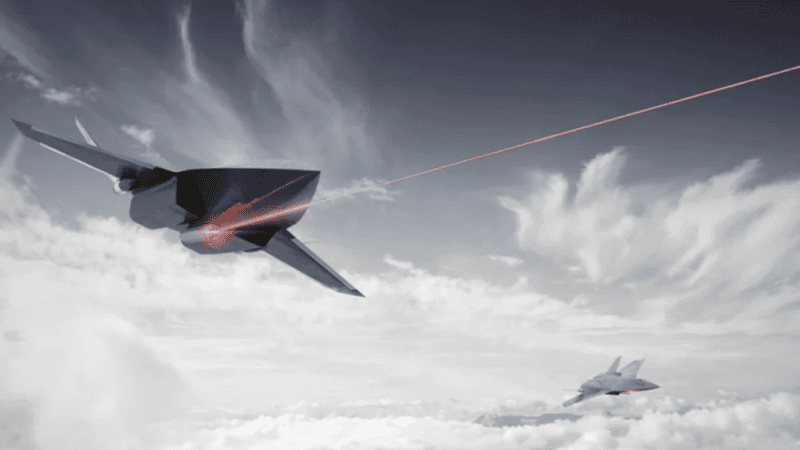
MBDA Germany has been awarded a contract to develop an airborne laser weapon pod demonstrator. The solution is to be based on national science and industry and will serve as armament for future manned jets and drones, MBDA announced.
The order was placed by the Federal Office of Bundeswehr Equipment, Information Technology and In-Service Support (BAAINBw). The aim is to lay the foundations for future airborne laser weaponry. Consequently, the demonstrator is likely intended to serve as the basis for developing an entire family of such systems.
According to the press release, lasers have been considered a priority research area in Germany since 2019. It is regarded as a „key national technology”. MBDA is a natural partner in this field, as it has been working on such solutions for a long time, including through its own internal funding. As a result, the company claims it already possesses a range of advanced solutions, including ready-made laser demonstrators and energy storage methods. However, it likely lacks a demonstrator designed for use as a pod on an aircraft or helicopter.

Technological challenges and power supply in the development of airborne laser weapons
The currently assigned work is intended to help assess whether airborne laser weapons can be developed and whether such solutions are viable. The greatest challenge in laser technologies is the issue of storing sufficient energy reserves on board. While this is not an issue for ground-based defence systems, such as the Israeli Laser Dome – where a laser can be connected to containerised batteries or theoretically even the power grid – an aircraft must carry everything on board and is limited by its payload capacity.
For these reasons, the first American airborne laser test, the YAL-1 Airborne Laser Testbed (ALTB) programme, was housed in a large Boeing 747 Jumbo Jet passenger aircraft. The airborne laser was large and intended for intercepting ballistic missiles, but the primary weight was accounted for by its batteries. The ALTB programme was closed in 2012, and since then, technology – and particularly the miniaturisation of power sources – has made significant progress. This progress has been so substantial that naval and ground-based laser defence systems have emerged, and in recent years, programmes for fighter-borne lasers have also appeared.
It is therefore no surprise that in Germany, the development of an airborne laser is considered a particularly difficult „supreme discipline” of laser weapon technology – mainly due to extreme requirements regarding size, weight, and resistance to flight conditions.

Defensive role of airborne lasers and the low cost of neutralising targets
The intended use of this weapon is currently defensive, focused on neutralising long-range kamikaze drones and cruise missiles. In essence, it targets the same threats that jet fighters engage now. However, it offers unlimited ammunition and a significantly lower price point compared to using air-to-air missiles or even APKWS II class rockets or similar systems. The cost of a single laser pulse is a few US dollars – roughly the price of a cup of coffee.


