












- WIADOMOŚCI
Pegasus lands a new order. The US Air Force chooses a bird in the hand

 Add as preferred on Google
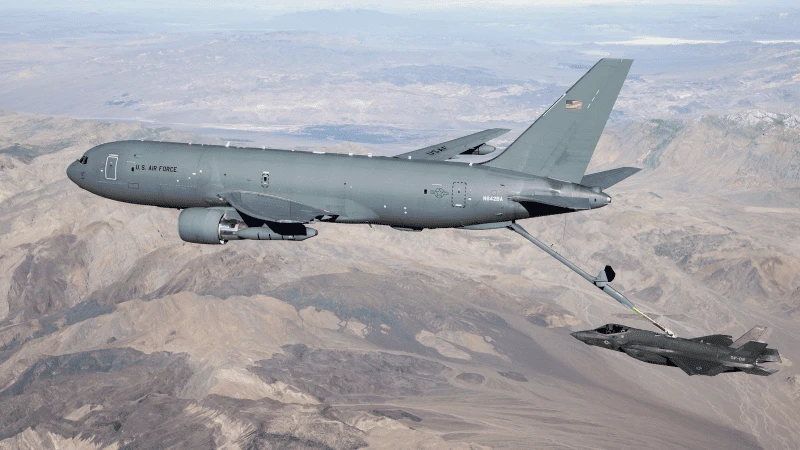
Photo. U.S. Air Force, Ethan Wagner (Public Domain)
The United States Air Force has placed orders for 15 KC-46A Pegasus aerial refuelling aircraft. This fulfils the 2011 framework agreement, which provided for the acquisition of 188 aircraft. But that is unlikely to be the end of the story.
The next 15 Pegasus aircraft are expected to cost USD 2.81 billion. They are due to be delivered between mid-2029 and mid-2030, immediately after the most recently contracted batch. So far, the KC-46A has attracted only two export customers: Japan has bought six aircraft, while Israel has ordered four, with an option for four more. Türkiye—familiar with US aerial refuelling methods and currently operating KC-135 Stratotankers—Indonesia, and Qatar are now considering the aircraft.
This modest result is due, on the one hand, to technical problems and, on the other, to a highly successful competitor: Europe’s Airbus A330 MRTT. The European aircraft is not only larger, giving it greater range and payload capacity, but has also long since overcome its early teething troubles. Its design stores fuel primarily in the wings, allowing the A330 MRTT to carry not only passengers and fuel but also palletised, small-cargo loads. This is an additional capability that Boeing’s aircraft does not offer.
Pentagon support gives Boeing an advantage
The KC-46A’s manufacturer is not struggling to find buyers. The Pentagon is compelled to purchase the aircraft, given its substantial need for tankers and the political requirement to buy a domestic product. It is worth recalling that the Pentagon initially selected Airbus’s design, but the decision was overturned for political reasons.
Orders to meet the needs of the US Air Force, which have now reached the 188 aircraft planned in 2011, exceed all the orders the rest of the world could place. To put this in perspective, total orders for the competing A330 MRTT—a global export success—stand at 91 aircraft.
Boeing’s good fortune does not end there. The US Air Force needs far more than “just” 188 aircraft in this class. A supplementary purchase of up to 75 aircraft is under consideration, along with the Advanced Tanker Systems (ATS) programme for a future tanker, also known as KC-Z.
The USAF’s fleet of nearly 500 tankers
Boeing has a strong chance of winning the contract for the first 75 aircraft, although Northrop Grumman and Embraer are working on developing a rigid boom for the KC-390 Millennium. If successful, their work could produce an interesting, Americanised competitor. The ATS programme, meanwhile, was intended to deliver a next-generation stealth aircraft capable of refuelling closer to the battlefield and enemy forces. However, costs and technical challenges could lead to a rethink of this ambitious policy and a move towards a more reliable option—for example, a Pegasus free of its latest technical problems and upgraded with new capabilities.
The USAF currently operates nearly 500 boom-equipped aerial refuelling aircraft, including just under 100 KC-46As. The rest are ageing, smaller KC-135 Stratotankers.


