












- ANALIZA
- WIADOMOŚCI
Race for the skies: the evolution of interceptor drones and Russia's adaptation

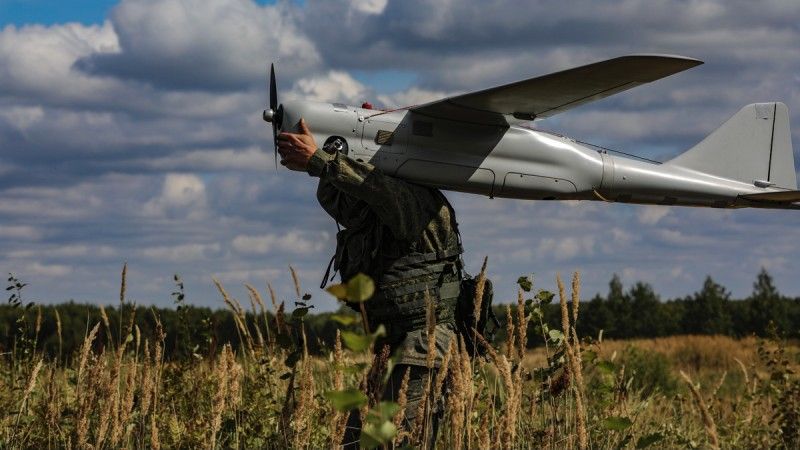
Photo. mil.ru
The character of the Russo-Ukrainian war is evolving in leaps and bounds, shaped under the pressure of mass drone deployment, powerful electronic warfare (EW), artificial intelligence, and network-centric warfare approaches. What was an auxiliary asset just a few years ago, such as small UAVs for reconnaissance and fire correction, now defines battlefield architecture and compels militaries to revise operational concepts across all domains.
The Russian military has formed a dense reconnaissance and strike complex over Ukraine on the basis of fixed-wing UAVs, notably tactical drones such as Orlan-10, ZALA, and others. These platforms provide continuous patrolling across the operational and tactical depth of Ukrainian formations. These UAVs transmit target coordinates in real time to Iskander-M systems, Smerch MLRS, Lancet-type kamikaze drones, and other assets, forming a unified reconnaissance-strike loop.
Concurrently, Russia has been scaling up the production and operational deployment of Shahed-type strike drones, their derivatives, and jet-powered UAVs. For instance, Russia launched approximately 2,800 Shaheds against Ukraine in 2023, and during the first seven months of 2026 alone, this figure exceeded 41,500. Russia established domestic mass production of these drones in the Alabuga Special Economic Zone (Tatarstan). In 2023, around 2,800 drones were manufactured, whereas by 2026 production surged to 5,800 drones per month (roughly 3,000 of which are jet-powered ones). This scale constitutes a continuous threat to Ukrainian logistics, industry, critical infrastructure, and civilians behind the frontline.
Mass deployment of Russian strike drones contributed to shortages of air defence systems, notably surface-to-air missiles (SAMs) for Soviet systems, against the backdrop of constrained supplies of modern Western air defence systems and respective munitions. Consequently, traditional air defence cannot provide continuous, impenetrable coverage along the entire frontline, in border regions and deep within the country.
In April 2024, the Ukrainian state defence tech cluster Brave1 launched a targeted competition to develop dedicated interceptor drones. The baseline operational requirements were clear: the ability to engage aerial targets travelling at speeds up to 150 km/h at altitudes up to 1,500 metres, integration with detection and data transmission systems, and the capacity for mass production. Dozens of private companies and volunteer groups answered the call. This established a new segment within the miltech industry – interceptor drones as a distinct weapon category. In a short period, Ukraine moved on from isolated experiments to the systematic deployment of a new unmanned air defence echelon along the frontline.

Ukraine is scaling its interceptor UAV crew numbers and expanding personnel training programmes. Simultaneously, efforts are underway to establish a fourth echelon of air defence. The manufacturing of anti-UAV technologies, EW systems, and interceptors has been separated as a dedicated aerospace direction within the domestic defence industry. Approximately 450 companies focused on UAV production currently operate in Ukraine, with over 160 focusing exclusively on developing and manufacturing FPV drones.
Ukrainian interceptors have evolved from adapted FPV platforms into specialised systems such as P1-SUN, Sting, F7 LITAVR, Merops, Bullet, Besomar, and others. These drone types have been codified by the Ministry of Defence and are deployed in combat. They vary in range, speed, and payload configurations. The core advantage of these interceptors is the cost-to-kill ratio. With a unit cost estimated at $1,000-$2,000, a Ukrainian interceptor drone can neutralise fixed-wing reconnaissance UAVs or Shahed-type strike drones that cost significantly more to produce and deploy, creating a cost asymmetry.
The Defence Forces conserve expensive SAMs for cruise and ballistic missiles, leaving drones to the interceptors. This constitutes a multi-levelled defence economics model, where EW, interceptor drones, and conventional air defences complement one another based on cost per shot and threat volume.
Interceptors have become a critically important component of small air defence. In March 2026, they intercepted over 33,000 hostile UAVs of various types. At the same time, decision-making promptness, data quality, and resilience in heavy EW environments remain decisive factors, as EW accounts for the majority of interceptor drone losses. In response, Ukraine is developing GPS-independent navigation, multi-frequency secure communication links, on-board AI modules that allow drones to continue the mission autonomously after the severance of the communication link, as well as remote-control ability and integration into unified C2 systems.

Notably, by early June 2026, the Ukrainian Defence Forces intercept Shaheds autonomously due to the automation of roughly 95% of the interception process. The operator selects the target and authorises the engagement; the interceptor then autonomously computes the intercept trajectory, identifies the target drone, and executes terminal guidance. This is a human-machine loop where automated systems handle the majority of technical stages: target detection, tracking, closing calculation, and target guidance. The final authorisation remains with the operator.
Ukrainian interceptor drone capabilities are already extending beyond a strictly domestic context. Kyiv is demonstrating these capabilities to international partners in Europe and the Middle East. Work is underway to secure international investment for domestic drone production in Ukraine and establish joint production lines abroad. In practice, the export to NATO of combat experience and technologies proven in an environment with the world’s highest drone and EW density takes place.
In the coming years, interceptor UAVs stand every chance to become standard air defence components. The edge will belong to those who integrate interceptor capabilities into a flexible, multilayered, and interoperable ecosystem capable of continuously adapting to innovations and new solutions.
However, the increasing deployment of interceptor drones is compelling Russia to adapt its own UAV fleet. Russia’s deployment of new jet-powered drones introduces challenges for Ukrainian air defence, primarily due to large production volumes and altered technical parameters. As of August, Russian production output reached approximately 3,000 Geran-4 and Geran-5 kamikaze drones per month. The core problem is their flight speed exceeding 400 km/h. This critically shortens the detection, tracking, and engagement window for both mobile air defence fire teams and other interception weaponry, notably the interceptor drones. High speed, combined with huge numbers of rocket launches, reduces current interception rates. The interceptor success rate against jet-powered targets stands at approximately 10% of total launches – roughly 300 intercepted drones – prompting Ukraine to develop new countermeasures to neutralise this emerging threat.
See also 

Kyiv is developing solutions shaping its own defence, as well as the EU and NATO members’ security. As the threat of low-cost drones has become a challenge for Europe, Ukraine is ready to share its experience, including its mistakes and successful cases. Ukrainian expertise shall become a component of Europe’s collective defence architecture. Russia’s scaling of jet-powered drones demands an immediate technological response, particularly the further development of interceptor drones. This is another challenge Kyiv is facing ahead of the autumn-winter period.
Author: Dmytro Zhmailo, Deputy Head of the Ukrainian Security and Cooperation Centre, military expert.


