












- WIADOMOŚCI
- WAŻNE
- ANALIZA
The rockets game: Why is Poland still waiting for permission to produce HIMARS munitions?

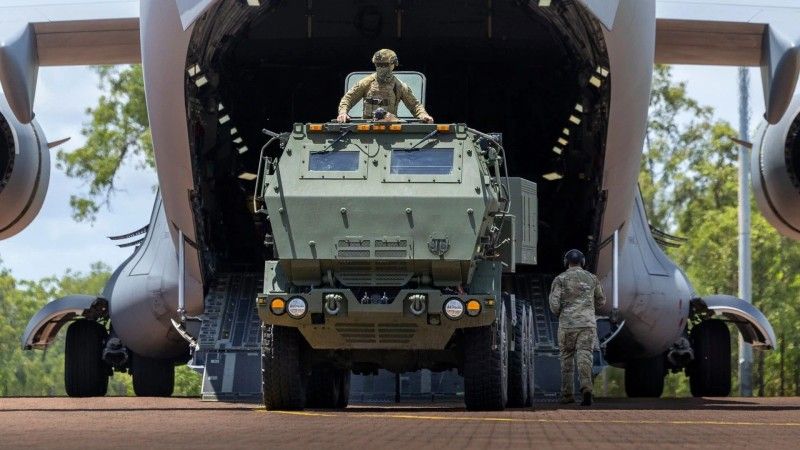
Photo. LCPL Donegan / CPL Linards - Australian Army
I think the real problem is that some current political leaders are deeply wary of giving states the ability to strike targets deep inside Russian territory. In my view, some of those same concerns also shape decisions about sharing certain technologies with other countries, retired U.S. Gen. Philip Breedlove, former top commander of U.S. and NATO forces in Europe, told Defence24.pl in the context of the U.S. refusal to approve the transfer of technology for ammunition used by HIMARS launchers to Poland.
As Defence24.pl recently reported, the United States has still not given approval for the transfer of GMLRS production to Poland. GMLRS is the main munition used by HIMARS launchers, which in their Polish-ized version are known as Homar-A. The „Polonization” program for the American rocket artillery system has reached an impasse. Colonel Grzegorz Polak, spokesperson for the Armament Agency, acknowledged that negotiations have been under way since 2023 and that no breakthrough has yet been achieved. Bringing them to a close will require a number of government-level approvals. All of this is happening at a time when the second rocket artillery program, based on Korean technology under the Homar-K name, is being carried out successfully.
Gen. Breedlove commented for Defence24.pl on the problems Poland is facing in obtaining U.S. approval for the transfer of HIMARS ammunition technology. „I think the real problem is that some current political leaders are deeply worried about giving countries the ability to strike targets deep inside Russian territory. We saw this during the war in Ukraine as well. The West, especially the United States, had many opportunities to provide Ukraine with long-range strike capabilities. Sometimes such capabilities were indeed delivered, but almost immediately restrictions were imposed on whether they could be used against targets in Russia and, if so, which ones,” the general said.
In his view, the lack of approval may be politically motivated, just as with the restrictions imposed on Ukraine’s use of long-range weapons.
Breedlove said that for the Armed Forces, this is especially frustrating, because Russia has fired thousands of long-range missiles at Ukraine. He urged the audience to imagine if the same number of missiles were falling on Moscow. He noted that the West has largely accepted a situation in which Russia could strike targets across Ukraine, while Ukraine received only a limited ability to respond: „a little here, a little there, one target yes, another no”, he said. He added that in his view, some of the same concerns also influence decisions about sharing certain technologies with other countries.
Gen. Breedlove also stresses that relations between Poland and the United States are good. He adds that the US president points to Poland as a country that understands the importance of allied obligations, including in the context of Article 3 of the Washington Treaty, which calls for building up one’s own defense capability and supporting the defense of other states. Poland understands this perfectly and has taken that duty very seriously. „In my opinion, it is doing an excellent job in this regard,” the general said.
What's next for the Polish Homar-A?
Let us recall that the GMLRS missile is the standard armament of HIMARS launchers: six missiles in each launch pod, with a range of 85 km; the alternative is one ATACMS missile. In HIMARS (and in the heavier M270A1/A2 MLRS system, which uses two launch pods on a tracked chassis) GMLRS plays a role similar to that of the Korean CGR-080 in Homar-K, which has a range of 80 km. The contract for manufacturing these missiles was signed in 2025. A contract for the „Polonization” of the launcher had been signed earlier, and from the very first order, Polish chassis and a Polish fire control system were already being used.

Cooperation with the Americans, however, is proceeding at a hampered pace. Difficulties in obtaining approval to produce the ammunition mean the entire Homar-A program is hanging in the balance. While the purchase and transfer of technology for the Korean launchers is moving ahead quickly and according to plan, with more than 150 launcher modules having already been delivered, out of a total program requirement of 290, talks with the Americans have made little progress over more than two years since the framework agreement was signed in 2023.
Where is the US HIMARS program headed?
For now, the only country outside the United States that has received approval and begun producing GMLRS missiles remains Australia, which has ordered fewer than 100 HIMARS launchers in total. Talks are also continuing with Germany as part of the GMARS offer developed by Rheinmetall and Lockheed Martin, covering not only GMLRS but also heavier missiles. So far, however, no GMARS order has been finalized. Germany, meanwhile, has not received approval to integrate GMLRS missiles onto its EuroPuls launchers, built by KMW in cooperation with Israel’s Elbit. Germany was denied such approval despite being a member of the MLRS program since the Cold War, just like Italy, the United Kingdom and France.

In Poland’s case, it cannot be ruled out that a certain number of American HIMARS launchers, for example, several dozen, will be purchased to complete the 1st Rocket Brigade, where a HIMARS battalion already serves today, so that it will be ready for allied operations. The American system is still being developed. Alongside the standard GMLRS rounds, GMLRS-ER missiles with a range of 150 to 200 km are also entering production. Poland has already received approval to buy them from US factories under the FMS system, as have other allies such as Estonia and Finland.
What is more, a new tactical missile, the PrSM, is being introduced for HIMARS and MLRS launchers, with a range of about 500 km. Two such missiles fit into one launch pod, instead of a single 300 km ATACMS missile. Outside the United States, however, the only other participant in this program is Australia. It may also eventually be transferred to the United Kingdom. For now, though, there is no decision on broad export of these missiles. And when discussing HIMARS, it is also worth remembering that the Americans plan to field an autonomous, modular CAML-M system, which is intended to replace the current crewed launchers.
All signs therefore point to the prolonged talks over a license to produce the basic ammunition for HIMARS having a political basis, which is unfavorable for Poland and, more broadly, for NATO’s eastern flank states. It should also be noted that this runs counter to the logic of increasing production capacity across the North Atlantic Alliance. Both the war in Ukraine and the conflict in the Middle East show that there is never enough ammunition, especially modern precision munitions. The United States, Middle Eastern countries, European states are all learning this lesson. This includes autonomy-minded France, which lacks guided missiles for its fighters and at the same time has not integrated its aircraft with weapons from other countries. If the United States and its allies do not change their approach to technology sharing and mutual integration across different combat platforms, the problem of precision munitions availability will only grow. Meanwhile, adversaries, including Russia, which is now supplying Iran with modernized technology after buying its first Shaheds from it, are building up their capabilities faster and constantly refining them based on battlefield experience.


