- WIADOMOŚCI
- ANALIZA
Fleet modernisation amid crisis. Two new ships flying the Russian flag

The Russian Navy is going through a difficult period. Despite the Admiralty’s many efforts, its needs are taking a back seat. Priority is being given to the Ground Forces and the Strategic Rocket Forces. That is why the commissioning of even the smallest vessel is an important event for the Navy.
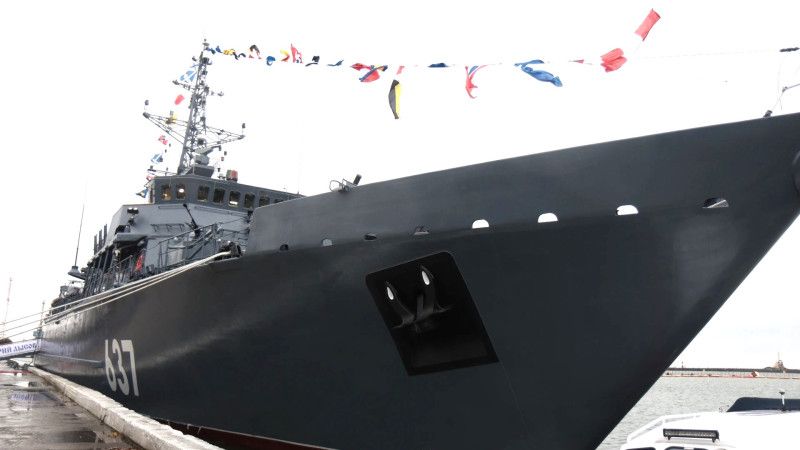
On 18 November 2026, two flag-raising ceremonies took place. At Baltiysk, the Russian naval ensign was raised on the sea minesweeper (minehunter) Dmitry Lysov (637), Project 12700 Alexandrit. Meanwhile, at Severodvinsk, the Russian ensign for auxiliary vessels was raised on the torpedo recovery vessel TL-2202. Both vessels were commissioned into the Northern Fleet, although the minesweeper still has to make its way there from the Baltic, where it was built.

Photo. Russian MoD
Project 12700 Alexandrit was developed by the Almaz Central Marine Design Bureau. Its official classification is sea minesweeper, but functionally it is closer to a minehunter. Construction of the prototype and the entire series was entrusted to the Sredne-Nevsky Shipyard. The prototype entered service in 2016. The first two production vessels raised the Russian naval ensign in 2019. One minesweeper was delivered to the customer in 2020, one in 2021, two in 2022, one in 2023, one in 2025 and another in 2026.

As is easy to work out, Dmitry Lysov is already the eleventh vessel of this type. The Russians have to distribute their mine warfare forces among four separate fleets. The Caspian Flotilla has only relatively small forces of this kind, which were recently weakened further when two small roadstead minesweepers were transferred to the Black Sea Fleet. Eleven Project 12700 minehunters have been assigned across all four fleets. The Black Sea Fleet, Northern Fleet and Pacific Fleet have received three each, while the Baltic Fleet has received two. A further three minehunters are likely to be assigned to the Northern Fleet, which would undoubtedly greatly enhance its mine-countermeasure capabilities.
A total of five more vessels of this type are under construction, one of which, Semyon Agafonov (605), was launched on 30 September 2026. The Commander-in-Chief of the Russian Navy has repeatedly announced plans to build as many as 30 minehunters of this design, followed by further vessels in an upgraded variant. For some time, there have been announcements that production of these mine-countermeasure vessels would begin at another Russian shipyard to increase deliveries to the fleet. So far, this has not happened, and there is no sign that it will. Project 12700 is the largest minehunter with a composite hull. It is about 62 metres long and 10 metres wide, displaces around 890 tonnes, has a top speed of about 16 knots and a crew of 44. Building such large hulls from glass-reinforced plastic rather than steel at a second shipyard would require it to master new technologies, and so far there is no information that this is happening.
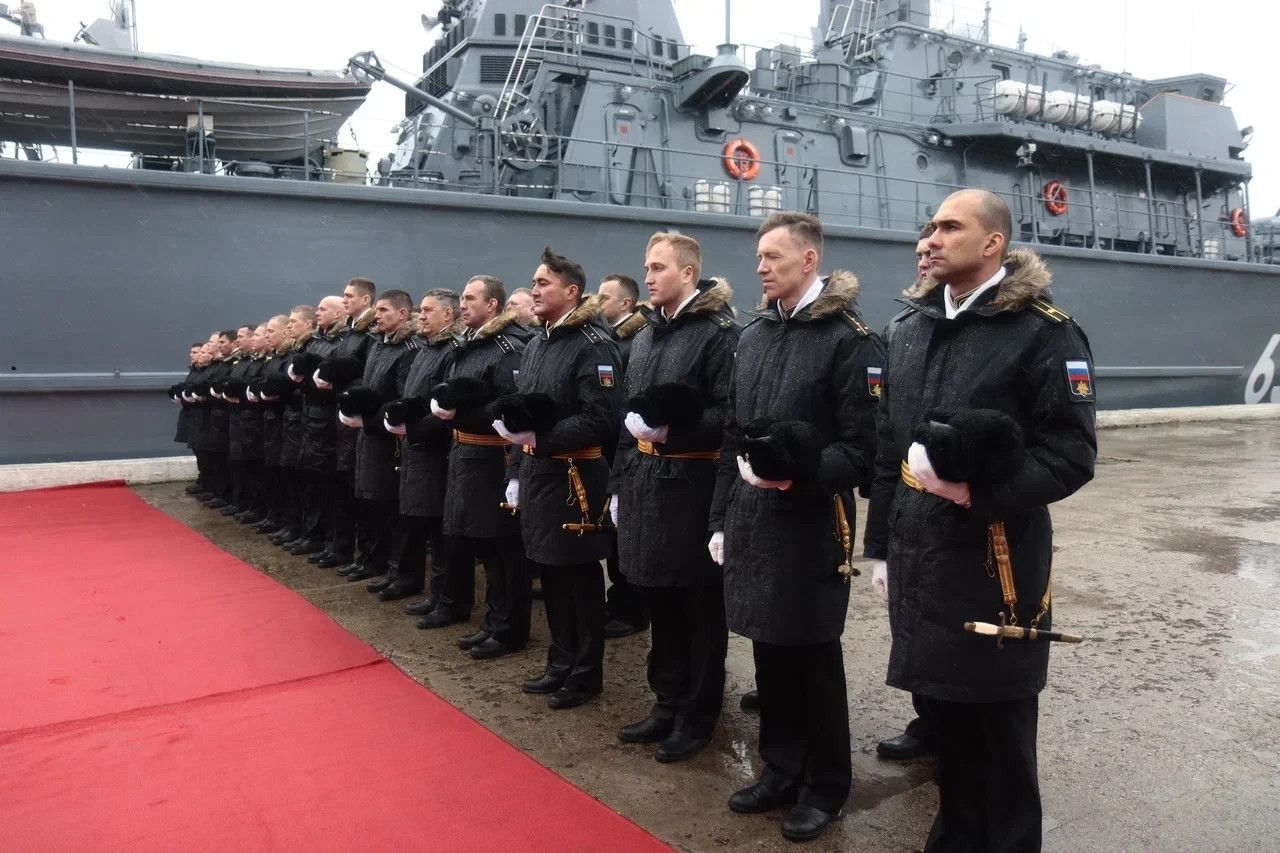
Photo. Russian MoD
Until recently, Project 12700 was offered for export under the designation Project 12700E (E for eksportny, meaning export). However, at the international naval exhibition in Kronstadt in June, only Project 12701 was presented—a modification of Project 12700. The Russians are offering this type of vessel for export, but so far there have been no apparent buyers. The main reasons are its relatively unsophisticated mine-countermeasure equipment and the declining relevance of vessels of this kind. The future is more likely to lie with large magnetic-signature vessels serving solely as platforms for a new generation of underwater robots.
Each Russian fleet includes auxiliary vessels. They are part of the Navy, but are crewed by civilian personnel. Sometimes they are reservists, but that is not always the case.
All four fleets are struggling with a shortage of auxiliary vessels across all classes. Each needs an adequate complement of transports, tankers, tugs, rescue vessels and so on. This also applies to torpedo recovery vessels. The Russians continue to build these specialist vessels instead of, for example, assigning their role to tugs.

Photo. Russian MoD
Many years ago, construction began on Project 1388 torpedo recovery vessels. The design proved successful enough to spawn numerous variants, including the Project 1388R chemical reconnaissance boat and the Project 1388N, 1388NZ and 1388NZK liaison boats. In its primary role as a torpedo recovery vessel, the design led to the 1388NZT variant, of which two vessels were built. These were TL-2195 Sokolskoye, commissioned in 2021, and TL-2196, commissioned in 2023.
Now it is time for the serial construction of another variant, designated Project 1388NZTM. A contract to build probably six of these vessels was signed on 16 August 2023 at the Army 2023 exhibition. They are being built at Sokolskaya Shipyard, just like the two previous vessels. The commissioned TL-2202 is the prototype for this series. It was built under yard number 453 and launched in June 2026. Given the currently slow pace of shipbuilding in Russia, further vessels of this type are likely to enter service at fairly long intervals.