












- KOMENTARZ
- WYWIADY
- WIADOMOŚCI
Gamifying the frontline: social media recruitment and the first recorded FPV-Drone attack helicopter kill [INTERVIEW, Part 2]

Part 2 of the article, based on an exclusive interview with the media representative of the 59th Separate Assault Brigade of the Unmanned Systems Forces of Ukraine.
Weronika Barankiewicz: How does media presence influence recruitment? Are there stories of individuals who joined you because they saw your content on social media?
Pavlo (callsign „California”): There is a massive volume of such stories. We utilize various recruitment channels: ranging from direct enlistment and mobilization to working with personnel returning from AWOL (Unauthorized Absence) or those on conditional release. We also engage with state programs, such as the „18–24” initiative for drone operators (Editor’s note: The ”18-24” program offers a voluntary 1-year service term for citizens aged 18–24, with a total financial incentive of approx. 1,000,000 UAH consisting of a signing bonus and service-related payments.)
A recent example: a young man approached our head of recruitment through the drone operator program, which includes a financial incentive. He stated, „I want to be an operator to earn enough money to buy a horse. I want to be like a knight on horseback.”
Beyond brand recognition, word-of-mouth and our reputation as a veteran unit with a 12-year history play a significant role. We’ve been through it all. You know how they say „love lasts three years”? Well, as a brigade, we’ve already passed every stage, crisis, and evolution you could imagine. We’ve outlasted the typical cycles of burnout. And in the midst of this journey, the state introduced Delta - a unified statistical portal that tracks performance across various military sectors.
We are consistently among the leaders in the drone category. And when I say „leaders”, I mean it: there are currently 395 units participating in the system, and we steadily rank in the Top 5, Top 10, or Top 20. Our results aren’t just stories; they are verified data.

Are you referring to the eBonus system? I actually wrote an article and conducted a research study on this, and your brigade was one of the participants. Even then, I noted you among the leaders - you were consistently at the top of the efficiency rankings. That is remarkably impressive.
Exactly. If you look at the standings among nearly 400 units, we are consistently in the top tier. It’s important to understand the context: we are the only brigade that fully integrates a drone component with assault infantry while maintaining our own physical sector of responsibility. Despite such a complex structure, our efficiency rankings validate the model.
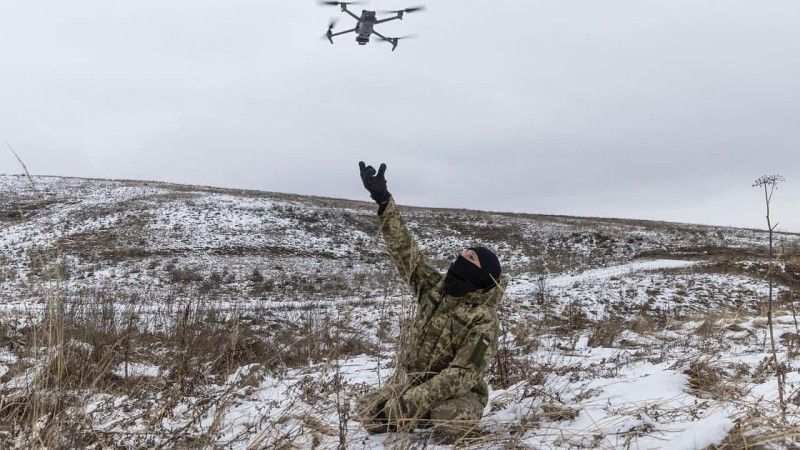
Last month alone, we recorded 11 destroyed tanks. A single tank costs between $4 and $6 million, and we neutralized eleven of them. But it was another incident that caused a true sensation. For the first time, our operator brought down a Russian Ka-52 „Alligator” - a machine worth $16 million - with a fiber-optic FPV drone.
It was a unique operation. The kamikaze drone overtook the aircraft and struck it in the tail section. Previously, this was considered technically impossible due to the helicopter’s speed and maneuverability. We proved that a $500 drone can neutralize the pride of Russian aviation. While the eBonus system officially recorded the kill, from a media perspective, it served as a signal to the entire world: the rules of war have changed forever.

Photo. ArmyInform

Photo. ArmyInform
Do you not consider that such gamification of war through social media and rankings might have negative consequences? Or does it function purely as a motivator?
It fosters healthy competition. More importantly, it allows us to highlight the heroism of the men and women whose actions would otherwise go unnoticed without social media. As the „owner” of this process, the Ministry of Digital Transformation proactively monitors and adjusts for all nuances.
For instance, there was prior criticism that the system only incentivized kinetic kills. However, points are now being introduced for logistical operations, UGVs (Unmanned Ground Vehicles), and medical services. This is crucial, as the support for a single assault trooper in the rear requires up to 20 personnel: logistics, supply, and staff command.
I frequently cite the example of colleagues who filmed the evacuation of damaged equipment within the „Kraken” unit. When hardware is disabled at the positions, different superheroes emerge - those from logistics. They don their body armor and drive into that same danger zone specifically to recover a vehicle or a tank.
Afterward, working days and nights in freezing workshops and makeshift sheds, repair units restore this equipment to return it to the line as quickly as possible. This is a hyper-critical component. Drivers, medics, and mechanics - these are incredibly vital professions without which the war would be impossible.
See also 
Why do many brigades still lack a social media presence? Is it due to a prohibition from leadership, a lack of resources, or a conscious choice to remain „in the shadows”?
Let’s start from the end. We are an assault brigade of unmanned systems. If you didn’t know us or see our work, would you agree to join? Wouldn’t that be intimidating?
Without social media, it would be a total abstraction. It is specifically through your videos that I see there are diverse roles in the army - for women, for analysts. This is inspiring and highlights opportunities I hadn’t considered before.
Exactly. You are partially answering the question yourself. However, our experience regarding communications specialists and platforms is very complex. There is an entrenched narrative that those in support roles will, of course, eventually be sent to their deaths. In reality, this is not the case. I haven’t heard of such situations occurring anywhere around here. Nevertheless, the existence of this narrative still affects the quantity and quality of our unit formations.
The answer to why some show their work and others do not is actually simple. We aren’t even talking about content quality yet - some may simply lack the means. No equipment to film with, no cameras, no vehicles to get around. This is a massive problem. I personally have had dozens of candidates apply for vacancies who disappeared over time because their circumstances changed or they grew fearful.
On the other hand: if you are a competent individual in any field, you will find that many competent people are managing processes within the Defense Forces today. There are two scenarios. Either you are a competent person managed by a competent leader - in which case you are „fully armed” and have a free hand to work. Or, you are a competent person and your leader is preoccupied with the war and says: „Great, I trust you, get to work.” In that case, you take full independent ownership of that sector.

Do you agree with the thesis that the Armed Force of Ukraine is currently the first army in the world to transition to the smartphone on such a massive scale? That „Digital Darwinism” is taking place, and if conventional brigades had the resources for social media, they would be significantly more effective?
Absolutely. We are building trust and confidence while narrowing the „bridge of misunderstanding.” However, regarding the idea that this has never happened before… in truth, it has always existed. Consider field mail: a husband writes to his wife, and she replies. Is that not a social network? It simply had one follower on each side. Today, the distance has merely collapsed, and the speed of information delivery from the unit to the viewer has increased exponentially.
Posters and visual agitation existed in the past as well. I have seen interesting examples of modern advertising, for instance, the „Rubizh” Brigade, which reimagines classic imagery. How important is such an information presence?
It is critically important. It is a matter of touchpoints. You could even place a „black square” everywhere with the inscription „59th Brigade” - and that would already be a win-win scenario, because we don’t know exactly where our potential recruit is located.
That is why we do everything: we enter every sphere possible. If the door isn’t opened for us, we knock again.
Pavlo, I am curious how your brothers-in-arms, specifically the infantrymen on the front line, perceive your role? Do they understand that your work on YouTube or Instagram brings donations and new recruits to the brigade? Or do you find yourself having to justify the importance of your work within the collective?
First and foremost, we build bridges of trust. I have been with our „Cossacks” since 2022. Traveling with them, seeing what they see, and living through those moments alongside them (Editor’s Note: Cossacks - a symbolic term used by the author to describe the spirit and bravery of modern Ukrainian frontline soldiers, drawing a parallel to Ukraine’s historical military heritage.)
I always say: name any profession within the Defense Forces that you consider unnecessary, and we will eliminate it. Is that actually possible? In reality, the simple law of supply and demand applies here: if there were no need for our work, these departments would not exist.
You are capable of refueling your own car, right? However, the service members who handle fuel and lubricants undergo specialized courses and receive certificates for their MOS (Military Occupational Specialty). You cannot simply sit down and manage an electronic document management system-you have to be trained for it.
The same applies to communications. If you perform your official duties correctly and on time, that is the baseline that ensures no harm is done and provides support to every subsequent or preceding link in the Defense Forces.
Should the state somehow push brigades that lack a media presence or train them according to a unified structure? Does a general communications doctrine exist, and do you maintain contact with central authorities?
We have everything we need in full. Under the General Staff and the Commander-in-Chief, there is a Main Communications Directorate. We have doctrines of use approved by formal orders, cyber-hygiene protocols, and content creation standards.
These vertical and horizontal structures have been operating and actively evolving since 2014. Whereas previously there were only small press centers within the General Staff, today, every line unit, at the battalion, regiment, and brigade levels, has formed fully-fledged communication groups or public affairs services.
These have become massive organisms that function, generate content, and occupy the information space daily. It is a stable and very serious institutional structure.
Are you considering adapting your brigade’s social media for a Western audience? Is this a priority - for example, through English-language posts or subtitles?
You are exactly right. We have groups that travel to meetings with foreign partners to exchange experience and secure resources. Most recently, our personnel traveled to Scandinavia. We specifically prepared adapted printed materials for them, tailored to their communication style: it is less „sharp” and colorful than ours.
Ukraine’s media sector is highly developed. The best communicators, designers, and creatives have now found themselves in the military, which is why our visual quality has increased tenfold. Is adaptation necessary? Of course. Every region has its own perspective and its own rules. Thanks to the concentration of intellect within the Armed Forces, we are able to deliver our messages to everyone.
Which platforms do you utilize for international communication? Are you active on X (Twitter) or LinkedIn?
In war, every method is viable. We communicate across all platforms: LinkedIn, YouTube communities, Viber groups, WhatsApp, Signal, and social media comment sections. If tomorrow we need to translate into Chinese - we will do it. If knowledge of Norwegian becomes an asset - we will learn it.

The evolution continues. The example of the 59th Brigade „Steppe Predators” proves that in modern warfare, victory belongs not only to those with superior weaponry but to those capable of building a transparent digital ecosystem of trust. Digital Darwinism is not a sentence; it is an opportunity for the AFU to transform into the most adaptive and open military in the world. Those who invest in communication today will secure the resources and personnel necessary for victory tomorrow. The „army in a smartphone” is no longer a metaphor-it is the new physics of survival.
Author: Weronika Barankiewicz


