












- WIADOMOŚCI
- ANALIZA
Japan prepares for next-generation war. Tokyo draws lessons from Ukraine

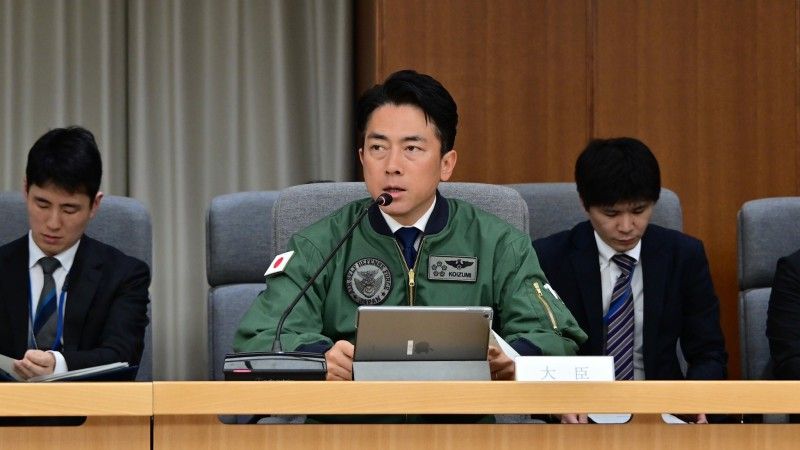
Photo. Official account of the Japan Ministry of Defense/Japan Self-Defense Forces
Japan appears to be increasingly preparing for the realities of next-generation warfare. This year’s Defense of Japan 2026, published by the Japan Ministry of Defence, shows that Tokyo considers the growing armaments of China and North Korea, as well as their increased military cooperation with Russia, to be its most serious challenges.
Tokyo has responded by accelerating efforts to bring defence spending to the level of 2% of GDP, developing modern technologies, including the unmanned SHIELD concept, strengthening its alliance with the United States, and reinforcing its domestic defence production and technological base. The White Paper also demonstrates Japan’s growing attention to changes occurring on the modern battlefield, including the role of artificial intelligence, cybersecurity, and information warfare.
Japan’s major security threats listed in the report
The „Defense of Japan 2026” report and its accompanying analyses indicate that Japan faces the most challenging and complex security environment since the end of World War II, with the main threats to its sovereignty encompassing challenges from individual states, technological threats, and domain-specific threats.
China:
Described as the „greatest strategic challenge” for Japan, with the caveat that this also applies to other actors in the international community. The report highlights the rapid expansion of China’s defence budget without transparency and the intensification of military operations around the Japanese Archipelago, including the Senkaku Islands. A key flashpoint is Taiwan, against which China has not ruled out the use of force for unification, as well as incidents involving Japan itself, such as Chinese fighter jets illuminating Japanese aircraft with radar, raising concerns about an attempt to unilaterally change the status quo by force.

North Korea:
Its actions pose a „grave and imminent threat” to Japan’s security. The country is rapidly developing its nuclear capabilities and missile technology, including hypersonic and irregular-trajectory missiles capable of reaching Japanese territory.
Russia:
Military activity in Japan’s vicinity, including in the Northern Territories (Etorofu, Kunashiri, Shikotan, and the Habomai Islands), which Japan considers its inherent territories under illegal occupation, remains a serious cause for concern. Russia’s aggression against Ukraine is therefore perceived as a signal that a similar situation could arise in East Asia, and the very blunt phrase „under illegal occupation” appearing in official documents represents Japan’s official position, not a neutral description of the legal status of the dispute.
This year’s White Paper notes with particular concern the strengthening of military ties between China and Russia (e.g., joint bomber flights) and between Russia and North Korea. China-Russia joint military activities in Japan’s vicinity are described as demonstration activities against Japan and South Korea, countries that cooperate closely with the United States and NATO.

Domain threats
- Unmanned Systems (Drones): The war in Ukraine and conflicts in the Middle East have demonstrated that the mass use of inexpensive drones can effectively cripple expensive military equipment and critical infrastructure. Recent conflicts have shown that investing in excessively expensive equipment that is difficult to quickly replace is counterproductive in the long term, and the very plan for military development requires reconsideration.
- Cyberspace: Attacks on critical infrastructure, computer devices, and software pose a serious threat to the functioning of a state, especially one that relies largely on the efficient operation of technologically advanced systems.
- Space and the Electromagnetic Domain: There is a growing risk from anti-satellite weapons and advanced electronic warfare systems that can disrupt command and communications – a risk the Japanese command is also aware of.
- Information Warfare and Disinformation: The use of artificial intelligence (e.g., deepfakes) to spread disinformation to destabilise society and influence government decisions is becoming increasingly problematic, and the costs of such attacks for their creators are disproportionately low compared to the consequences faced by the affected party.

Global and regional threats
As an island nation dependent on food and resource imports, Japan is vulnerable to disruptions to the freedom and security of navigation and flight, particularly in the South China Sea. Instability along trade routes therefore remains one of the main global challenges affecting the country’s security and development.
Furthermore, recurring ”gray zone” incidents related to territorial disputes, which do not constitute open conflict but disrupt the status quo, also affect the overall security situation in the region. These threats often combine military and non-military means in increasingly sophisticated ways. Examples include Chinese military aircraft approaching unusually close to Japanese aircraft, creating the risk of an accidental collision.
Ukraine changed Japanese thinking about war
The war in Ukraine became a key reference point for Japan, illustrating the nature of modern high-intensity conflict. In this way, Tokyo shifted from a presumption of a short, limited confrontation to preparations for a prolonged and devastating war, which requires immense state resilience. Key lessons from the Ukrainian battlefield include the importance of substantial resources and the ability to maintain operational continuity in the face of losses. It is worth noting that Japan itself has recognised that modern warfare in some respects resembles the operating model of tech start-ups, where innovations and battlefield data are implemented in real time.
Lesson one: Ammunition and industry
The most important logistical lesson from events in Ukraine is that modern warfare consumes vast quantities of ammunition and equipment, making the issue of stockpiles and production resilience crucial to the country’s survival. Japan is therefore placing unprecedented emphasis on strengthening its sovereign industrial and technological base, viewing it as an integral part of its defence capabilities. Tokyo is also striving to have sufficient missile and ammunition stockpiles to conduct operations without relying solely on external supply chains. Faced with concerns about American production capabilities, Japan is also strengthening cooperation with Australia and India to build alternative logistical support networks and joint production.
See also 

New ways of warfare
According to the National Defence Strategy (NDS), Japan plans to strengthen its defence capabilities by 2027 to a level that will allow it to assume primary responsibility for dealing with an invasion of Japan, while also taking into account the support of its ally and others.
In the context of warfare, the need to build stand-off defence capabilities and counterstrike capabilities using long-range missiles and hypersonic technologies, as well as integrated air and missile defence capabilities based on Aegis systems and SM-3 missiles, is strongly emphasised. What is more, Japan’s security framework also includes the massive deployment of unmanned systems as part of SHIELD (Synchronized, Hybrid, Integrated and Enhanced Littoral Defence), as well as the development of cross-domain operations that integrate traditional warfare domains with space, cyberspace, and the electromagnetic domain. Another key element is the integration of all forces under the new JSDF Joint Operations Command (JJOC) through the use of artificial intelligence. The next area focuses on mobile deployment capabilities and civil protection, which includes strengthening the defence architecture in the southwestern region. Finally, the last area focuses on ensuring the country’s stability and resilience by building ammunition reserves for prolonged conflict, strengthening the industrial and technological base, and transforming the medical force for field operations.

📢 [Defense of Japan]
— Japan Ministry of Defense/Self-Defense Forces (@ModJapan_en) August 4, 2026
The cover characters have come to life!
Watch them guide you through the key highlights of the 2026 Defense of Japan White Paper.
A simple and engaging introduction to Japan's defense and security policy.
▶️ Check this out! pic.twitter.com/AN6XAGThSu
Is Japan "Preparing for War"?
Currently, a fundamental, qualitative shift is being observed in the Japanese state’s perception of security. Japan is not preparing for aggression, but for survival in a world where high-intensity conflict has become a realistic scenario.
The new strategy emphasises sustainability and resilience, which means building ammunition stockpiles, strengthening shelters, and deploying bases. This, in turn, can be linked to the idea of not only deterrence but, above all, survival with minimal losses in the face of potential conflict. The introduction of long-range missiles allows Japan to conduct counterstrikes against an opponent in order to prevent further attacks, which, in a sense, represents a break with its previous, extremely reserved interpretation of pacifism. At the same time, the experience gained from the war in Ukraine has forced Tokyo to shift from thinking about short-term incidents to preparing for a long-term defensive campaign.
In summary, Japan, despite its long-standing reluctance to engage in armed conflict, is forced to change its current policy due to geopolitical realities. It is building a comprehensive defence architecture, integrating the country’s full potential to ward off threats that seemed only theoretical a decade ago.


