












- WIADOMOŚCI
- ANALIZA
Patria expands its production facilities in Latvia

 Add as preferred on Google
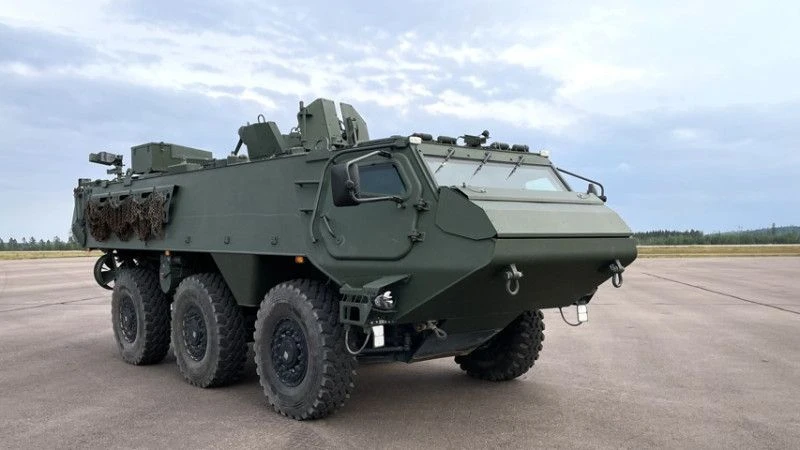
Photo. Patria Group
Patria Latvia has begun construction of a new manufacturing facility at the Valmiera Industrial and Export Park in Latvia. The plant will be responsible for the assembly, production and maintenance of Hunter infantry fighting vehicles and Patria 6×6 armoured personnel carriers, strengthening Latvia’s domestic defence industry and military production capabilities.
The foundation stone for the new facility was laid on 7 October, with Latvian Defence Minister Raivis Melnis among those attending the ceremony. Construction is scheduled for completion in 2027. The plant will manufacture and maintain Patria 6×6 wheeled armoured personnel carriers while also creating opportunities to implement additional projects for the Latvian Armed Forces.
Patria increases production capacity in Latvia
One of these projects will involve the assembly, partial production and maintenance of Hunter infantry fighting vehicles, of which Latvia has ordered 84 from General Dynamics European Land Systems (GDELS). The new facility could also support other defence programmes in the future.
The Patria Latvia plant is being constructed at the Valmiera Industrial and Export Park, next to an existing facility operated by Defence Partnership Latvia SIA.
Finnish defence manufacturer Patria is the majority shareholder in Defence Partnership Latvia SIA, holding 70.03% of its shares. The remaining shares belong to the Latvian company Unitruck SIA. The existing facility is also expected to participate in the Hunter infantry fighting vehicle programme. Its current activities primarily involve the production and maintenance of Patria 6×6 wheeled armoured personnel carriers.
In addition to manufacturing more than 250 vehicles in armoured personnel carrier and command vehicle configurations, the existing facilities have produced several dozen Patria 6×6 vehicles for Ukraine. As a result, the Valmiera industrial area will eventually accommodate two facilities responsible for the production, assembly and lifecycle support of Hunter infantry fighting vehicles and Patria 6×6 armoured personnel carriers.
“This facility represents a significant investment in the development of Latvia’s defence industry and the capabilities of the National Armed Forces. Our objective is to establish domestic industrial capacity that will enable us not only to manufacture and maintain armoured vehicles locally, but also to strengthen security of supply and resilience. Patria’s experience and the capabilities of the new facility, combined with the expertise of Latvian companies, provide a solid foundation for long-term cooperation that will help strengthen the defence capabilities of both Latvia and its allies,” said Latvian Defence Minister Raivis Melnis.
The construction of the new plant is also expected to contribute to the development of Latvia’s wider defence industry, which has been gradually expanding its capabilities in recent years through domestic initiatives and technology acquired alongside foreign defence procurement programmes. Another example is the development of industrial capabilities associated with Latvia’s acquisition of Morana self-propelled howitzers.
“This investment is clear evidence of Patria’s long-term commitment to Latvia and the Latvian National Armed Forces. By strengthening local production, developing expertise and involving Latvian companies in the defence supply chain, we are building industrial capacity that supports both security of supply and long-term resilience. At the same time, our cooperation with GDELS demonstrates how strong partnerships and local industrial capabilities can help deliver modern military capabilities to the Latvian National Armed Forces more quickly and effectively,” said Panu Routila, President and CEO of Patria.
Hunter and Patria 6×6
The Hunter is Latvia’s infantry fighting vehicle based on the Spanish-Austrian ASCOD 2 tracked platform. It is equipped with the Israeli UT30 Mk 2 turret system, featuring a 30 mm Mk44S Bushmaster II automatic cannon paired with a 7.62 mm general-purpose machine gun. Ammunition capacity is approximately 200–250 rounds for the main gun and more than 500 rounds for the machine gun. The main armament’s vertical elevation range extends from -10 degrees to approximately 60–70 degrees.
To engage armoured targets, the vehicle will carry Spike-LR2 anti-tank guided missiles in a twin launcher. Its hull provides STANAG 4569 Level 4 ballistic protection, while mine protection meets Level 4a/4b requirements. The vehicle is powered by a 720 hp MTU 8V 199 TE20 diesel engine coupled to a Renk HSWL-256B transmission. This configuration enables a maximum speed of approximately 72 km/h, with the vehicle weighing around 28 tonnes.
The Patria 6×6 is a Finnish three-axle armoured personnel carrier developed by Patria to replace the Sisu Pasi XA-180/185/200 family of vehicles. It was designed using the XA-200 armoured personnel carrier as a basis, incorporating components from the heavier Patria AMV 8×8. This approach has increased technical commonality while reducing production and operating costs.
The vehicle has a crew of two and can carry up to eight dismounted soldiers. Depending on the armour configuration, protection ranges from Level 2 to Level 4 under STANAG 4569A. It is powered by a Scania DC09 074A diesel engine producing 294 kW (400 hp), allowing the 24-tonne vehicle to reach a maximum speed of 100 km/h.
The Patria 6×6 can be fitted with a remotely operated weapon station or a manned turret equipped with a heavy machine gun, automatic grenade launcher or automatic cannon. The platform can also serve as the basis for numerous specialised variants, including command vehicles, self-propelled mortars, electronic warfare vehicles and self-propelled anti-aircraft systems.
Patria 6×6 vehicles are currently in service with the armed forces of Finland, Latvia, Denmark, Ukraine and Sweden. They are also expected to enter service with Germany and Norway, while the United Kingdom and the Netherlands remain potential future operators.


