












- ANALIZA
- WIADOMOŚCI
Ukraine as forward defence. Czech case shows Europe has no single answer on volunteers

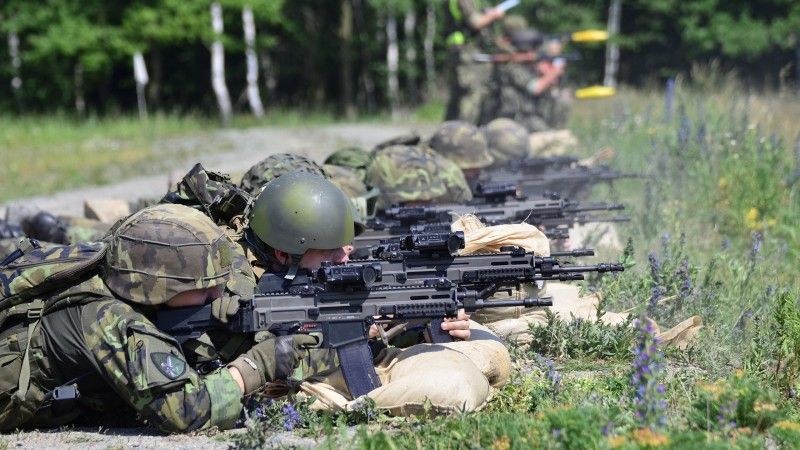
Photo. JanHermanek/CC BY-SA 4.0
A Czech prosecutor has stopped criminal proceedings against a Czech citizen who fought in Ukraine without official approval. The argument matters more than the case itself: the defence of Ukraine was described as a form of forward defence of Czechia. It is not a general legalisation of foreign service, but it shows how Russia’s war is changing the way Central and Eastern European states look at their own citizens fighting for Kyiv.
The Czech case is important because it moves the discussion beyond a narrow reading of the law. The man joined Ukrainian forces despite not having the required authorisation from the Czech president. Under normal circumstances, that would be treated as unlawful service in foreign armed forces. The prosecutor, however, decided that bringing him to court would make little sense in the wider context of Russia’s aggression. Ukraine was not presented as a distant conflict, but as a country defending itself against a power that also threatens Czech security.
This does not mean that Czechia has opened the door to uncontrolled service in Ukraine. The decision concerns one person and may still be reviewed. Its political meaning is nevertheless clear. The prosecutor did not simply say that the state should be lenient towards a volunteer. He accepted that fighting against Russia in Ukraine can be understood as an action consistent with Czech security interests. That is a significant shift in language.
Poland chose a different route. Instead of waiting for individual prosecutorial decisions, Warsaw adopted a legal solution in 2026 covering Polish citizens who had served on Ukraine’s side without the required permission in the period from April 2014 to July 2026. In practice, this was a form of retrospective amnesty. It did not abolish the general rule for the future. A Polish citizen who now wants to serve legally in a foreign army still has to follow the state procedure. Poland therefore cleared the past, but did not create a permanent blank cheque.
Latvia went further and earlier. Already in the first days after Russia’s full-scale invasion, Riga amended its law to allow Latvian citizens to volunteer for military service in Ukraine, provided the relevant notification requirements were met. That is the cleanest model in the region: the state recognised the political and security logic of service in Ukraine from the start, rather than dealing with the issue later through prosecutors or amnesty.

Estonia and Lithuania remain more cautious. Estonia did not adopt the Latvian model, although it quickly criminalised support for Russian and Belarusian armed formations after the full-scale invasion. Lithuania keeps a stricter legal framework, under which service in a foreign state without government authorisation may carry consequences, including in the field of citizenship. These approaches do not mean weaker support for Ukraine. They show that even the most exposed states draw the line between individual volunteering and state control in different places.
The wider picture is more important than the legal details. Czechia, Poland, Latvia, Estonia and Lithuania all understand that Russia’s defeat or containment in Ukraine is tied to their own security. Yet they have not produced one common legal model for citizens joining Ukrainian forces. Latvia legalised it from the beginning. Poland forgave past cases in law. Czechia now has a striking individual decision built around the idea of forward defence. Estonia and Lithuania remain more guarded.
That is why the Czech decision matters because it does not overturn the law, but it changes the political framing (during unstable political times). A citizen fighting in Ukraine is no longer automatically seen only as someone who violated the rules of service abroad. In the new regional context, such a person may also be viewed as acting against the same Russian threat that his own state identifies in its security documents. This is the real consequence of the war, and Ukraine has become not only a battlefield, but also a test of how neighbouring states define their own defence.


