- WIADOMOŚCI
- ANALIZA
- OPINIA
Neither a new Yalta nor a triumvirate. What does the Shenzhen summit really mean for Europe?

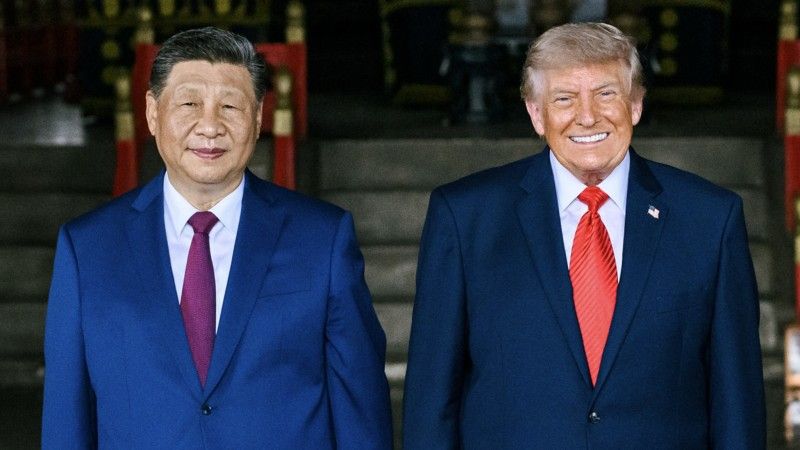
Donald Trump, Xi Jinping and Vladimir Putin’s meeting on the sidelines of the APEC summit in Shenzhen is above all a strong political signal, but it is difficult to cast it as a “new Yalta”. Even if China’s Foreign Ministry describes it as “groundbreaking”, with discussions set to cover strategic stability, nuclear issues, trade and the context of the wars in Ukraine and Iran, it would be a stretch to see it as drawing a new political map of the world.
Neither a new Yalta nor a triumvirate
To begin with, this is not the first high-level meeting organised by China. In May 2026, Xi hosted Trump and Putin in Beijing, one after the other. Taken together, these meetings signalled a shift away from the post-war emphasis on multilateral institutions towards a more personalised diplomacy among the great powers — although the key roles here are still played by the US and China.

Comparisons with the conference in Yalta in February 1945 have appeared in Western media and are being actively fuelled by the Kremlin. Not without reason. Talk of a “new European security architecture” and a “new Yalta” gives Moscow licence to think again about returning to great-power status, with the right to define its own spheres of influence. That was the case after the historic Big Three meeting, and it is certainly a scenario Vladimir Putin would relish.
Russian negotiator Vladimir Medinsky has spoken of the need for a “new, modern Yalta” as the basis for European security. In the Russian narrative, simply sitting at the table with the US and China is a success — a rehabilitation of Russia as an equal global player. At the same time, it will be in Russia’s interest to marginalise Europe completely, because only through such manoeuvring can it return to the European concert of powers as the dominant partner.
Historical analogies, however, have limited relevance here. Of the three, only the US and China have the status of undisputed world powers. Russia is included mainly because of its nuclear capabilities, not as a rising empire.
The motivations of the three parties
It will come as no surprise that Russia has the most to gain from the summit and will exaggerate its importance in every way it can. The meeting legitimises Putin on the international stage despite the war in Ukraine, allows him to criticise Western sanctions as “punishing themselves”, and promotes the narrative of a multipolar world. Bilateral talks with Xi ahead of the trilateral summit served to coordinate positions and strengthen the partnership. For the Kremlin, this format alone is a propaganda victory, regardless of any concrete agreements. Russia is expected to push for recognition of its security interests in Europe and possible concessions on Ukraine, although Ukraine was not officially a major item on the US agenda.

China, meanwhile, wants to present itself as a great stabiliser and an impartial arbiter. Xi portrays China as a defender of free trade and an opponent of protectionism. At the same time, he is strengthening the partnership with Russia (or, rather, gradually bringing it into a vassal-like relationship with China) while seeking to maintain stable ties with the US. China does not want to take direct responsibility for resolving the war in Ukraine, however, and avoids any format that would decide Europe’s fate without representatives of the Old Continent at the negotiating table. In practice, the status quo suits it best: Russia remains dependent, while the US is occupied on other fronts, including the war with Iran.
Finally, there is the United States, for which this format is the least clearly defined. President Trump will want, on the one hand, to demonstrate undisputed superiority over Beijing and Moscow — making discussions on reducing nuclear arsenals and a new form of the New START programme a priority — and, on the other, to show that he can resolve the wars in Ukraine and the Persian Gulf effectively and swiftly.
Of the three, however, Xi Jinping is in the strongest position. Putin has little room for manoeuvre, not least because of Russia’s heavy dependence on Beijing, while Trump has been weakened by his party’s recent Congressional election losses, poor approval ratings and the war with Iran.
Implications for Europe and NATO's eastern flank
However, it is difficult to expect a breakthrough as a result of the summit. It may facilitate further nuclear talks (even if China resists) and help manage crises, but it will not bring about an immediate end to wars or divide Europe and the world into new spheres of influence. There is, however, another more troubling development: the marginalisation of European partners.
For NATO’s eastern flank — including Poland — this format artificially elevates Russia to the status of a global superpower, which it has not been for a long time. That is why discussions have also begun to emerge about Russia’s 2021 demands, when it called for NATO installations to be withdrawn to their pre-1997 positions — in other words, before Poland joined NATO.
Conclusions for Poland and the region
The Shenzhen summit is not yet a critical turning point, but it is certainly a moment when a proverbial warning light should come on. The whole affair overturns the liberal assumptions that have shaped thinking about international relations — or, rather, clearly marks a shift towards a more realist approach. In this version of events, the final say belongs to those who possess strength and capability first and foremost, rather than treaties and international law.

For Poland and NATO’s eastern flank, this is another wake-up call to strengthen our own agency, not a reason to panic. Poland and the region should respond on four fronts:
- using the situation to hold a serious discussion about the future and shape of the European Union;
- deepening cooperation through regional formats such as the Bucharest Nine, the Three Seas Initiative and Nordic-Baltic cooperation (with an expanded Intermarium in mind), as a complement to NATO and the EU;
- increasing cooperation with Washington on the prospect of a permanent US base in Poland;
- consistently strengthening defence capabilities and building societal resilience.
We should, however, avoid exaggerated analogies, which are very much in the Kremlin’s interests. Russia remains the main military threat, and building genuine deterrence capabilities and resilience is still the best response to attempts to impose a logic of spheres of influence. Concrete changes will depend not on a photograph in Shenzhen, but on what Central and Eastern Europe does in the coming months.