












- ANALIZA
- WIADOMOŚCI
China's sea-cased component and the gaps in Washington's response.

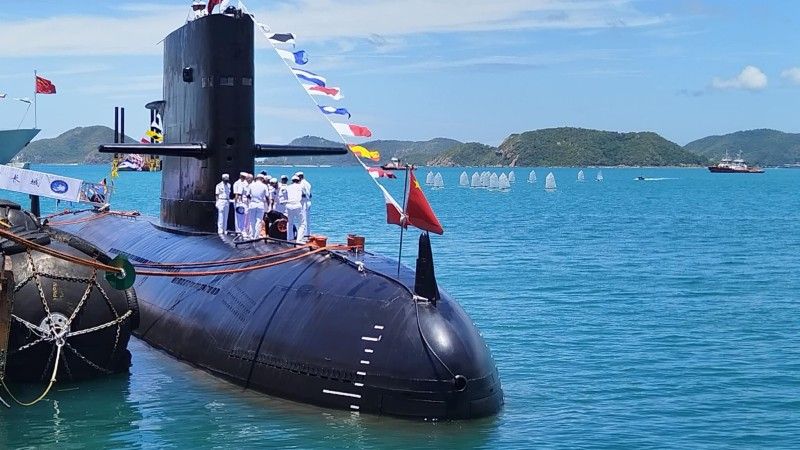
On 6 July 2026, a Chinese submarine launched a ballistic missile with a dummy warhead toward the open waters of the Pacific. It was the first Chinese launch in history from beneath the surface of the ocean into international waters. Not all of the states affected by the test were warned in advance, and those that were notified received two hours at most. The response from “the West” came five weeks later.
On 11 August, in Geneva, 41 states, Poland among them, called for notification 24 hours in advance, without naming China. On the same day, Washington delivered a separate national statement, this one directed explicitly against Beijing. Both remain words. The Chinese fleet can be counted and described. The American response amounts to a delayed shipbuilding program, a classified review and two statements in Geneva.
What does China have today?
The component rests on six Type 094 (Jin-class) boats at the Yalong base near Longpo on Hainan. The two newest are improved variants of the baseline design, referred to in Chinese publications as the Type 094A, which neither the Pentagon nor the Chinese side has confirmed. Satellite imagery has settled the speculation about sixteen launch tubes: each boat carries twelve missiles, which gives the fleet 72 launch tubes. The hull bulge on the newer boats relates to quieting, not to the number of tubes. Six is the current figure, not the target, because China is building further boats of the same type in parallel with work on a successor.
The armament consists of the JL-2, with a range of 7,200 km, and the JL-3, with a range of roughly 10,000 km. An important discrepancy runs through this point. The 2024 Pentagon report described the replacement of the JL-2 by the JL-3 as spread over time, as boats returned for overhaul. A more recent Pentagon assessment, cited by the Federation of American Scientists, speaks of a completed replacement, which cannot be reconciled with the July test, in which, according to the same Federation, a JL-2 was used. The National Air and Space Intelligence Center (NASIC) credits the JL-3 with a multiple-warhead capability, something American intelligence has never explicitly confirmed.
Infrastructure is growing alongside the fleet. Two additional piers were completed at Longpo in 2024, and work continues on a radar station and on a probable second tunnel entrance. Since 2021, China has conducted deterrence patrols described by the Pentagon as “near-continuous”, meaning that at least one boat is at sea intermittently, not that the entire fleet stands unbroken alert. Imagery from 8 March 2026 showed the whole fleet in port: four boats at Longpo and two at Huludao. Since May 2025, a single Type 094 has been observed periodically at Jianggezhuang, the Northern Fleet base, where no such boat had been seen for close to a decade.

The Type 096 remains at a stage that cannot be resolved from the outside. Construction was to have begun at the start of the decade, and in its 2024 report the Pentagon wrote that it would begin “soon”. A new assembly hall at Huludao, dating from 2022, may serve this program, but there is no certainty. Reports of twenty-four launch tubes have no basis in official sources. The Federation of American Scientists, setting them against current and projected missile stocks, considers 12–16 more plausible. Because these boats are credited with 30–40 years of service, the Pentagon assumes parallel operation of both types, which would give a force of 8–10 units.
Proportion is worth keeping in view. Against roughly 620 warheads in the entire Chinese arsenal, the sea-based component accounts for 72 launch tubes. The Pentagon also noted that the stockpile held at the low six hundreds throughout 2024, at a production rate slower than in preceding years, while sustaining its projection of more than a thousand warheads by 2030. Almost all Chinese warheads are stored separately from their delivery vehicles. The sea-based component may be the exception: some American officials told the Federation of American Scientists that boats on deterrence patrols carry warheads, though no one has said so publicly.

Photo. US Department of Defence
What does this component not do yet?
Whether five weeks of delay and two statements constitute a proportionate response depends on what the July launch demonstrated. And it demonstrated less than is commonly supposed, because public commentary blurs the difference between possessing a missile and being able to hold a target at risk.
Even with the JL-3, a Chinese boat cannot threaten the 48 contiguous states from the South China Sea. To hold the northwestern states at risk, it must move into northern waters, and here the Federation of American Scientists points to the Bohai Sea. To hold Washington at risk, it would have to pass northeastern Japan, that is, to leave the waters in which Chinese surface, air and subsurface cover makes sense. This is the FAS assessment, based on NASIC data, and it differs from what many trade publications repeat.
The distances bear this out. From a bastion in the South China Sea, Seattle lies roughly 11,000 km away along the great circle, which is beyond the reach of the JL-3. From the Bohai Sea, Seattle lies at about 8,600 km, but Washington already at about 11,200 km. Only from a position east of Hokkaido does the capital lie at a distance of roughly 9,800 km. Every one of these steps takes the boat out from under its cover.
The conclusion, however, hangs on a single figure. The margin between the range of the JL-3 and the distance to Seattle is about ten percent, which falls within the uncertainty of the estimate itself. At a range estimate on the order of 12,000 km, as some publications give, the argument about the limits of the bastion reverses. Anyone who accepts that argument accepts the NASIC figures along with it.
Here lies the core of the Chinese dilemma. The bastion protects boats whose acoustic signature remains high, but it constrains targeting reach. Leaving the bastion inverts that relationship.

The launch of 6 July confirms as much. The missile flew roughly 7,300 km over northern Luzon and fell within the nuclear-weapon-free zone established by the Treaty of Rarotonga. The impact point is reported inconsistently, from an area between Nauru and Tonga to a position roughly 300 km east of Tonga, but in every version the track runs south rather than toward American targets. The demonstration had regional addressees, including the Philippines, over which the missile passed, as well as Australia and the participants in the RIMPAC exercise.
Analysis of navigational warnings further suggests that two options were under consideration for that day: a launch from the Bohai Sea with overflight of Japan, and the one that took place. Washington did in fact accuse Beijing of contradictory notifications that implied a launch over the territory of certain American allies. If the reconstruction is accurate, the option left unexecuted ran through waters from which targets in the northwestern part of the continent are reachable.
The test does not, however, settle the dispute over range. The distance covered falls within the maximum of the JL-2, so it says nothing about the capabilities of the JL-3, that is, about the figure on which the entire assessment above hangs.

Photo. United States Naval Institute News Blog / Wikimedia Commons
Three gaps on the American side
The material gap. The original schedule for the Columbia program called for delivery of the lead boat in October 2027. The Navy’s official budget request for fiscal year 2027 gives March 2029, while the contractor, General Dynamics, stated in April 2026 that it would be the end of 2028. The first patrol must begin in fiscal year 2031, that is, from October 2030, or a break will open in the continuity of sea-based deterrence. The buffer is thinner than assumed: service-life extension for four or five Ohio-class boats was under consideration, and by May 2026 the Chief of Naval Operations was already speaking of changed plans and of a single certain case. The American sea-based component is therefore passing through a generational gap of its own in the same decade in which the Chinese one reaches operational maturity.
The conceptual gap. Three things that public discussion runs together have to be separated here. The administration abandoned a formal Nuclear Posture Review, judging the 2018 document sufficient in March 2026. Separately, the announcement of the August symposium in Omaha pointed to a nuclear strategy review in preparation. Separately again, a classified review of employment guidance is under way, confirmed at that same symposium on 5–6 August 2026 and focused, according to reports, on lower-yield options in the event of a regional war with China or Russia. None of these tracks answers the growth of the Chinese strategic component. A fleet of ballistic missile submarines bears on retaliation at the highest level, not on a situation in which someone reaches for a low-yield weapon in a war over Taiwan.

The institutional gap. There is no ballistic missile launch notification agreement between Washington and Beijing. The United States and the USSR signed one on 31 May 1988, Russia and China on 13 October 2009. China is also the only P5 state remaining outside the Hague Code of Conduct, in which 145 states participate. The Geneva appeal of 11 August is the first collective reaction after the July test, yet it calls only for 24 hours’ notice and for the class of missile, the launch area and the direction to be given. On the same day, the United States delivered a separate national statement naming China, referring to the two hours of notice and to a “confusing and provocative” approach, and noting that in September 2024 Beijing had given better notification than in July 2026. Practice, then, is not standing still; it is deteriorating. Beijing dismissed both statements as political manipulation and “microphone diplomacy”, recalling that it has not signed the Code and is not bound by it. Since the expiry of New START on 5 February 2026 there is no wider structure within which this dispute could be resolved.

Photo. United States Government Accountability Office
Conclusion
The build-up of the Chinese sea-based component is not a leap but an accretion: further hulls, quieter variants, longer-ranged missiles, new piers, longer patrols. Even the warhead production rate points in this direction, slower than before, though the projection of more than a thousand warheads by 2030 remains in force. A process of this kind is easy to overlook between tests. The American response reacts event by event, through statements and classified reviews. The first real talks on strategic stability in a trilateral configuration will therefore take place without settled procedures and without the accumulated practice of New START. Poland put its name to the Geneva appeal, which is the right step and, at the same time, a measure of how few instruments remain. It is in this context that decisions on the shape of American extended deterrence guarantees, Europe’s included, will be taken.
Author: Oliwier Gorgoń


