












- ANALIZA
- WYWIADY
- WIADOMOŚCI
French nuclear deterrence: modernisation, forward presence and support for Poland

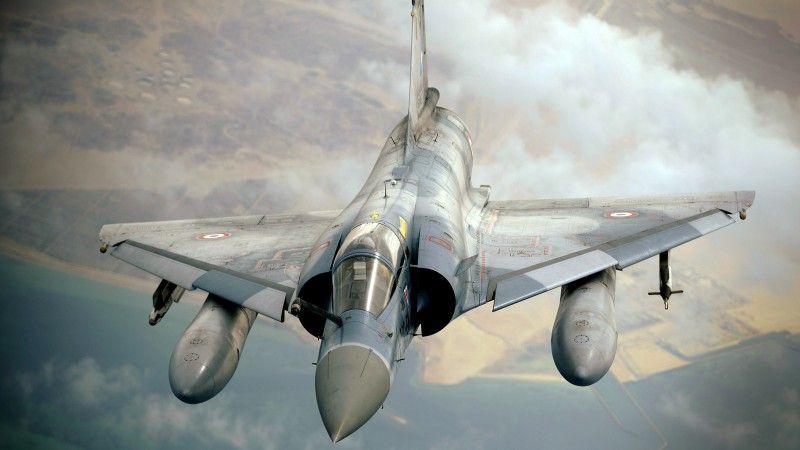
France is entering one of the most important phases of modernising its nuclear deterrent since the end of the Cold War. Over the next decade, a significant part of the systems that make up the Force de dissuasion will be replaced, while Paris is simultaneously trying to strengthen the European dimension of its doctrine through the concept of forward deterrence. For Poland, two questions are particularly important: will this initiative survive the presidential transition in 2027, and can Poland’s security become permanently connected to the French understanding of “vital interests”? Paris is not creating an equivalent of US nuclear sharing and will retain full control over any decision to use nuclear weapons.
France is modernising both components of its nuclear deterrent at the same time. At sea, it is developing the third-generation SNLE 3G strategic submarines and further versions of the M51 ballistic missile. The airborne component is expected to rely on the Rafale F5 and the new ASN4G missile. This is not a single procurement programme, but a process spread over several decades. France is preparing a deterrent that must remain technically and militarily credible even as potential adversaries significantly improve their conventional capabilities and air and missile defence systems.
At the same time, Emmanuel Macron is trying to change the political environment surrounding French nuclear weapons. Forward deterrence, or dissuasion avancée, does not mean transferring French warheads to European partners or giving them a role in decisions on nuclear use. Paris retains full control over its arsenal. The change lies elsewhere. France wants to take the interests of key European partners more directly into account, involve them more closely in exercises and conventional support, and gradually broaden the geographical understanding of French security beyond the borders of the Fifth Republic.
This is also the most politically uncertain part of the concept. France’s nuclear modernisation will continue, but the European dimension of its deterrence could slow considerably after the 2027 presidential election. The industrial programmes, new submarines, missiles and aircraft are relatively predictable. What remains much less clear is how far France is prepared to go in linking its nuclear deterrent to the security of its allies, and what this would mean in practice during a major crisis.
The debate is therefore not only about the number of French nuclear warheads. It is also about political credibility, doctrinal clarity and the relationship between nuclear and conventional forces. France is not building an American-style system of extended deterrence. Instead, it is broadening the way in which it defines its own vital interests and considering how the security of European allies may become part of that calculation. For Poland, this distinction is fundamental.
We discuss the future of French nuclear deterrence with Héloïse Fayet, researcher at IFRI’s Centre for Security Studies and head of the Deterrence and Proliferation programme. She assesses the future of dissuasion avancée after the 2027 presidential election, the direction of French nuclear modernisation, work on hypersonic systems, the relevance of the current arsenal size, and how Paris could interpret its “vital interests” in the event of a Russian attack on Poland.

Could the 2027 presidential election significantly affect the future of the French forward deterrence initiative? How is the idea viewed across the main political camps?
Nuclear policy is closely tied to the presidency in France. There is a broad consensus on possessing nuclear weapons, but not on how they should be used. We saw very strong reactions from La France Insoumise (the left) and the Rassemblement National (the far right) as early as 2022, when the first ideas about a European dimension to French deterrence emerged in the public debate.
Both parties spread misinformation or misinterpretations — LFI accused Macron of changing the doctrine altogether, while the right claimed France was “selling” nuclear weapons to Germany or the EU. Reactions were more measured after the March 2026 speech, which was deliberately crafted to avoid provoking public opinion, but misinterpretation and germanophobic rhetoric resurfaced after the announcement of Franco-German coordination in July 2026. As for the 2027 election and its aftermath, I don’t think future governments would try to unravel what has already been built, but any further progress would likely stall. That’s why it’s important to act now.
What are the main priorities for the future development of France's nuclear deterrent, and what role could forward deterrence play within this strategy?
The priority is to continue modernisation and prepare both components — air leg and sea leg — for future challenges. Nearly everything will be renewed over the 2030s: the third-generation SSBN, the new M51.4 missile, the Rafale F5 standard, the ASN4G (a new hypersonic-capable nuclear cruise missile), and a partial increase in the size of the arsenal.
It’s essential to maintain a technically and operationally credible deterrent — one capable of penetrating enemy defenses, achieving the intended effects against adversaries, and reassuring allies. On the doctrinal side, France needs to think through how its nuclear forces articulate with allied conventional forces — this is the principle of European mutual support.
See also 
How advanced are French efforts to develop hypersonic systems capable of carrying nuclear warheads?
Work is progressing well — MBDA unveiled a first ASN4G prototype this spring, and it should enter service around 2035. The question of a long-term carrier platform remains open given the failure of the SCAF programme, but for now the Rafale F5 is the intended platform by 2040. France is also developing a conventional hypersonic glide vehicle, the V-Max.
How does France preserve strategic continuity when each president has considerable freedom to interpret and define the nuclear doctrine? Can a change of president substantially alter operational planning?
Every French president has adapted nuclear doctrine to the international context and evolving threats — tactical nuclear weapons were deployed during the Cold War and withdrawn afterward, the arsenal was reduced, transparency increased, and the European dimension was deepened, among other changes. But the core has remained constant: guaranteeing France’s survival, sovereignty, and strategic autonomy.
Moreover, while presidents change, the administration does not — the officials working on nuclear issues at the Ministry of the Armed Forces and the Ministry for Europe and Foreign Affairs are the real custodians of the doctrine, and they can act as a check against overly drastic shifts.
Is the current arsenal size sufficient to extend credible protection to European partners participating in a forward deterrence framework?
The question isn’t really about being credible in the eyes of allies through a larger arsenal — it’s about being credible in the eyes of whoever we want to deter, namely Russia, and perhaps China one day. The increase decided by Macron was meant to reassure allies, but above all to ensure France retains the ability to inflict immense damage on an adversary decades from now. France doesn’t need to follow the American model of a large, diversified arsenal to be credible. Instead, the focus should be on political credibility, doctrinal clarity, and coordination with other European countries.
Also, on a side note, it’s important to understand that France is not “extending its deterrence” only to countries participating in the forward deterrence initiative. First, it’s not extension per se, but a broadened scope of what French vital interests encompass (see question 6). Second, if there is a large-scale attack on a country that is not part of the initiative, but the French president considers it might have an impact on French vital interests, it will not prevent them from intervening. The initiative only gives an additional layer of connexion, understanding, and insights into the French nuclear thinking.

How should France's "vital interests" and their "European dimension" be understood in practice? Would a Russian attack against Poland be considered a direct threat to those interests?
It means France factors its allies’ interests into its own calculation of vital interests. The frontier of deterrence is effectively pushed out to the edges of Europe, because France is embedded in a network of alliances and shared interests. It ultimately falls to the President to determine whether an attack on Poland would trigger French nuclear interests, but given the Nancy Treaty and Poland’s membership in both the EU and NATO, it’s virtually certain that France would not simply stand by.
That said, there’s a wide range of options short of nuclear use: deploying troops, conventional strikes on Russian territory, hybrid responses, raising the alert level of nuclear forces, and so on. This calls for creativity and boldness.
Fayet’s remarks show that a key element of the French concept remains the broadening of France’s understanding of its “vital interests” to include the security of European partners, while preserving full freedom of decision for the President. The same mechanism, from a practical and institutional perspective, is described by Corentin Barré, Chairman of the Europe Committee at Les Jeunes IHEDN:
”The French model of forward deterrence is based on a clear distinction between consultation and joint decision-making. Partners may participate in strategic dialogue, exercises and temporary force deployments, and may also provide conventional support for French deterrence capabilities. However, under the current French approach, the decision to use nuclear weapons, nuclear planning and the conduct of nuclear operations remain exclusively under French control. Poland can therefore present its interests and concerns and participate in consultations, but it has no right to co-decide on French nuclear plans. This allows France to develop the European dimension of deterrence while retaining full national control over its nuclear forces.”
The political and doctrinal dimension of French deterrence is only one part of the entire system. Credibility also depends on maintaining military capabilities that allow France to retain the ability to respond regardless of how the situation develops. The sea-based component is particularly important here, as it contains most of the French nuclear arsenal and guarantees a retaliatory capability. This is why the development of the new SNLE 3G strategic submarines and M51 missiles remains one of the most important programmes of the French Armed Forces for the coming decades. This technical and military dimension of French deterrence is underlined by Antoni Walkowski of Defence24:
The construction of four third-generation strategic ballistic missile submarines sous-marins nucléaires lanceurs d’engins de 3e génération, SNLE 3G) is the result of many years of planning and programming for the development of the French Navy Marine nationale) and represents one of the two legs of the national deterrence system Force de dissuasion). In March, President Emmanuel Macron announced that the first submarine would be named L’Invincible, or “The Invincible”. The names of the subsequent units remain unknown.
The first concepts concerning future oceanic nuclear deterrence systems futur moyen océanique de dissuasion, FMOD) were presented in 2011. The actual design phase was launched six years later at Naval Group and TechnicAtome. The fact that this stage was reached more than twenty years after the introduction of the Le Triomphant-class submarines gives an idea of both the longevity of strategic submarines and the extraordinary complexity of such projects.
Construction of L’Invincible began in 2024 at the Cherbourg shipyard with the cutting of the first steel. It is expected to enter service roughly a decade later. Its home will be the Île Longue base in Brittany, which, despite its name, is located on a peninsula. Today, four Le Triomphant-class submarines are stationed there. It should also be underlined that the French Armed Forces Forces armées françaises) no longer possess a nuclear triad following the withdrawal of the land-based Pluton and Hadès tactical ballistic missile launchers and the S3 intermediate-range missiles.
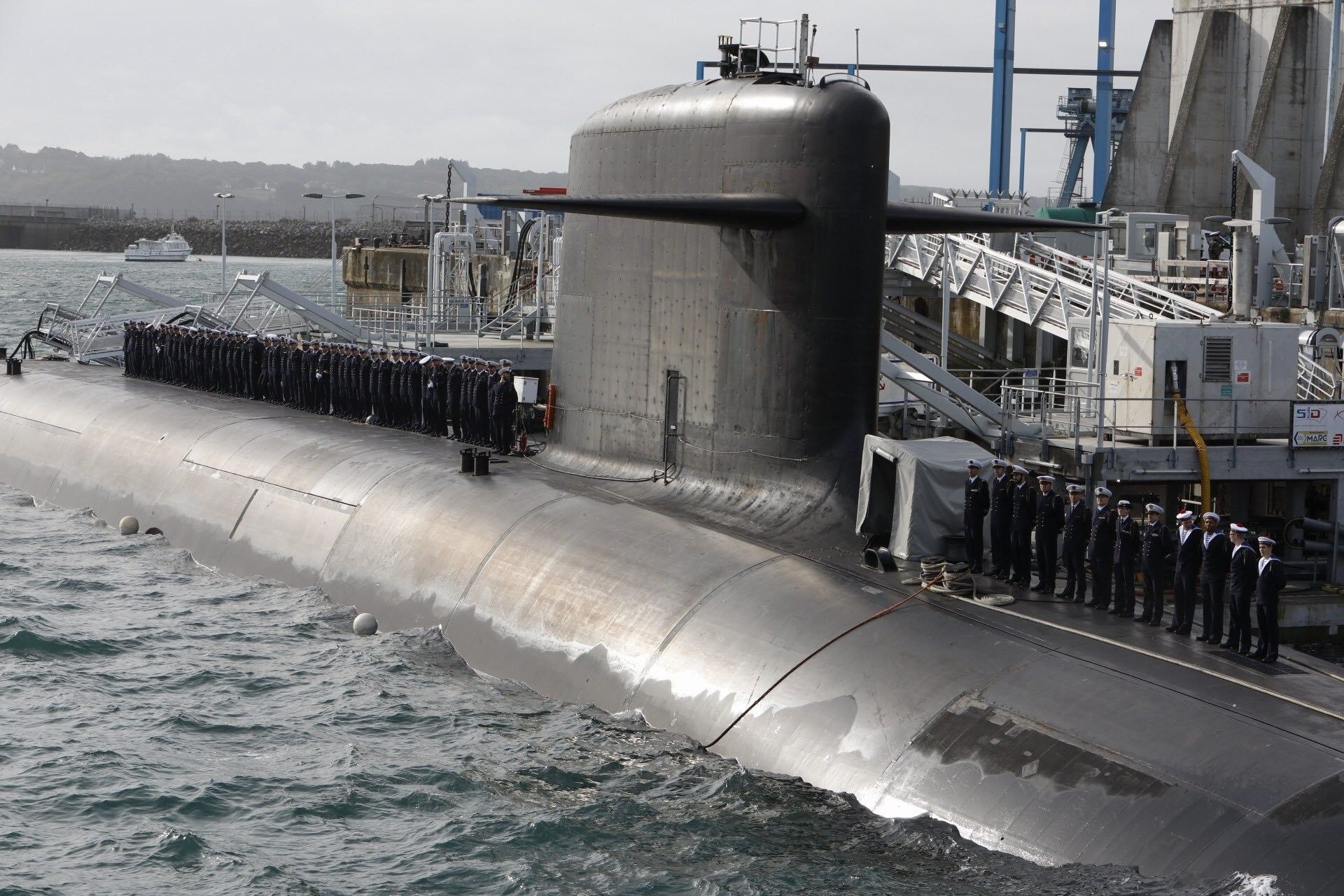
The designers are taking an evolutionary approach to most of the submarine’s key components. One example is the TechnicAtome K22 nuclear reactor. The starting point for the new design was the K15 system used on the Le Triomphant and Suffren classes. At the same time, the K22 will generate 225 MW of thermal power, around 50% more than its predecessor. A similar evolutionary approach has been adopted in the development of the M51.4 strategic ballistic missile.
The fourth submarine is expected to enter service in 2050. According to current plans, the vessels are to remain in service until around 2090. This means that all of them will have to undergo repeated and extensive modernisation in many areas during their service lives. This will be made possible by the modular architecture of many key components and the use of software-defined equipment. Naturally, neither the Marine nationale nor Naval Group shares many details.
The almost unimaginable complexity of the project is a natural risk factor. On the other hand, the SNLE 3G submarines will already represent the third generation of French strategic submarines, following the Le Redoutable and Le Triomphant classes. In the SNLE 3G programme, France can draw on more than half a century of technical, industrial, institutional, political and military experience accumulated through the construction of 20 nuclear-powered submarines by the beginning of 2026.
Le Triomphant-class submarines each carry 16 multiple-warhead M51 submarine-launched ballistic missiles. The L’Invincible-class units will have the same number of launch tubes. The Submarine Forces Forces sous-marines) therefore possess the clear majority of the French nuclear arsenal, probably more than 200 warheads out of around 290. By comparison, around 50 warheads are allocated to land- and carrier-based Rafale fighters armed with ASMPA-R air-to-surface missiles.
This means that the construction of the L’Invincible-class submarines simply cannot be allowed to fail; at most, the programme may suffer delays or cost increases. Even if the next-generation ASN4G airborne nuclear missile programme proves fully successful, and even if France were to return to land-based nuclear weapons – which today remains purely hypothetical – then, to use economic language, the submarine leg of the Force de dissuasion is simply too big to fail, particularly in a country where strategic autonomy is treated as almost sacred, Antoni Walkowski concludes.

A change of president will not stop investment
The most important conclusion is not that France will continue to modernise its nuclear weapons. That is essentially already settled. The industrial programmes extend over several decades, the sea-based component of the Force de dissuasion contains most of the French arsenal, and maintaining a retaliatory capability remains the foundation of the entire system. A change of president will not stop the construction of the SNLE 3G, the development of the M51.4 or work on the Rafale F5. What is far less certain is whether, after 2027, the next president will be equally interested in the European dimension of French deterrence.
This distinction must be made very clearly. French nuclear weapons are permanent, but forward deterrence is not yet permanent. In France, there is broad agreement on maintaining an independent arsenal and full sovereignty over decisions concerning its use. There is no similar consensus on gradually extending the political significance of that arsenal to additional European partners. The next president does not have to reverse Macron’s decisions. It would be enough simply to stop developing them.
This is why the period remaining before the 2027 presidential election is so important. It is no longer about another speech or declaration concerning the European dimension of French interests. The more that can now be translated into regular exercises, consultations, infrastructure preparation, aviation cooperation or other concrete initiatives, the harder it will be later to completely extinguish the process. After the election, the issue may be put aside for some time regardless of who wins.
France is therefore in a situation where the technical part of the entire system is much more predictable than its political dimension. A submarine started today may still be in service in the second half of the twenty-first century. This does not, of course, mean that the next president will be able to rebuild the entire French system at will, because the strength of the Force de dissuasion lies precisely in its institutional foundations. Successive presidents have changed the level of transparency, the size of the arsenal and the way the European dimension of deterrence is described, but they have not challenged its core principles: independence of decision-making, protection of vital interests and the ability to inflict unacceptable damage on an adversary.
For Paris, the sea-based component is particularly important. This is where most of the capability to retaliate after a possible enemy first strike – Russian, for example – is concentrated. If a submarine remains undetected, a potential adversary cannot assume that it can deprive France of the ability to respond with a single strike. This is precisely why the SNLE 3G programme is, in practice, one from which Paris cannot withdraw.
The airborne component performs a different role and, precisely for that reason, is particularly important for forward deterrence. Rafale aircraft can be deployed to an allied country, participate in exercises, use air-to-air refuelling, receive protection from other aircraft and use the infrastructure of a partner state – Poland, Sweden, Finland, Greece? It can serve as a tool for signalling determination without revealing the details of nuclear planning.
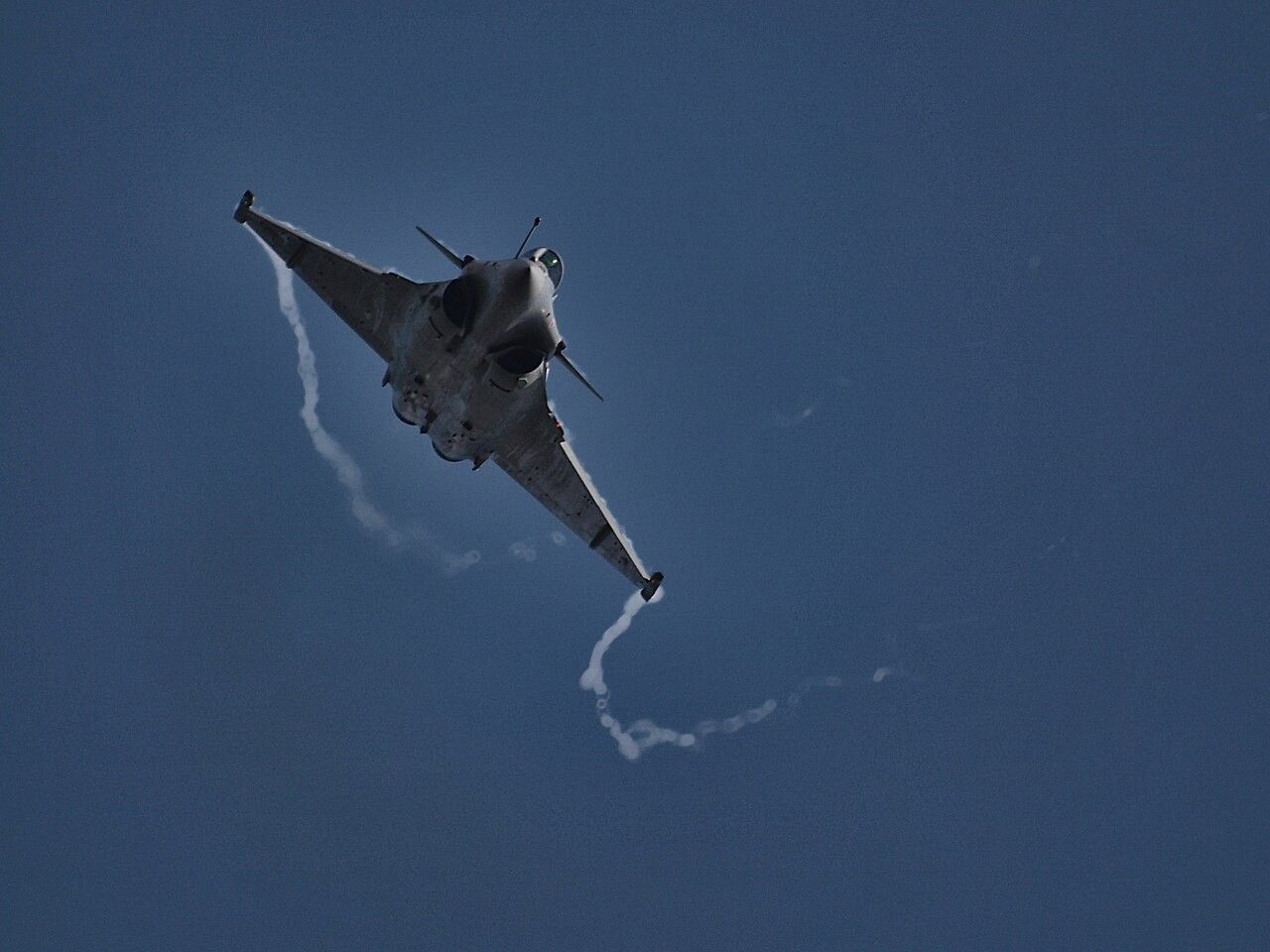
Photo. KGyST / Wikimedia Commons / CC BY 3.0
This is why the significance of the ASN4G goes beyond the mere development of another missile. If the system achieves the intended capabilities and is integrated with the Rafale F5, France will gain a tool enabling it to maintain the airborne component of deterrence in an environment of increasingly advanced air and missile defences. The ASN4G is expected to enter service around 2035 and replace the ASMPA-R, with penetration of future enemy defences being one of its central design assumptions.
However, the credibility of deterrence cannot be reduced to missile parameters – even if my colleagues at Defence24 praise them very highly. A state can possess the best missile, a modern submarine and a sufficient number of warheads, but deterrence works only when the adversary believes that they could actually be used. In the case of the purely national defence of France, this problem is relatively simpler. It is much more difficult to answer whether Moscow would believe that the French president would genuinely be prepared to raise the stakes in response to aggression against Warsaw, Stockholm or another European partner.
Does France have enough warheads?
The debate about the number of French nuclear warheads is framed incorrectly. France is not trying to build an arsenal numerically comparable to the Russian or American ones. The French principle of stricte suffisance – strict sufficiency – assumes the maintenance of a capability sufficient to inflict losses on an adversary that it would not be prepared to accept. Credibility is therefore supposed to derive not from numerical parity, but from maintaining the forces, penetration capabilities and certainty of retaliation.
This is precisely why around 290 warheads should not automatically be presented as an argument against France playing a greater role in European deterrence. The question should not be: “Does France have as many warheads as Russia?”, but rather: “Can Russia be certain that it would be able to avoid French retaliation?” These are two completely different ways of measuring and thinking about credibility.
At the same time, forward deterrence is not and will not become the French equivalent of American nuclear sharing. Poland and the other states participating in the initiative will not co-decide on target selection, the threshold for use or the moment when nuclear weapons would be employed. The French make a very clear distinction between cooperation necessary to enable their forces to operate and the actual decision to use nuclear force.

From Poland’s perspective, this should not automatically reduce the importance of the initiative. Warsaw will not receive a French “nuclear button”, and expectations should not be created around something Paris has never intended to provide. Poland can, however, seek the deepest possible involvement in that part of the system which precedes the actual decision to use nuclear weapons: exercises, aviation cooperation, use of bases, air-to-air refuelling, early warning, air and missile defence, and support for the operation of French forces.
The more concrete such cooperation becomes, the more important Poland becomes in the French calculation – security and war are also business. A state that receives only a political declaration can relatively easily be marginalised in the future. A state whose territory, infrastructure, air force and support systems have been incorporated into regular cooperation becomes much more deeply connected to the French security system.
Would Paris defend Warsaw?
For Poland, however, the most important element remains France’s “vital interests”. It cannot be stated today that Poland automatically falls under a French nuclear guarantee. No such guarantee has been given. France deliberately maintains ambiguity, while the final determination of whether a specific event threatens its vital interests remains a decision of the President of the Republic.
The French use this ambiguity very deliberately. The nuclear threshold is not published precisely so that an adversary cannot plan its actions just below it with precision. Broadening the European dimension of cooperation therefore does not require drawing a specific line on the map or identifying a particular “Russian target” that would be destroyed. In a sense, the strength of the entire arrangement lies in leaving Moscow with the question of where exactly that line now runs.
There is also no doubt that the entire initiative serves France not only by increasing European security. Paris is strengthening its own political position, building military and industrial relationships and demonstrating that the United States is not the only country capable of offering a nuclear option to European allies. For Macron, the nuclear umbrella is also a tool for increasing France’s importance in Europe.
Ultimately, therefore, the most important question concerning cooperation is not how many French warheads could theoretically be “allocated” to individual partners. France does not divide its arsenal between states. The most important question is whether Russia will believe that a major act of aggression against Poland could simultaneously be regarded as a threat to France’s vital interests.

Technology is intended to make that credibility possible. The SNLE 3G submarines are to guarantee survivability and the ability to retaliate. The M51.4 is to preserve the credibility of the sea-based component. The Rafale F5 and ASN4G are to enable penetration of increasingly sophisticated defences and provide the President with additional signalling options. Meanwhile, exercises with partners, infrastructure development and deeper political ties are intended to show that the European dimension of French deterrence does not end with a presidential speech.
For Poland, this final element should now be the most important. Before the 2027 presidential election, the objective should be to maximise the number of concrete links with the French system: military, political, infrastructural and training-related. The more such elements are created before the end of Macron’s term, the greater the chance that the next president will inherit not only the idea of forward deterrence, but an existing mechanism that will be much more difficult to reverse completely.
France after Macron will remain a nuclear power. There is no certainty, however, that it will remain equally interested in the Europeanisation of its deterrence. For Poland, the most important issue today is therefore not another declaration from Paris, but using the period before the 2027 election to translate those declarations into concrete action.


