












- WIADOMOŚCI
Patriot versus hypersonic missiles. The debut of a new missile

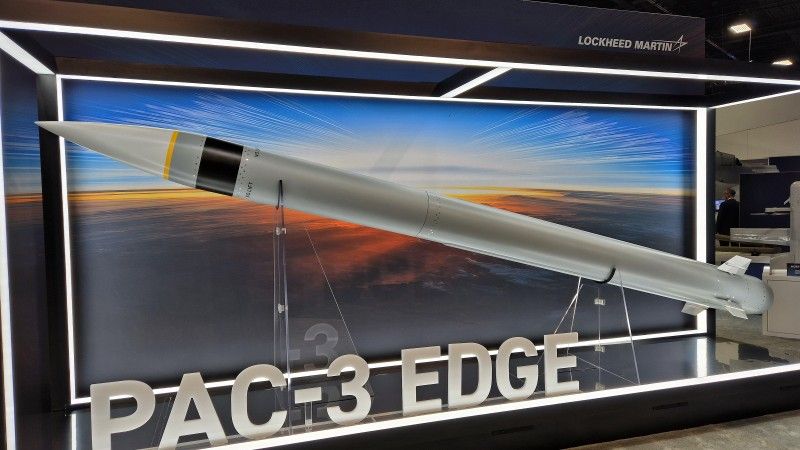
Photo. Robert Czulda
During this year’s AUSA exhibition in Washington, Lockheed Martin presented the latest addition to the well-known anti-missile armament family: the PAC-3 Edge interceptor. The new design is being developed for the US Army’s Future Interceptor programme and is intended to provide a direct response to cutting-edge, difficult-to-detect hypersonic threats, as well as advanced cruise and ballistic missiles.
The American manufacturer positions the Edge as a highly effective solution for destroying targets at significantly higher altitudes and ranges than before, which will markedly expand the capabilities of integrated air and missile defence. In practice, this means that within the US Army, the new missile will fill the operational gap existing between the currently deployed PAC-3 MSE missiles and the long-range THAAD system, designed to intercept ballistic targets at the highest altitudes.
In terms of design, the PAC-3 Edge is based on the extensive experience gathered during the operation of earlier versions of the PAC-3 family. It utilises combat-proven technology from the PAC-3 MSE (Missile Segment Enhancement) missiles, which operate on the hit-to-kill principle. PAC-3 missiles are extensively used against Russian missiles in Ukraine and support defence in the Middle East. The PAC-3 Edge also draws on experience from the lower-cost PAC-3 ACE (Adapted Capability Effector) variant and an earlier production cost-reduction initiative known as PAC-3 CRI (Cost Reduction Initiative). However, engineers have added entirely new elements to the proven solutions, which are intended to give the missile higher speed, greater power, and unprecedented manoeuvrability.

Photo. Lockheed Martin
A key element of the new missile is the active seeker head, designed and manufactured by the corporation’s Strigo Product Center division, as well as a multi-pulse solid rocket motor developed by Northrop Grumman, replacing the dual-pulse propulsion used in the MSE version. The entire control system has also been redesigned, resulting in a significant increase in range and maximum intercept altitude.
From its inception, the project has been designed for full integration with the US Army’s current and future defence architecture. The new missile will be able to seamlessly operate with the IBCS integrated battle command system, standard M903 launchers, containerised launchers, as well as HIMARS Flex launchers.
Despite the impressive presentation, the manufacturer is currently withholding technical details and has not disclosed hard data regarding the exact range, altitude, maximum speed, or estimated unit cost. However, the preliminary programme schedule is known, according to which the first field tests will take place as early as next year, and the achievement of so-called residual operational capability is planned for 2031. This involves delivering a small series of missiles to the military, ready for use in emergency situations, even before the official induction of the weapon into service and the launch of full-rate production.

The debut of the new missile is part of a broad expansion of the American defence sector’s production capacity. In January 2026, Lockheed Martin signed a seven-year agreement with the Department of Defence to scale up production of the currently used PAC-3 MSE missiles, which envisages an annual capacity increase from the current approximately 600 to as many as 2,000 units, while in the whole of 2025, the corporation delivered 620 missiles of this type to its customers.


