


- WIADOMOŚCI
- ANALIZA
Did Zelenskyy reject peace in 2023? Ukrainian MP’s claims raise serious doubts

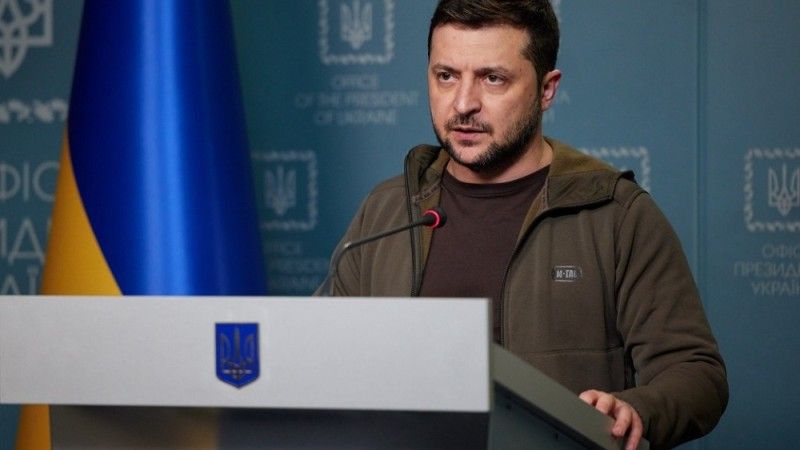
Ukrainian MP Oleksiy Honcharenko claims that in 2023, Volodymyr Zelenskyy rejected a proposal to end the war on terms significantly more favourable to Ukraine than those currently available. According to the MP, Russia was allegedly prepared to withdraw from most of the territories it had occupied since February 2022, provide hundreds of billions of dollars for the country’s reconstruction and accept Western security guarantees. The problem is that his account of events contradicts the Kremlin’s position at the time.
Oleksiy Honcharenko, a member of Ukraine’s Verkhovna Rada, has presented details of an alleged 2023 peace proposal that President Volodymyr Zelenskyy reportedly rejected. According to his account, Moscow was prepared to agree to withdraw its troops from most of the territory of four Ukrainian regions whose annexation it had declared in September 2022.
The new line of demarcation would have run approximately along the positions held by Russian forces before the start of the full-scale invasion. Russia would have retained de facto control over Crimea and the previously occupied part of Donbas, while Ukraine would have committed not to attempt to regain these territories by military means. This would not, however, have amounted to formal recognition of Russian sovereignty over the peninsula.
Honcharenko also claims that the Russians were prepared to return the Zaporizhzhia Nuclear Power Plant to Ukraine, consider withdrawing from Melitopol and accept the use of approximately USD 300 billion in frozen Russian assets for Ukraine’s reconstruction. Moscow would, at the same time, have retained Tokmak and obtained guarantees that a land corridor to Crimea would remain operational. The agreement would have been backed by NATO member states, which would have provided Ukraine with security guarantees.
At first glance, this appears to be an exceptionally favourable proposal for Kyiv, particularly when compared with Russia’s subsequent demands. This is precisely why the account raises serious doubts. Honcharenko has not presented any document confirming that Putin accepted such terms. Nor has he explained why the Russian leadership would have agreed to such far-reaching concessions.

Who Is Oleksiy Honcharenko?
Honcharenko has long been one of Ukraine’s most recognisable and controversial parliamentarians. Originally from Odesa, he began his political career in local political structures before becoming associated with the Party of Regions, the political base of Viktor Yanukovych.
Following the Euromaidan events, he joined Petro Poroshenko’s political camp, with which he remained associated for several years. He served as an MP representing the Petro Poroshenko Bloc and subsequently European Solidarity. His political career demonstrates a significant evolution in his views and an ability to navigate different political alignments.
Over the years, the MP has built his public profile through media appearances, outspoken statements and political provocations. He has repeatedly used international forums to criticise the Russian authorities, with his actions often intended to attract widespread media attention.
In October 2026, however, the MP began attracting attention for a different reason. He has become increasingly active in promoting the idea of ending the war through negotiations, allowing for compromises that have previously been rejected by a significant proportion of Ukraine’s political establishment.
The options he has considered include Ukrainian neutrality, abandoning NATO membership, partially lifting sanctions against Russia and discussing the future status of Donbas. The politician argues that continuing the war is devastating the country and that negotiations should begin before Ukraine’s position deteriorates further.
Honcharenko has also criticised Zelenskyy, accusing him of being unwilling to engage in an open discussion with the public about the costs of the war and possible concessions. He also claims that some MPs privately share his position but are afraid to express it publicly.

Negotiations from the first days of the war
Contrary to opinions sometimes expressed, Ukraine made efforts to end the war through diplomatic means from the very first days of Russia’s full-scale invasion. The first meeting between delegations from the two countries was organised on 28 February 2022 in Belarus. Talks continued in March, both through further direct meetings and remotely. Turkey also became involved in the diplomatic process, hosting the two countries’ foreign ministers, Dmytro Kuleba and Sergei Lavrov, in Antalya on 10 March. Despite the absence of a breakthrough, negotiations continued, with their most important stage taking place towards the end of the month.
It was during the meeting in Istanbul on 29 March that the Ukrainian delegation presented a proposal for the country’s neutrality in exchange for international security guarantees. Kyiv declared its willingness to discuss abandoning NATO membership, as well as a multi-year negotiation process concerning Crimea’s status. These were significant concessions, demonstrating that the Ukrainian leadership was genuinely seeking a diplomatic solution to the conflict. However, Russian demands concerning limitations on Ukraine’s military capabilities and the mechanism for future security guarantees remained problematic. Moscow sought to secure influence over the activation of these guarantees, which could have undermined the effectiveness of the entire agreement.
The prospects of reaching a compromise began to diminish as the military situation changed and crimes committed by Russian soldiers in Bucha and other towns in Kyiv Oblast came to light. The withdrawal of Russian troops from northern Ukraine, followed by further successes by the Ukrainian army, also changed both sides’ calculations. The counteroffensive in Kharkiv Oblast was particularly significant, enabling Ukraine to regain substantial areas of territory in September. The Kremlin responded by announcing partial mobilisation, while towards the end of the same month, Putin declared the illegal annexation of Donetsk, Luhansk, Zaporizhzhia and Kherson oblasts.
The Russian leader’s decision further reduced the prospects of an agreement. Zelenskyy subsequently approved a position ruling out negotiations with Putin, while Ukrainian diplomacy focused on building international support for its own vision of ending the war. This was based on the ten-point peace formula presented by the Ukrainian president during the G20 summit in November. Among other provisions, it called for the restoration of the country’s territorial integrity, the withdrawal of Russian troops, nuclear and energy security, and the release of prisoners of war.
Diplomatic initiatives continued in the following months, although their nature changed considerably. Instead of direct negotiations between Kyiv and Moscow, consultations involving third countries became predominant, with these states attempting to establish the basis for a future agreement. In February 2023, China presented its own twelve-point document concerning a political settlement of the conflict. Several months later, a delegation of African leaders travelled to Ukraine and Russia, also seeking to initiate peace talks.
At the same time, Kyiv sought international support for its peace formula. One of the most important events was the August meeting in Jeddah, Saudi Arabia, attended by representatives of more than 40 countries. Similar consultations were subsequently held in Malta, and the process led to the organisation of a peace summit in Switzerland in June 2024. No Russian delegation participated in any of these three meetings, limiting the possibility of directly negotiating the terms for ending the war.
The talks only gained new momentum following Donald Trump’s return to the White House in 2025. The US president initiated intensive contacts with Moscow and Kyiv, declaring his intention to bring the conflict to an end. One outcome of these efforts was the resumption of direct negotiations between Russian and Ukrainian delegations in Istanbul in May, more than three years after the previous talks held in the city.
The course of these events is important when assessing Oleksiy Honcharenko’s latest claims. Numerous peace initiatives were indeed undertaken in 2023, but these primarily involved diplomatic consultations and attempts to establish a common position among countries engaged in seeking a resolution to the conflict. No draft agreement negotiated with the Kremlin that envisaged the withdrawal of Russian troops almost to their pre-February 2022 positions was publicly presented at the time. This makes the claim that such far-reaching concessions were accepted by Putin and subsequently rejected unilaterally by Zelenskyy all the more questionable.
The Kremlin had no intention of relinquishing annexed territories
The most serious problem with Honcharenko’s account is that it contradicts Russia’s official policy. In September 2022, Putin announced the annexation of four Ukrainian regions. From that point onwards, the Russian authorities consistently presented them as integral parts of the Russian Federation. In the following months, Kremlin representatives repeatedly emphasised that any future agreement would have to take account of the so-called new territorial realities. Moscow’s claims were not limited to the territories it actually occupied but extended to the entirety of these regions within their administrative boundaries.
According to Honcharenko, however, Putin was already prepared to relinquish most of these areas in 2023. This version of events contradicts public statements made by the Russian leadership. In 2023, Russia was still counting on exhausting Ukraine’s military capabilities and weakening Western support. Russian forces were expanding fortifications in southern Ukraine, while the Kremlin was preparing its economy for a prolonged conflict. Moreover, in June 2024, Putin presented peace terms that went significantly further than those described by Honcharenko. He demanded the complete withdrawal of Ukrainian troops from Donetsk, Luhansk, Zaporizhzhia and Kherson oblasts, including areas that remained under Kyiv’s control.
The Russian president also demanded that Ukraine abandon its aspirations to join NATO, adopt neutrality and recognise Russia’s territorial claims.

Russia's objectives go beyond territory
Moscow has sought to restrict Ukraine’s strategic sovereignty for years. Even before the start of the full-scale invasion, in December 2021, the Russian authorities presented the United States and NATO with draft agreements concerning the European security architecture. Russia’s demands included blocking further NATO enlargement and limiting the Alliance’s military presence in Central and Eastern Europe. Ukraine was therefore one element of a much broader Russian strategy.
Following the start of the invasion, the Kremlin demanded Ukrainian neutrality, demilitarisation and restrictions on military cooperation with Western countries. In this way, the Russian leadership sought to establish lasting influence over the security policy of its neighbouring state. For this reason, reducing Russia’s objectives solely to the issues of Crimea and Donbas is a mistake. Even retaining control over these territories would not guarantee Moscow the achievement of all its strategic objectives.
From the Kremlin’s perspective, it would also be advantageous to create a situation in which Ukraine remains formally independent but its ability to cooperate militarily with the West is restricted, while Russia retains instruments of influence over its domestic and foreign policy. This is why the nature of the security guarantees that would supposedly have accompanied the alleged 2023 agreement remains such an important question.
The entire affair therefore appears primarily to be an attempt to use vague information about behind-the-scenes diplomatic contacts for current political purposes. Honcharenko presents events from three years ago in a way that makes it possible to hold Zelenskyy responsible for prolonging the war while simultaneously justifying his own calls for negotiations to begin quickly. In Ukraine’s current political situation, with growing public war fatigue and increasingly difficult prospects for ending the conflict, this is a message that could attract a wide audience.
However, the manner in which this information has been disclosed is itself unconvincing. The MP presents an account of enormous significance for assessing the decisions of the Ukrainian authorities, but does not explain how he knows the details of the alleged arrangements or why he has decided to reveal them now. The names of those involved in the talks, documents and independent confirmation of his account are all missing. Instead of answers to these questions, the public is presented with a ready-made interpretation of events in which responsibility for a missed opportunity for peace is attributed to the Ukrainian president.


