- WIADOMOŚCI
- ANALIZA
South Korea and Türkiye. Two defence powers join forces

South Korea and Türkiye are developing military and industrial cooperation that could significantly influence the global arms market in the coming years. Both countries possess increasingly advanced capabilities in the production of tanks, artillery, warships, aircraft and unmanned systems and intend to develop new joint projects while expanding into international export markets.
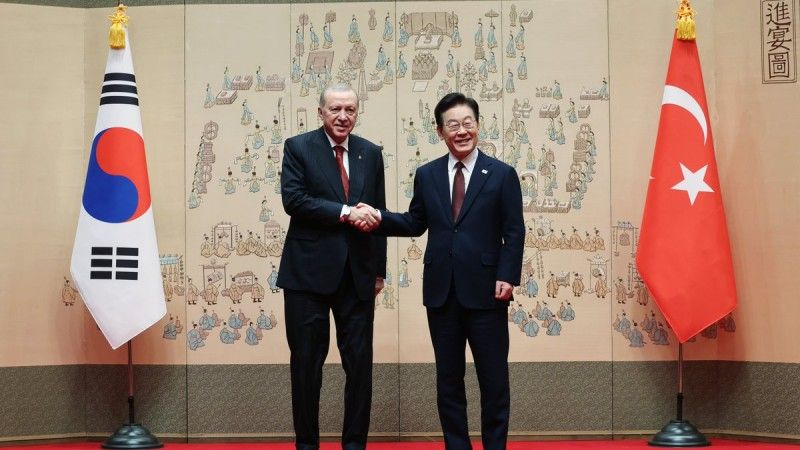
The meeting between Presidents Recep Tayyip Erdoğan and Lee Jae-myung in Seoul demonstrated that Ankara and Seoul have no intention of limiting themselves to existing programmes. Importantly, South Korea is also strengthening its cooperation with NATO, having participated as a partner country in the Alliance’s July summit in Ankara.
On 2–4 November 2026, Turkish President Recep Tayyip Erdoğan visited South Korea, where discussions focused on military, energy, technological and economic cooperation. Both countries intend to expand joint weapons production, technology transfers and exports to third countries. Agreements were also signed concerning energy, natural resources and emerging technologies, while bilateral trade is expected to increase from approximately $11 billion to $15 billion.

It is no coincidence that the defence industry was among the most important subjects discussed. South Korea is one of the world’s fastest-growing arms exporters, producing systems, including the K2 main battle tank, K9 self-propelled howitzer and K239 Chunmoo multiple rocket launcher, while also developing the KF-21 fighter aircraft. Türkiye, meanwhile, continues to expand its domestic capabilities in unmanned systems, missiles, armoured vehicles, warships and aviation, including the KAAN fighter programme.
Tanks, artillery and warships
It is worth emphasising that Turkish-South Korean cooperation did not begin with the latest presidential meeting. As early as 2001, the two countries began cooperating on the T-155 Fırtına self-propelled howitzer, which uses technology developed for South Korea’s K9 Thunder. Another important project was Türkiye’s Altay main battle tank, developed with the support of South Korean expertise and technology.
Interestingly, the first 85 production Altay tanks are expected to receive South Korean powerpacks, including DV27K engines and EST15K transmissions. This demonstrates that even a country investing as heavily in its domestic defence industry as Türkiye continues to rely on foreign technology for some of its most important weapons programmes. However, this does not mean abandoning domestic solutions, as Ankara is simultaneously developing its own BATU powerpack.

Cooperation is already expanding into additional areas. In September 2026, a letter of intent concerning military shipbuilding cooperation was signed, while South Korean company Kencoa Aerospace secured a contract to supply 34 types of structural components for 27 HÜRJET aircraft. This is particularly important because both countries have well-developed naval and aerospace industries, whereas previous cooperation was largely concentrated on land-based systems.
Nevertheless, political declarations should not be confused with signed contracts. The Seoul meeting did not produce an announcement of a joint missile programme or a new jointly developed warship. It did, however, demonstrate that both countries want to move beyond supplying components and transferring technology towards developing new weapons systems together and subsequently offering them to international customers.
Türkiye in NATO, South Korea moving closer to the Alliance
Another important element is cooperation with NATO. Türkiye has been a member of the Alliance since 1952, while South Korea is one of NATO’s four Indo-Pacific partners. Importantly, President Lee Jae-myung participated in the NATO summit in Ankara on 7–8 July 2026, where discussions included European and Asian security and the development of cooperation with partner countries.
South Korea also maintains extensive military cooperation with the United States, while Türkiye possesses one of NATO’s largest armed forces. Both countries have experience in producing military equipment on a large scale, developing domestic technologies and adapting weapons systems to the requirements of international customers. At the same time, they can not only cooperate but also compete in the same markets, including Europe, Asia and the Middle East.
It is also worth recalling that relations between the two countries have a much longer history. During the Korean War, Türkiye deployed more than 21,000 military personnel in total to fight alongside South Korean and United Nations forces. In 2027, the two countries will mark the 70th anniversary of establishing diplomatic relations, while defence industrial cooperation could become one of the most important elements of their future relationship.

South Korea and Türkiye are two countries whose defence industries should not be underestimated. Just over a decade ago, many of their programmes remained dependent on foreign technology, whereas today both countries manufacture an increasing range of domestic weapons, develop new systems and compete for contracts against the world’s largest defence manufacturers. Moreover, their capabilities could grow significantly in the coming years, particularly if they decide to combine their technological expertise, financial resources and production capacities.
For now, Ankara and Seoul have already cooperated on tanks, artillery and aviation, while taking their first steps towards closer cooperation in naval construction. However, Türkiye is developing missile systems and unmanned platforms, while South Korea possesses advanced missile, electronic and aerospace technologies. Both countries could therefore move far beyond their existing industrial relationship in the coming years.
Could two such highly developed defence industries eventually join forces to develop a new long-range missile, a new generation of drones or an entirely different weapons system, which they could subsequently offer to NATO countries and customers around the world?