


- WIADOMOŚCI
- KOMENTARZ
Ambitious plans and the need for follow-up. Aftermath of Donald Tusk’s visit to India

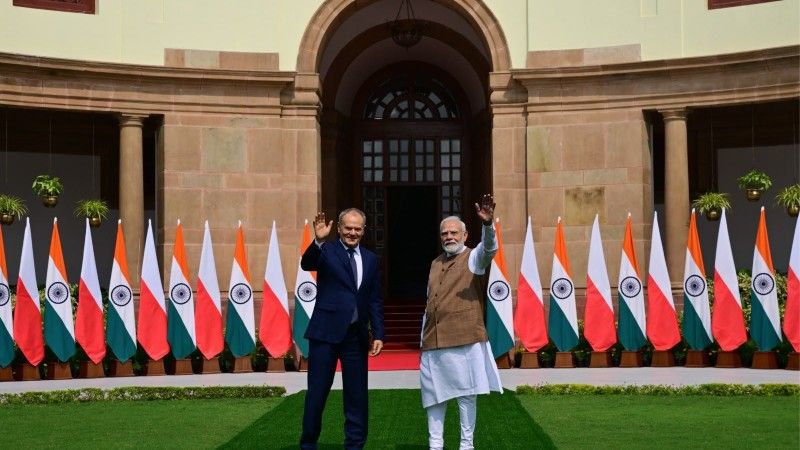
The October visit of Donald Tusk to India appears promising, particularly in the areas of technological cooperation and the defence sector.
It was the first visit by a Polish Prime Minister to India in 16 years. Tusk had also visited the country in 2010, but at that time both Poland and India were in entirely different places. Today, Poland aspires to join the G20, while India is increasingly spoken of as soon becoming the world’s third major power. “The world looks upon us with envy, at how India is developing and at Poland’s development,” Donald Tusk said during his meeting with Indian Prime Minister Narendra Modi.
The main topics of discussion were economic cooperation, with particular emphasis on the latest technologies and the defence sector. Both prime ministers announced that bilateral trade is to double by 2030, reaching USD 12 billion. Later, in remarks to the media, the Polish Prime Minister stated that even a tripling of trade – to USD 18 billion annually – is possible. Two Polish-Indian business forums, held in Delhi and Bengaluru, were also impressive: several hundred businesspeople from both sides met and signed more than a dozen MoUs. Poland and India are counting on the EU–India Free Trade Agreement, which is expected to be signed by the end of this year, to serve as a major instrument for developing economic relations. It will create entirely new conditions for trade.

Political issues were not the most important, although they were also raised. Poland supported UN reform in line with India’s plans, while India backed Poland’s membership in the G20. The Russian aggression against Ukraine was also mentioned – both sides expressed deepest concern over the war raging in Ukraine – as was the situation in Jammu and Kashmir, with both sides condemning in the strongest terms the terrorist attack in Pahalgam. Poland also joined the India-led Coalition for Disaster Resilient Infrastructure.
The visit represented a further step in the development of defence cooperation. Tusk emphasised that the Polish company WB Group is already present on the Indian market and operates there with considerable success, one example being the use of Polish weaponry in Operation Sindoor. The two sides agreed on more frequent contacts between working groups on armaments. Cooperation in cybersecurity, defence innovation and critical/emerging technologies was also underlined, and both sides expressed hope for the swift signing of an Agreement on Mutual Protection and Exchange of Classified Information.
The space sector was recognised by both sides as an area with strong development potential. Tusk visited Bengaluru together with representatives of the Polish Space Agency and companies from the sector (including ICEYE).

Much else also took place on the margins of the visit. The Łukasiewicz Research Network signed a letter of intent with the leading Indian institute IIT Madras and held talks with other research and development centres. A Polish-Indian Hub was established at the prestigious Jawaharlal Nehru University in Delhi, thanks to cooperation with the Faculty of Political Science and International Studies of the University of Warsaw and ITECH.
The visit was a success because it gave a clear impetus to the development of cooperation in sectors that had not previously been at the centre of Polish-Indian relations. The most important question now is whether the arrangements made during the visit will be followed up. On this depends whether the visit proves to be a real success. Doubling or even tripling bilateral trade is possible, but only with active state support – the same applies to cooperation in the field of technology. If there is no follow-up, the visit will be just one of many of its kind. If there is follow-up, the visit will prove to be a milestone.


