- WIADOMOŚCI
- ANALIZA
French troops secretly operating in Ukraine? Poland at the centre of Mission Volia

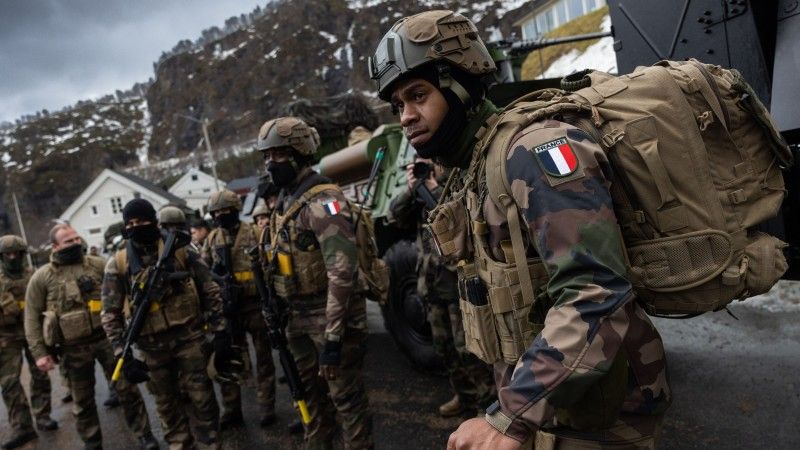
French soldiers have reportedly been operating on Ukrainian territory since at least summer 2026. According to Radio France Internationale (RFI), they are training Ukrainian military personnel and maintaining equipment supplied by Paris. These activities are being conducted under a confidential mission known as Volia, while an officially recognised French training mission operating in Poland is allegedly being used to conceal the presence of French troops in Ukraine. This marks another stage in France’s growing involvement in supporting Ukraine. It also confirms Poland’s importance as Kyiv’s principal training and logistical hub. Moreover, it demonstrates just how much Emmanuel Macron’s policy towards Russia has changed.
Mission Volia is commanded by a French general and consists of small groups of soldiers deployed to Ukraine for relatively short periods. Their responsibilities primarily include training and maintaining French military equipment, including Caesar self-propelled howitzers, Mirage 2000 aircraft and other advanced systems (France has not disclosed the full range of weapons it has supplied to Ukraine). The objective is not to participate directly in combat against Russian forces, but to support the Ukrainian army on its own territory. Interestingly, the Élysée Palace has not officially confirmed the existence of such a mission, and the information presented remains based on the findings of French journalists.
The Polish dimension is particularly interesting. According to RFI, Mission Gerfaut, which has operated in Poland since February 2023 under the EU Military Assistance Mission for Ukraine (EUMAM Ukraine), is allegedly being used to conceal the presence of French personnel in Ukraine. French soldiers have been training Ukrainians at Polish military training grounds for years, including in Wędrzyn. Personnel deployed to Ukrainian territory were reportedly instructed to state officially that they were travelling to Poland. However, it remains unclear whether the Polish authorities were informed about these activities or what the actual relationship between the two missions involved.
Poland remains one of the most important countries supporting Ukraine, not only through weapons deliveries but also by training its armed forces. As we reported on Defence24.com, more than 100,000 Ukrainian soldiers have already been trained under EUMAM, with nearly 25,000 receiving their training in Poland. French personnel also use Polish infrastructure to prepare Ukrainian soldiers. There is also Rzeszów-Jasionka Airport, which remains the principal transit hub for Western military assistance to Kyiv.
In recent years, alternative transit hubs have also been developed, including routes through Romania. However, this has not changed Poland’s central importance. The main route for transporting Western weapons still runs through Polish territory, while Polish military training grounds continue to prepare thousands of Ukrainian soldiers. This must be emphasised once again: Poland has the necessary infrastructure, experience and geographical location, none of which can simply be transferred to another country.
France recognises the potential
It should also be emphasised that military training cooperation benefits both sides. Ukrainians gain access to French weapons, instructors and specialist training. The French, meanwhile, acquire something that even the most extensive military exercises cannot provide: direct knowledge of the modern battlefield.
Ukrainian soldiers share their experience of using drones, electronic warfare, artillery, communications systems and tactics employed against Russian forces. The French Ministry of the Armed Forces has itself emphasised the importance of these lessons. Paris is not merely helping Kyiv; it is simultaneously preparing its own armed forces for future conflicts by drawing on the knowledge of soldiers who fight Russia every day.
Nor should we overlook the enormous change in Emmanuel Macron’s position. In 2022, the French president emphasised the need for dialogue with Moscow and argued that Russia should not be humiliated. At that time, it was difficult to imagine France becoming one of the leading advocates of deploying Western troops to Ukraine.
However, in February 2024, Macron refused to rule out such a possibility, and in subsequent years Paris became increasingly involved in preparations for a potential multinational military presence following the end of hostilities. If RFI’s reports are confirmed, it will mean that French military personnel are already carrying out missions on Ukrainian territory, although they are not participating directly in combat.

The issue also has a domestic dimension. One might even say that a political „scandal” is emerging in France. The French Parliament was not informed about Mission Volia. Senator Cédric Perrin, chairman of the Senate’s Committee on Foreign Affairs, Defence and the Armed Forces, drew attention to the constitutional obligations associated with deploying French soldiers abroad.
The mere existence of a confidential mission does not automatically constitute a violation of the constitution. Nevertheless, a fundamental question arises: on what legal basis would French military personnel be operating on the territory of a country engaged in a full-scale war, and why were parliamentarians not informed?
Moreover, on 9 November, the Council of the European Union extended EUMAM’s mandate until November 2028, allocating nearly €300 million for the following two years. It was also decided to establish a mission presence in Ukraine to coordinate activities with the Ukrainian military authorities and international partners.
This does not confirm the existence of Mission Volia, nor does it authorise European soldiers to participate in combat. However, it demonstrates that European military involvement in supporting Ukraine is taking on new forms.
More foreign troops in Ukraine?
Preparations are also continuing for the possible deployment of multinational forces to Ukraine following the end of hostilities. From 9 to 22 November, Exercise KOALICJA 26.2 is taking place in Poland, involving approximately 2,800 military personnel. The exercise, conducted with significant French and British involvement, is intended to test the ability of the Multinational Force – Ukraine to deploy, protect and sustain its forces in the event of a ceasefire.

I believe the period following winter 2026–2027 will be crucial. France will hold its presidential election in the spring, and Macron’s second term will end in May. His successor will inherit France’s commitments to Ukraine, but also responsibility for decisions concerning the possible deployment of French troops.
There is no guarantee that the next president will continue Paris’s current policy. This is particularly important because France’s further involvement could extend beyond training and technical support to include participation in multinational forces stationed in Ukraine following a cessation of hostilities.
France: From evolution to revolution
France has come a long way from Macron’s appeals for dialogue with Moscow to preparations for a military presence in Ukraine and, according to French journalists, the conduct of confidential training and military activities on Ukrainian territory. This is the France that Europe needed.
The most important question, however, concerns the future. Will France maintain such extensive involvement in Ukraine after the 2027 presidential election? Will the next president decide to deploy French soldiers as part of a multinational force if a ceasefire is reached? And will European countries that are currently training Ukrainian personnel and supplying weapons be prepared to take responsibility for Ukraine’s security after the fighting ends?
See also 

Macron has taken French policy towards Ukraine to a point that few would have anticipated just a few years ago. It remains to be seen whether this represents a lasting transformation of French policy or primarily Macron’s own political approach. If we want to maintain channels of communication, expand training cooperation and establish long-term arrangements, military relations must be strengthened as much as possible over the coming months.
For now, France has taken an exceptionally bold step by reportedly sending its military personnel into Ukraine, virtually without anyone knowing. This deserves praise, but the crucial question is whether the French public and parts of the political establishment share that view and will continue supporting Ukraine in the months ahead.