












- ANALIZA
- WIADOMOŚCI
Russian military presence in the Arctic: interests, infrastructure and capabilities [PART 1]


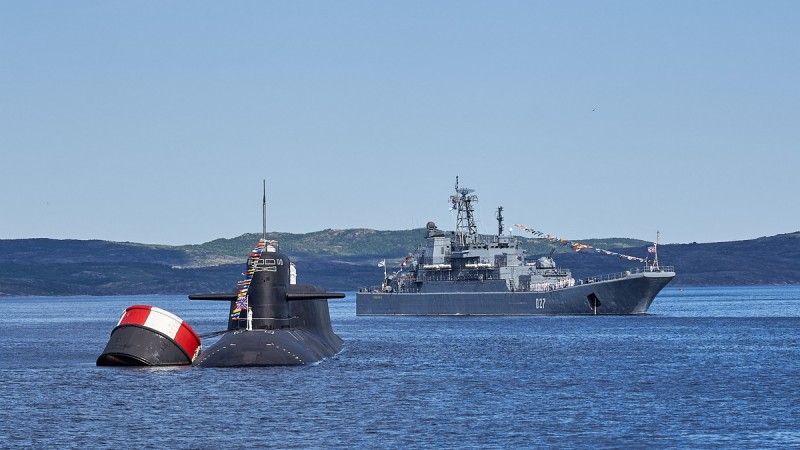
Photo. mil.ru
Melting ice is turning the Arctic into an arena of competition. Moscow has been building military superiority there for years. The Chinese presence is also growing. Is the Alliance ready for the escalating confrontation in the High North?
For decades, the Arctic was considered a region of relatively low potential for conflict. However, the melting ice cover is revealing not only significant raw material resources but also new shipping routes – such as the Northern Sea Route – thereby increasing the strategic importance of this area. It is no wonder, then, that the Arctic is gradually transforming into a space of competition between the Russian Federation and NATO – as well as other countries such as China. Russia has shown immense interest in the Arctic for decades. Europe, including Poland, has only been paying closer attention to this region for several years.
Russia is constantly strengthening its Arctic military presence, aiming to secure northern territories, develop the region economically, and maintain nuclear deterrence capabilities. In the last decade, this has included the reconstruction of former bases, the deployment of air defence systems, the development of reconnaissance capabilities, and an increase in the number of patrols and exercises. For years, the country has also been testing equipment adapted to polar conditions in the Arctic and regularly conducts exercises aimed at maintaining operational capabilities in extreme climates.
These actions have met with a response from the United States and NATO countries – particularly Sweden and Finland, which brought significant Arctic capabilities to the Alliance. Growing military activity on both sides, combined with China’s military expansion and tightening Russo-Chinese cooperation, is accelerating the transformation of the Arctic into one of the primary fields of global competition. Consequently, an armed conflict in the Arctic region – though still far from actual materialisation – is becoming an increasingly likely scenario.
Although from a Polish perspective the Arctic is still sometimes perceived as a peripheral area, for Russia this region is of fundamental importance – and awareness of its strategic weight is also gradually growing in Warsaw. The Arctic is a region of colliding interests – from security issues to raw materials, sea routes, military exercises, and the construction of bases – elements on which Russia largely bases its economy and power projection. Therefore, an analysis of the Arctic is fundamental for both current and future assessments of international trends. Without a doubt, the Arctic constitutes an element of the redefinition of the military engagement of individual NATO states, particularly the Nordic countries such as Sweden, Finland, Norway, and Denmark, as well as a specific point on the world map for Russia. The remainder of the analysis is devoted to these issues.

The Kremlin's Arctic interests
The Arctic represents one of the key areas of activity for the Russian Federation, in terms of economic, geographical, and demographic factors alike. Its dependent territory covers a vast belt of northern regions, archipelagos, and Arctic Ocean coasts exceeding 24,000 kilometres in length. Russia controls approximately 53% of the Arctic coastline, and about 2.5 million people live in its Arctic areas, accounting for nearly half of the region’s entire population. The scale of Moscow’s involvement in this area makes the Arctic one of the primary directions of foreign policy, serving primarily as a resource base and a space for economic development. The extraction of oil and natural gas, as well as the development of the Northern Sea Route as a major transport route, are of key importance.
The Northern Sea Route is approximately 3,500 miles long and can significantly shorten transport time between Asia and Europe – by as much as 15 days compared to the route through the Suez Canal, which in the long term could change virtually the entire structure of global trade. Additionally, the location of the Northern Fleet provides Russia with direct access to the Barents Sea, the Norwegian Sea, and the Atlantic, making it one of Russia’s most important instruments for power projection and economic potential. The functioning of the Northern Fleet depends on the expansion of the icebreaker fleet, of which Russia currently possesses about 50, including nuclear-powered units. Russia plans to build further icebreakers, such as the „Stalingrad”, which is scheduled for completion by 2030. Besides this, the country is investing tens of billions of dollars in port, logistics, and satellite infrastructure.
Regarding economic considerations, the Arctic accounts for about 30% of Russia’s GDP growth and is the source of approximately 80% of Russian gas extraction and about 17% of its oil. In practice, this means that without the Arctic, maintaining Russia’s current economic structure would be impossible. The „Vostok Oil” project and the liquefied natural gas (LNG) plant on the Yamal Peninsula are of particular importance.
Russia also views the Arctic as an arena for competition with NATO forces, and even as a site for potential armed conflict. Russian fears are raised by the increase in the military presence of the US and other Arctic countries in the region, as well as the potential deployment of weapons in the North capable of intercepting Russian ballistic missiles and conducting a preemptive strike.

Russian Arctic infrastructure and combat capabilities
By strengthening its military presence, Russia is focusing, among other things, on modernising the Northern Fleet and expanding infrastructure. In the last decade, a series of military installations have been restored or created – from the Kola Peninsula to Chukotka – including bases such as Nagurskoye and airfields in the New Siberian Islands. These actions should be seen as an attempt to maintain control over the northern direction and secure access to key waters.
For over a decade, Russia has been developing an extensive military infrastructure in the Arctic, based on the Northern Fleet and its cooperating naval, land, air, and air defence components. A network of forward bases located along the northern coast is of key importance, including facilities on Kotelny Island, Alexandra Land, and in Rogachevo, which form a system based on radars, air defence, and coastal security. These are supplemented by installations on Wrangel Island, Cape Schmidt, and in Tiksi, responsible for surveillance and early warning. The entire structure serves to maintain control over northern directions and secure the operation of submarines, which constitute a significant element of nuclear deterrence. At the same time, a slowdown in the development of some capabilities and a reduction in available forces have been visible since 2022, resulting from the commitment of equipment and units outside the region.
The Northern Fleet is a key element of the Russian security system in the Arctic, primarily responsible for protecting military infrastructure on the Kola Peninsula and securing the maritime component of nuclear deterrence. Simultaneously, its deployment allows Russia to demonstrate power specifically towards the „GIUK Gap” – the stretch between Greenland, Iceland, and the United Kingdom – a key area connecting the Atlantic with Europe, which in a crisis situation could enable the disruption of NATO’s main communication routes between North America and Europe. The Russian fleet also performs a surveillance function over the Northern Sea Route, combining military operations with the control of transport routes.

This development of forward military facilities, exemplified by the Ushakovskoye base on Wrangel Island located in the immediate vicinity of Alaska, is important in the context of US-Russia relations. It houses, among other things, a Sopka-2 radar capable of monitoring airspace for approximately 400 km, performing an early warning and surveillance function over traffic in the Bering Strait region. The expansion of infrastructure, including the runway, logistics facilities, and communication installations, highlights the growing importance of this area to Russia. Currently, it primarily allows for the monitoring of United States activity in the region.
The expansion of the runway at the Temp base on Kotelny Island is also significant; it is adapted to receive most types of military aircraft, including bombers capable of carrying nuclear weapons. The new infrastructure, which also includes landing approach systems and technical facilities, significantly increases the pace of aviation redeployment and response capabilities along the Northern Sea Route. The base is simultaneously equipped with air defence and surveillance systems, allowing for both civilian and military operations.
Russian military objectives and capabilities
The Kremlin’s primary military objective is to secure key economic megaprojects and protect the country’s gradually exposed northern coastline, which constitutes an essential pillar of Russian defence strategy against a potential conflict with NATO. For these reasons, Russia constantly strives to expand military infrastructure in the region to strengthen its operational readiness. Russia’s military bases are primarily concentrated in the Murmansk region; however, the scope of these capabilities is gradually broadening and moving more clearly further north. At the same time, the expansion of NATO to include Finland and Sweden has increased Moscow’s concerns regarding the restriction of freedom of action in the Atlantic direction, as the North Pole is the shortest route for the potential use of missiles or bombers against the United States.
A special place in Russian strategy is held by maintaining „second-strike capability”. This is because all elements of the Russian nuclear triad are located in the region, including strategic submarines, land-based missile systems, and long-range aviation, particularly around the Kola Peninsula.

The Kola Peninsula remains the main base for Russian Borei-class and Antey-class strategic submarines, capable of carrying intercontinental ballistic missiles and forming the core of the naval component of the Russian nuclear triad. Russia may also use the pretext of protecting its nuclear assets to initiate limited regional escalations, such as armed incidents in Norway or Finland. Additionally, precision long-range strikes are possible against high-value targets for NATO countries, such as Norwegian F-35 fighter jets and the infrastructure necessary for their maintenance, including command centres, radar systems, and bases supporting naval capabilities and anti-submarine warfare aircraft, such as the P-8 Poseidon.
Look out for part 2 of the analysis which will be published on Tuesday


