











- WIADOMOŚCI
- ANALIZA
Turkish F-16s in Somalia. Ankara is emerging as a major power in Africa


Photo. Jerry Gunner/flickr/CC BY 2.0
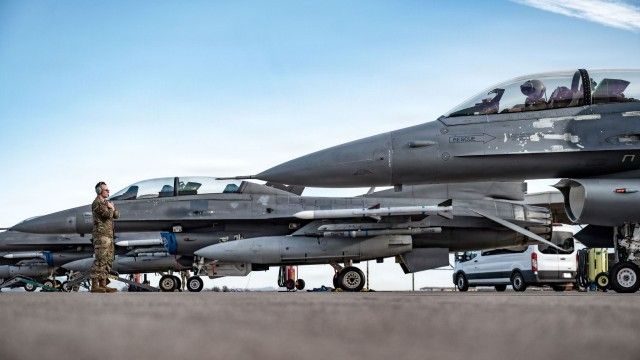
Turkish F-16s have completed a rotation between Somalia and Türkiye, covering more than 11,000 kilometres in two non-stop flights. Ankara is demonstrating its ability to sustain combat aircraft thousands of kilometres from its own territory. At the same time, Türkiye is training troops in the Sahel, selling weapons, deploying warships, exploring for oil and strengthening its economic position across the continent. Behind the scenes, it is building its capabilities.
On 17 November 2026, the Turkish Ministry of National Defence announced the completion of a rotation of F-16 fighters stationed in Somalia. Pilots from the 161st Fighter Squadron covered a total of 11,038 kilometres in two flights between Mogadishu and Bandırma, supported by aerial refuelling. The entire operation lasted 55 hours.

The first three Turkish F-16s arrived in Somalia on 28 January 2026. Türkiye also operates T129 ATAK attack helicopters, transport helicopters and unmanned aerial vehicles in the country. At the end of October, Ankara deployed two frigates, TCG Gökçeada and TCG Yıldırım, to support its mission in Somalia.
On 21 July 2026, the Turkish parliament extended the military mandate in Somalia for another two years. Turkish forces will therefore remain in the country until at least July 2028. Interestingly, on 12 November, the Turkish Ministry of National Defence denied reports of plans to deploy as many as 15,000 troops to Somalia. I think it needs to be stated explicitly: Türkiye has its own military base in Africa, and it is located in Somalia.
Beyond the Horn of Africa. Türkiye is moving into the Sahel
As I have pointed out in previous analyses, Türkiye is rapidly expanding military cooperation with the Sahel countries, particularly Niger, Mali and Burkina Faso. The Turks are not limiting themselves to selling Bayraktar TB2 and Akıncı drones. They are also training their operators and providing technical support.
In April 2026, the defence ministers of Türkiye and Niger signed an agreement on conducting military training directly on Nigerien territory. Previously, African military personnel primarily travelled to Türkiye for training. Now, Türkiye is increasingly sending its instructors to Africa.

In November, the activities of former Turkish SAT naval commandos were also confirmed. Operating through the private company Equipped Tactical Academy, they are training Malian special forces. Meanwhile, on 9–13 November, the BAMEX 2026 defence industry exhibition, co-organised by Turkish partners, took place in Bamako.
Another particularly interesting aspect is the private military company SADAT, whose activities have long been associated with the expansion of Turkish influence in Africa. Its involvement in Niger and Mali is another element of Turkish activity that cannot be ignored, although the Turks themselves are reluctant to discuss SADAT’s presence in Africa.
Türkiye is clearly making use of its armed forces, private military companies and domestic defence industry. It does not need to establish military bases to expand its influence.
Turkish Airlines, oil and a spaceport
When analysing Türkiye’s presence in Africa, it is impossible to overlook the phenomenal growth of Turkish Airlines. According to the carrier’s figures at the end of the third quarter of 2026, its network covers as many as 65 destinations in Africa. In this respect, Africa ranks second only to Europe.
Turkish Airlines operates flights to Bamako, Niamey, Ouagadougou, Mogadishu, N’Djamena, Tripoli and Juba, among other destinations. Istanbul has become one of the most important transit hubs for passengers travelling between Africa, Europe and Asia. This represents enormous economic, diplomatic and logistical potential, which Ankara is consistently exploiting.
In April 2026, Türkiye began exploring for oil in Somali waters, deploying its drilling vessel Çağrı Bey. This is the first Turkish undertaking of its kind outside its own waters. At the same time, Ankara is developing a project to build a spaceport in Somalia.
In a single country, Türkiye is therefore developing a military base, sustaining combat aircraft, training the local armed forces, exploring for natural resources and investing in space technologies. And the choice of this country is no geographical coincidence. Somalia occupies an exceptional geographical position in the Horn of Africa, close to the Bab al-Mandab Strait.
It is time to recognise Türkiye as a major power in Africa
When analysing the involvement of foreign powers in Africa, I most frequently come across studies focusing on the United States, Russia, France and China. Today, we can state explicitly that Türkiye should also be recognised as one of the most important external powers on the continent.
A permanent military base in Somalia is one thing, but far more interesting is Ankara’s ability to operate simultaneously in the Horn of Africa, North Africa and the Sahel. Türkiye is developing cooperation both with countries maintaining close relations with the West and with those where Russia is present.
While France has lost much of its influence in the Sahel, the Americans have withdrawn from Niger, and the Russians are focusing primarily on military cooperation, Türkiye is operating on multiple levels simultaneously.
And that is precisely where its advantage lies. The Turks act pragmatically, talk to everyone and refrain from interfering in the domestic politics of their partners. If someone needs drones, they sell drones. If there is a need for economic or logistical cooperation, Ankara gets involved. And whenever an opportunity for military cooperation arises, the Turks are open to it. I believe Türkiye is only beginning to demonstrate its potential on the African continent.