- OPINIA
- KOMENTARZ
- ANALIZA
- WIADOMOŚCI
What the CIA director brought to Moscow


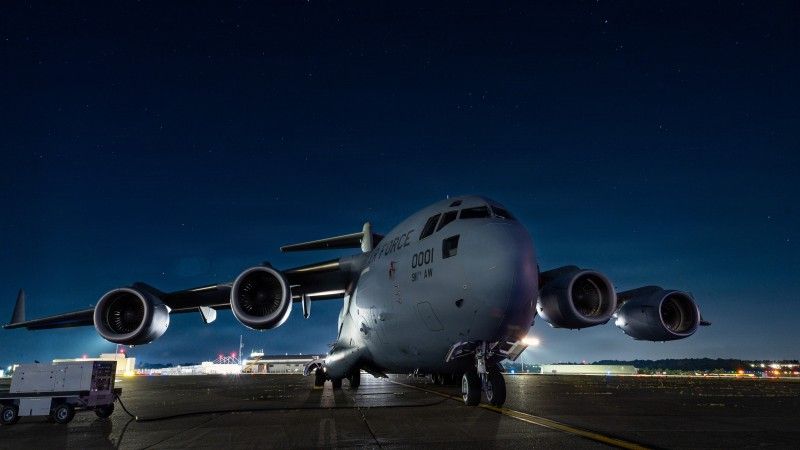
Photo. U.S. Air Force photo by Tech. Sgt. Timothy Leddick, Public Domain
An American military transport aircraft flying solo toward Russia’s decision-making centre sparked widespread international commentary—especially given reports that CIA Director John Lee Ratcliffe was on board.
A visit by an American delegation to Moscow should not, in principle, be viewed as extraordinary. First and foremost, regardless of the current state of bilateral relations, these are major powers that will always communicate through various tools and formats, both bilateral and multilateral. However, several indicators related to the CIA Director’s visit (presumably accompanied by advisers) underscore its significance and warrant a broader perspective.
See also 

The first indicator is the aura of mystery crafted by both sides—a deliberate manoeuvre in a modern landscape dominated by “controlled leaks.” The more terse the official statements and comments are, the more both parties imply that matters of strategic importance were discussed. Regarding the agenda, analysis remains largely speculative and sensational, fuelled—intentionally or otherwise—primarily by social media. At present, we can assume that bilateral dynamics point to the possible consideration of several key areas:
- The situation regarding the war in Ukraine, including U.S. support for negotiations between the warring parties. Alongside the Department of State and special envoys, the CIA must be engaged, particularly given the broad array of state actors directly or indirectly involved in similar global discussions (such as in the Middle East). The U.S. President and his administration frequently rotate the diplomatic mechanisms used to engage key global powers; they may have determined that direct contact with Russian intelligence services offered the most effective channel to the Kremlin. This aligns with modern decision-making dynamics within Kremlin access architecture—particularly given Vladimir Putin's long-standing reliance on special services and their operational toolkits. A derivative topic within this domain could be the issue of a "new mobilisation." This term is used loosely, as analysts such as Jarosław Ciślak have noted in Defence24, since Russia's mobilisation system is a highly propagandised construct that has actually been operating continuously (see: “When will a mobilisation in Russia happen? It's been happening all along!”, July 15, 2026 Defence24 - article in Polish).
- U.S. military assistance to Ukraine, specifically intelligence support for operations conducted deep within Russian territory. The CIA remains a cornerstone asset of the U.S. Intelligence Community, and its Director—even following the establishment of the Office of the Director of National Intelligence (ODNI)—continues to play a critical role in international processes involving U.S. intelligence assets. Observers note that the U.S. has previously leveraged intelligence-sharing mechanisms to exert pressure in the public domain.
- The security architecture in Europe, particularly within NATO, is shaped by the U.S., which remains the critical guarantor of alliance commitments. In this context, the public identification of a stopover in Riga, Latvia, is notable. Given that the Baltic states have been evaluated in recent months as potential targets for Russian activities below—or bordering on—the threshold of armed conflict, concerns have emerged that U.S. officials were alerting Moscow to intelligence regarding potential provocations or direct tests of Article 5 of the North Atlantic Treaty. Latvia currently faces a particularly complex security environment due to its defence resources, geographic vulnerabilities, and internal dynamics surrounding its Russian-speaking minority.
- The situation in the Middle East, with a specific focus on Iran's foreign policy, its clandestine nuclear programme, threats to maritime navigation in the Strait of Hormuz, and strikes against Arab (or European) nations—as evidenced by the recent reinforcement of air defence assets on the Greek island of Crete following intelligence assessments (more on this at Defence24). Russia maintains working relations with Iran (though media depictions of this alignment are often oversimplified and warrant deeper analysis) and possesses established communication channels across Iran's fractured power centres.
- Potential Russian military posture globally. In recent days, U.S. forces were forced to recall a military aircraft en route to Antarctica, which returned to New Zealand after the Civil Aviation Authority of New Zealand (CAA) was notified by Russian air traffic authorities of a planned missile launch creating a "potential hazard to international airspace within the Auckland Oceanic Information Region (FIR)." This coincides with reported missile exercises in the Kuril Islands, as documented by Defence24.
- The drafting or finalisation of high-profile intelligence asset and hostage exchanges. Moscow has increasingly adopted the practice of detaining non-intelligence personnel to build leverage for bilateral exchanges or negotiations involving third parties.
- Issues regarding Weapons of Mass Destruction (WMD), specifically nuclear and chemical capabilities. Russia has consistently used its WMD arsenal as a strategic lever to obfuscate core vulnerabilities within its state apparatus and armed forces. Given that U.S. intelligence rigorously monitors Russian WMD developments, the CIA's direct involvement in these discussions is a plausible way to bypass standard diplomatic formalities.

A second defining element of this visit is the choice of transport. Deploying a U.S. military aircraft (such as the C-17 Globemaster III) into Russian airspace sends an unmistakable signal about the gravity of the situation. A military transport of this scale over Moscow would inevitably be spotted and recorded by civilians, leading directly to video documentation online even within an authoritarian state like Russia.
Had the CIA or the U.S. administration wished to conduct these talks covertly, they could have utilised low-profile, non-standard aircraft that are significantly harder to track or observe during landing. Instead, both sides permitted public visibility; indeed, the U.S. side likely intended to amplify the message by generating international discussion around the appearance of a C-17 in Russia. Intelligence services have long functioned as an indispensable tool of statecraft, providing reliable channels of communication between adversaries and combatants alike. They offer operational anonymity, allowing states to maintain plausible deniability while transmitting high-level political signals. Working-level intelligence visits are typically masked or conducted at lower organisational tiers to avoid unnecessary fallout, often occurring in third-party countries.

However, direct engagement by agency directors signifies extraordinary stakes. In Europe, the CIA and the UK’s MI6 performed monumental work ahead of the 2022 full-scale invasion of Ukraine, alerting allies to Russia’s intent when several European intelligence services assessed the threat differently based on their own rationales. Consequently, the recent high-level contact naturally raises concerns among European partners about potential escalation between Russia and NATO, a scenario increasingly cited in European intelligence circles.
Broadly speaking, one primary objective of such high-level contact is pre-emptive warning: informing an adversary that their plans lack the element of surprise to deter strategic miscalculations, including the deployment of specific military, intelligence, or WMD assets. While intelligence agencies typically guard their insights for internal decision-makers and close allies, circumstances occasionally demand a selective disclosure of intelligence directly to an adversary to prevent uncontrolled escalation.
Similar methods were employed during Cold War crises, notably surrounding Soviet anxieties during Operation RYAN. The most-cited precedent remains former CIA Director William Burns’s trip to Moscow in late 2021 to convey warnings directly to Vladimir Putin about Ukraine. High-level representation serves a dual purpose: it underscores the gravity of the message while ensuring that sensitive intelligence sources are not compromised during interactions with foreign counterintelligence.

Providing an adversary with specific warnings inevitably prompts them to evaluate their operational security and identify potential intelligence leaks. Moscow is fully aware that its operations are actively targeted by U.S. signals intelligence (SIGINT), human intelligence (HUMINT), and imagery intelligence (IMINT) assets. Consequently, any shared intelligence forces the CIA leadership to weigh the deterrence value against the risk of revealing collection capabilities or exposing human sources.
Both sides intentionally selected a direct intelligence channel to convey critical signals while avoiding public diplomatic leaks. Any media leaks surrounding the visit should likely be viewed as part of an operational narrative linked to the event. For instance, online commentary on the “removal of U.S. and EU flags” in Moscow highlights how Russian channels may leverage the event to reinforce broader narratives that stoke fears of a wider conflict. While monitoring these developments is essential, it is equally important to avoid alarmist conclusions or simplified geopolitical interpretations.

Ultimately, an effective intelligence capability requires more than multi-source data collection and analysis—it demands the infrastructure to communicate reliably with allies, partners, and adversaries alike. Maintaining secure, adaptable communication channels during international crises remains a fundamental pillar of national defence, requiring agency leaders to possess the diplomatic weight and strategic discipline necessary to conduct high-stakes exchanges with formidable interlocutors while managing the surrounding information environment.
There is one additional element that significantly raises the importance of Ratcliffe’s visit. According to U.S. media reports, Washington informed Ukraine in advance that a senior American delegation would be travelling to Moscow and asked Kyiv to suspend strikes until the delegation had left Russia. Such operational deconfliction would hardly be necessary for a routine working-level intelligence meeting. It suggests that the U.S. administration regarded the visit as sufficiently important—and potentially sensitive—to temporarily factor it into the conduct of military operations in the wider theatre. At the same time, this does not reveal the substance of the talks, but it significantly narrows the range of plausible interpretations surrounding the journey.
It is also important to stress that Ratcliffe did not arrive in Moscow without an established channel of communication with the Russian intelligence leadership. In March 2025, he spoke directly with Sergei Naryshkin, Director of Russia’s Foreign Intelligence Service (SVR), with both sides indicating their intention to maintain contacts between the services. Ratcliffe was subsequently personally involved in negotiations that led to the April 2025 exchange of Ksenia Karelina for Arthur Petrov, with the CIA playing a central role in talks with Russian intelligence. The Moscow visit should therefore be understood not simply as the reopening of an intelligence channel, but as an escalation in the level and visibility of a channel that had already been functioning for more than a year.