












- ANALIZA
- WIADOMOŚCI
Capital returns to Syria: Reconstruction as an arena of competition and a potential opportunity for Poland

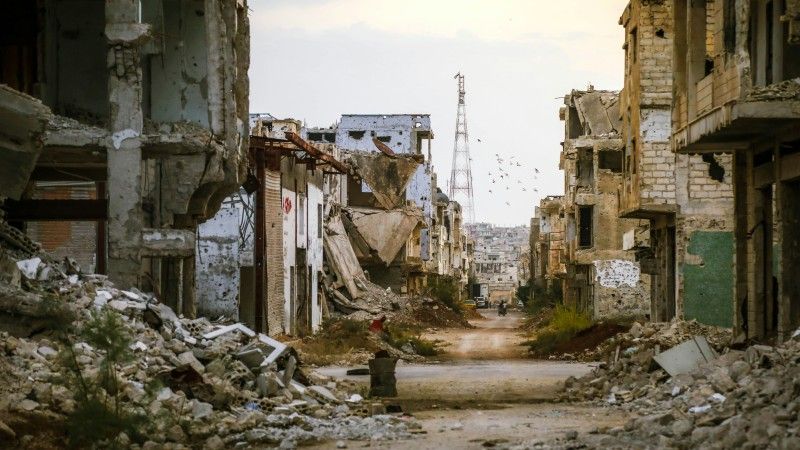
Capital is not returning to Syria because the country has already become safe. It is returning because positions in the reconstruction process are secured before risk has fully disappeared. France is returning to Damascus alongside representatives of major companies; Gulf states are announcing projects, mobilising financing and positioning themselves in key sectors, while international operators are securing long-term concessions to manage and develop Syrian port terminals.
Reconstruction is not merely an economic undertaking. It is also becoming an arena for competition over future transport routes, access to the Mediterranean and influence in a country situated between Iraq, Türkiye, Jordan and Lebanon. Syria may regain importance as a transit corridor linking the Gulf with Europe. Poland should not assume that it will be able to enter this market only after others have made it safe.
The actual scale of returning capital should not, however, be measured by the combined value of announced projects. The transition from declaration to investment can be assessed against four successive stages: the conclusion of a binding agreement, financial close, the start of implementation and the achievement of a measurable operational result — an increase in available power-system capacity, port throughput or the volume of cargo handled. According to these criteria, some projects remain at the declaration stage, while port investments have already entered the implementation phase.
The end of isolation does not mean the end of risk
For nearly 47 years, Syria remained on the US list of State Sponsors of Terrorism. The designation, imposed in 1979, was one of the longest-standing measures of its kind, but it should not be equated with a single, unchanged sanctions regime. Economic restrictions were expanded from 2004, tightened after the war began in 2011 and supplemented by another layer of restrictions through the Caesar Act of 2019.
The situation changed following the fall of Bashar al-Assad’s regime. The United States ended its comprehensive sanctions on Syria with effect from 1 July 2025. The Caesar Act was repealed on 18 December of the same year, when the President signed the National Defence Authorisation Act for Fiscal Year 2026. On 24 August 2026, Syria was formally removed from the list of State Sponsors of Terrorism. The European Union had already lifted most of its economic sanctions in May 2025.
This does not amount to full normalisation. The US Treasury’s Office of Foreign Assets Control continues to maintain targeted sanctions against, among others, members of Assad’s former circle, individuals responsible for human rights violations, Captagon traffickers, members of terrorist organisations and entities linked to Iran. Any company entering Syria must therefore continue to screen its counterparties, ownership structures and sources of capital.
Comprehensive restrictions no longer, in themselves, make most transactions involving Syria prohibited. Banks and insurers may nevertheless continue to apply enhanced caution. The lifting of sanctions does not eliminate political risk but changes its character: instead of facing a legal barrier covering almost the entire economy, companies must assess a specific counterparty, project and source of financing.

A market larger than the state's capacity
According to the World Bank, the cost of Syria’s reconstruction may amount to approximately $216 billion, within an estimated range of $140 billion to $345 billion. Direct damage to buildings and infrastructure was assessed at $108 billion, of which approximately $52 billion relates to infrastructure alone. Total reconstruction needs are almost ten times greater than Syria’s estimated nominal GDP in 2024. The Bank also notes that these figures are subject to considerable uncertainty.
The Syrian state cannot finance a programme of this scale on its own. Reconstruction will depend on capital from Gulf states, international institutions, export financing and public-private partnerships. Saudi Arabia and Qatar cleared Syria’s arrears to the International Development Association, enabling the resumption of financial cooperation with the World Bank. In June 2025, the Bank approved its first project in Syria in nearly four decades — a $146 million grant intended to support the reconstruction of the electricity sector.
The gap between Syria’s needs and the resources available means that the market is likely to develop unevenly. Priority will probably be given to projects that enable the rest of the economy to function: energy, water management, transport, ports, telecommunications and the banking system.
The electricity sector provides a useful example. Reuters, citing the Syrian Ministry of Energy, reported that two-thirds of the transmission grid had either been destroyed or required extensive repairs, estimated to cost $5.5 billion. Even the construction of new power plants will not produce the intended result if the electricity generated cannot be delivered to consumers.

France returns with its companies
Emmanuel Macron’s visit to Syria on 6–7 July 2026 was the first trip by the head of an EU member state to Damascus since the fall of Assad. The French President did not arrive solely to make a political gesture. He was accompanied by a business delegation that included the chief executives of TotalEnergies and CMA CGM.
At the French-Syrian business forum, Macron presented reconstruction as the first stage of a broader project. Syria could eventually become a regional logistics, energy and digital connectivity hub, linking the Gulf states with Europe and reducing some of the risks associated with dependence on the Strait of Hormuz. France identified energy, water management, transport, logistics, aviation and banking as potential areas of cooperation. It also announced the use of export-support instruments, including FASEP.
Paris is therefore not limiting itself to pursuing individual contracts. It is attempting to participate in the development of a model that brings together French companies, Gulf capital and Syrian infrastructure needs in larger projects. France possesses considerable knowledge of Syria, but it also carries the political burden associated with the legacy of the French mandate administration.
The security risk remains visible. During Macron’s visit, two explosions occurred near the hotel where he was staying. The French President did not cancel his subsequent meetings. The incident illustrates the logic of the current phase: foreign actors are not waiting for threats to disappear entirely but are attempting to build their positions while managing the remaining risk.
Gulf states position themselves
In July 2025, Saudi Arabia announced a package of investment projects in Syria with a declared value of $6.4 billion. The signing of 47 agreements was announced during the forum, including infrastructure and real-estate projects worth $2.93 billion and telecommunications and information-technology projects valued at approximately $1.07 billion. Representatives of more than one hundred companies attended the event.
Not all announced amounts represent capital that has already been deployed. Some projects remain dependent on further contracts, regulatory approval and the securing of financing. The memorandum signed with a consortium led by Qatar’s UCC Holding should be assessed in the same way. The plan, with a declared value of $7 billion, provides for gas-fired power plants with a combined capacity of 4 GW and a 1 GW solar power plant. Construction remains conditional on the conclusion of final agreements and financial close. According to the criteria established above, both packages therefore remain between political declaration and full implementation.
Port projects are more advanced. France’s CMA CGM secured a 30-year concession to manage and develop the container terminal at the Port of Latakia. The agreement provides for investments worth €230 million, including the construction of a new berth. The company has managed the terminal since 2009, and after the change of power the terms of the contract concluded under Assad were renegotiated.
The Port of Tartous is being developed by DP World of the United Arab Emirates. The 30-year concession provides for an investment of $800 million and follows a Build–Operate–Transfer model. It does not constitute a sale of the port or a transfer of sovereignty over its territory. The operator receives the rights and assumes the responsibilities associated with the port’s development and commercial operation within the scope defined by the agreement.
In this case, implementation has already moved beyond the declaration stage. By 17 August 2026, three new mobile harbour cranes had been delivered to Tartous. The project’s full effect will be measurable only through changes in port capacity, vessel turnaround times and cargo volumes.
Long-term concessions concerning the principal port terminals have been granted to CMA CGM in Latakia and DP World in Tartous. A sustained presence in a port may also provide an operator with greater insight into cargo flows and planned logistics projects.
See also 

An alternative to Hormuz, not a replacement
Syria’s importance is increasing amid pressure on maritime export routes. According to the US Energy Information Administration, an average of 20.9 million barrels per day of crude oil and petroleum products passed through the Strait of Hormuz in the first half of 2025, equivalent to approximately one-fifth of global petroleum liquids consumption. At the same time, attacks on shipping in the Red Sea reduced traffic through the Bab al-Mandeb Strait and the Suez Canal, forcing some carriers to use the longer route around Africa.
Against this background, the concept of a pipeline connecting Iraqi oilfields with the Syrian coast has re-emerged. According to Reuters, the project would follow the corridor of the former Kirkuk–Baniyas pipeline but would require the construction of almost entirely new infrastructure. The preliminary concept assumes a capacity of up to 2 million barrels per day. Sources involved in the project estimated that it would cost at least $15 billion and require approximately four years to build. These parameters are not final. The project remains at the feasibility-study stage, with Chevron, TI Capital and Qatar’s UCC Holding participating in the preparatory work.
This does not mean that the Gulf states have collectively decided to redirect their exports through Syria. Saudi Arabia and the UAE already have more accessible pipelines leading to the Red Sea and the Gulf of Oman respectively, while Asian states remain the main recipients of oil transported through Hormuz. A Syrian corridor would therefore supplement the existing system rather than replace the strait.
The project may be most significant for Iraq, whose exports remain particularly dependent on the Persian Gulf, and for supplies directed towards Europe. The planned infrastructure would be constructed in a state where Islamic State remains active and where energy installations have previously been targeted by sabotage. Security costs would therefore have to be incorporated into the project from the design and financing stages.
According to the criteria established earlier, the pipeline remains the project furthest from becoming operational: it has no final technical parameters, financial close or construction phase. Its current significance is primarily strategic, as it demonstrates how Syria’s location could be used in the future diversification of export routes.

Poland would not be starting from scratch
Polish experience in Arab markets is not merely a nostalgic reference to the communist era. An archival study by Poland’s General Directorate for National Roads and Motorways indicates that between 1974 and 1987 Dromex completed 84 major contracts in Libya, with a combined value at the time of approximately $830 million. The company built 3,400 kilometres of roads and 30 bridges and viaducts. In Iraq, it was responsible for a 145-kilometre section of Expressway No. 1, valued at nearly $300 million.
The overall scale of Polish activity was broader. As historian Przemysław Gasztold-Seń explains in his study „Orientalne saksy”, approximately 30,000–40,000 Poles worked each year in Africa and the Middle East during the 1970s and the first half of the 1980s, primarily in Arab states. Budimex reportedly built almost 5,000 kilometres of roads and motorways abroad, worth more than $1.7 billion. Data from the Polish Ministry of Foreign Affairs also indicate that approximately 150,000 Polish citizens worked in Libya during the 1970s and 1980s.
Not all of these contracts proceeded without difficulty. The archival accounts of the General Directorate describe delays, organisational mistakes and unsuccessful decisions. Dromex rebuilt the confidence of its Libyan client only after a difficult beginning. This history therefore provides both evidence of competence and a warning against entering a market without sufficient preparation and contractual safeguards.
Syria itself also bears a Polish imprint. A peer-reviewed study published by the Warsaw University of Technology describes the participation of Polish architects and urban planners in the design of the National Library in Damascus, development plans for Dummar, Douma, Adra and Hama, the sports complex in Latakia and the campus of Al-Baath University. Syrian students were educated in Poland in fields including architecture, civil engineering, medicine and agricultural sciences. The contacts established through academic cooperation represent potential relational capital, although their current condition requires renewed assessment.
Poland exercised neither colonial nor mandate rule in Syria or elsewhere in the Middle East. This represents a potential reputational asset, but not an automatic commercial advantage. History may facilitate dialogue, but it cannot replace financing, diplomatic presence or a competitive offer.

The cost of risk and the price of absence
Poland should not begin by independently financing major projects or attempting to compete directly with Gulf sovereign funds. Its initial objective should be to secure an option on the future market: identifying partners, joining consortia, participating in pilot projects and obtaining the qualifications required in subsequent procurement procedures.
A realistic model would involve Polish companies participating as technology suppliers, specialist contractors or partners to French and Gulf firms. Potential areas include the reconstruction of electricity networks, water management, roads and bridges, modular construction, equipment for public facilities and information and communications systems.
Entry into the market would require coordination between the government, economic diplomacy, Bank Gospodarstwa Krajowego and the Polish Export Credit Agency. BGK has instruments for financing foreign purchasers of Polish goods and services, while KUKE can provide cover for export credits, investments and certain categories of political risk. Applying these instruments in Syria would require an individual assessment of each project, counterparty, security package and country risk. Their effective use would depend on combining them within a coordinated strategy for entering the Syrian market.
Poland’s actual readiness to enter this market could be assessed against four indicators: the establishment of permanent monitoring of projects and counterparties, the identification of partners for joint consortia, the preparation of financing and insurance for a specific transaction and the award and execution of an initial pilot contract. Only the completion of these stages would mark a shift from declared interest to an actual economic presence.
Syria will not automatically become a gateway to the entire Middle East. It could, however, serve as a reference market for projects subsequently pursued in Iraq, the Levant and the Gulf states. In a region where investment decisions are based not only on price but also on relationships and previous performance, a successfully completed first contract also provides evidence of a company’s capabilities.
The question is therefore not whether Poland should immediately direct billions of dollars towards Syria. It is why it has not yet begun a coordinated assessment of a market in which other participants are already securing their future positions.
If Poland enters only once the level of risk has clearly declined, it may discover that the most attractive contracting and operating roles have already been taken by those that arrived earlier.
Author: Patryk Radke


