












- WIADOMOŚCI
Russia is looking for an anti-drone system. It shows how behind it is

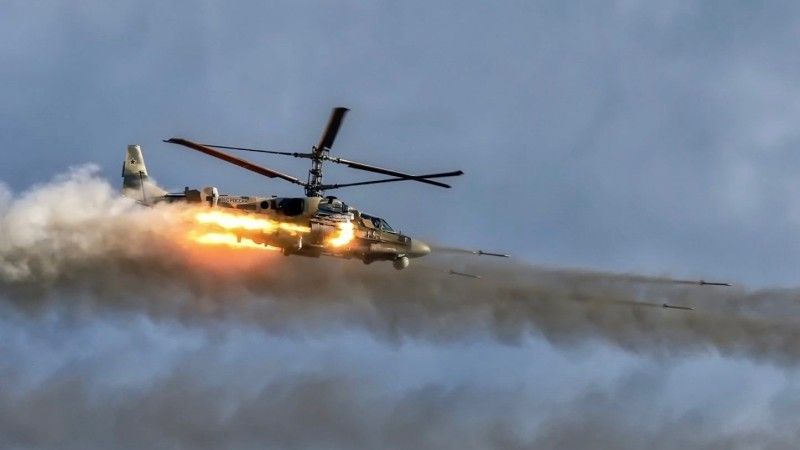
Russian development centre Zaslon JSC has proposed the creation of a light anti-drone system that, in principle, resembles the American APKWS and European FZ275 LGR systems. The idea of basing it on a low-cost unguided rocket is similar; however, the similarities end there.
The matter was reported by the Dead District channel on X. The proposed system, named Kochevnik, is based on the 80 mm S-8 unguided rocket modernised to the VT variant – an equivalent to the NATO 70 mm unguided rocket (commonly referred to as the Hydra).
The S-8VT is a modernisation of the Soviet-era S-8 unguided rocket from the Warsaw Pact period, created for the latest Russian attack helicopters – the Ka-52M, Mi-8AMTSH-V, and the naval Ka-29 – as well as ground-based launchers. It has been equipped with a high-explosive fragmentation (HE-FRAG) warhead with a programmable fuze, allowing it to destroy long-range one-way attack unmanned aerial vehicles (OWA UAVs) by striking them with a cone of fragments; thus, it does not require a direct hit.

The range is projected to be from 400 metres (minimum) to 4 kilometres, which is shorter than that of Western missiles. Nevertheless, it would still be a much better solution than eliminating drones with expensive air-to-air missiles or an autocannon. According to a documentary about the operations of a Russian helicopter unit protecting Moscow, the autocannon is currently the most frequently used tool, which can be both risky for the helicopter and inefficient – the machine must waste time closing in on the target each time, during which other OWA UAVs may complete their mission.
ruSSia wants its own APKWS. Zaslon JSC is proposing the development of a lightweight anti-drone air defence system called Kochevnik, based on a new 80 mm S-8VTs rocket adapted to engage drones. ❌ The upgraded S-8 unguided rocket has been developed for integration onto Ka-52M helicopters (Project Rezets), Mi-8AMTSh-V (Project Konevets), as well as Ka-29 helicopters and ground-based platforms. In addition to the rocket itself, the system includes an upgraded airborne radar for target acquisition and missile guidance, as well as B810-UV control units. ❌ The S-8VTs is reportedly capable of engaging targets at ranges of 400 to 1,500–4,000 metres, depending on the helicopter platform. It carries a high-explosive fragmentation warhead with a programmable fuze.
— 𝔗𝔥𝔢 𝕯𝔢𝔞𝔡 𝕯𝔦𝔰𝔱𝔯𝔦𝔠𝔱🎻🇬🇪🇺🇦🇺🇲🇬🇷 (@TheDeadDistrict) November 3, 2026
Russian APKWS equivalent to use radar guidance, showing lag behind the West
An interesting detail is the information regarding the need to equip the helicopter or ground platform with a modernised on-board radar for detecting and guiding the missiles, as well as a control unit. This means that the Russian equivalent of APKWS II will have a different guidance system, based on radar and data exchange between the missile and its carrier. Meanwhile, the American solution features independent semi-active laser guidance. The Russian solution could therefore potentially be jammed, for example, if Ukrainian drones were equipped with jammers.
The desire to create a cheap weapon based on numerous unguided rockets already in stock – which are now almost useless in other applications – demonstrates that the Russians are also seeking cost-effectiveness in countering unmanned aerial vehicles.
The fact that while Ukraine is already using Western APKWS anti-drone missiles, such a solution is only just being proposed in Russia – and is likely inferior to the American original – highlights the lag of Russian technology compared to the West. The American system was successfully demonstrated as early as 2019, well before the war…


