












- WAŻNE
- WIADOMOŚCI
- WYWIADY
NATO no longer constrained. Gen. Nowak: New air defence rules in Poland [INTERVIEW]

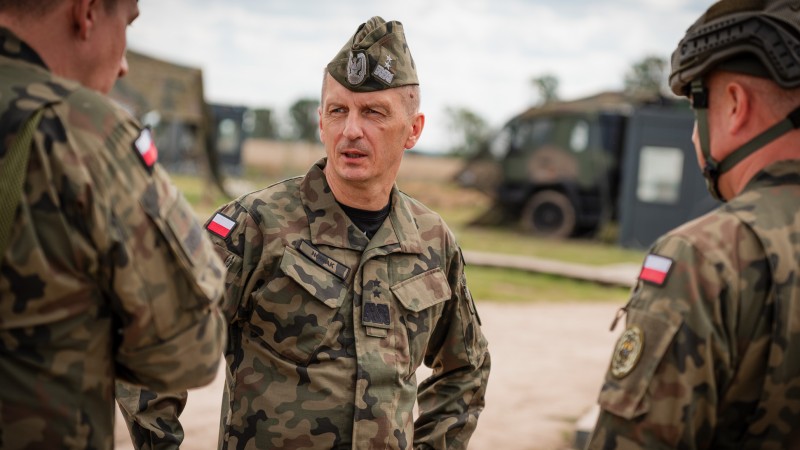
Photo. st. kpr. Łukasz Marzec / Combat Camera DO RSZ
A special, sterile prohibited area, designated “P”, will be established in Polish airspace to facilitate operations by ground-based air defence systems in the east of the country. In an interview with Defence24, Armed Forces Operational Commander Maj. Gen. Ireneusz Nowak explained that the change is intended to give operators confidence and certainty about targets crossing the border.
Maciej Szopa: An Air Force officer and pilot has become the Operational Commander. Does this reflect Poland’s current situation? Do we regard an air attack as the greatest threat?
Maj. Gen., Pilot Ireneusz Nowak, PhD: I would not want to link my professional background as a pilot to my appointment as Operational Commander. I hope someone recognised my experience and my vision for developing the armed forces and considered them the best fit for the threats we currently face.
Leaving my own appointment aside, it is encouraging that genuine “jointness” is developing within the Operational Command. Maj. Gen. Maciej Jabłoński has become my first deputy. He is an Army officer with extensive experience who recently served as deputy commander of the US Army’s V Corps. There, he worked directly with the part of the US Army that would assist us during a crisis or war. My second deputy is Vice Adm. Piotr Sikora, another highly experienced officer, from the Navy. We communicate well as a team. These are constructive discussions that produce something worthwhile.
Both the Operational Command and the General Command now have this “joint” character. Our commanders have different backgrounds. Each of us is different, and each brings something unique to the organisation. This is a modern approach for these difficult times.
How are you developing a multidomain approach within the Armed Forces?
We are developing it continuously, and it is a long-term process. It involves changing organisational culture and ways of thinking, while constantly monitoring trends. Russia’s war against Ukraine also gives us food for thought, although we must avoid certain conceptual traps. As we have repeatedly said, we do not want to fight that way. We do not want a static, frozen, attritional conflict lasting many years. We must find a different model for how the armed forces operate and boldly address the challenges emerging before us.
A multidomain approach is not easy. It requires broad awareness, beginning with an officer’s education at a military academy. Officers should then encounter it at successive stages of their professional development.
Someone who is closed-minded, stands still, and refuses to accept change will never be a good soldier capable of being creative and responding to new challenges. In our reality, those challenges sometimes change from week to week.
Are you starting from scratch, or has Poland already achieved something in this area?
There are areas where the multidomain approach is strong and has become firmly established. One example is what we call air-land integration.
This began with the JTAC programme, Joint Terminal Attack Controllers, but is evolving much more broadly. It has found fertile ground, for example, in cooperation between aviation and Army artillery.
So there are centres from which this way of thinking can spread. One is the Missile and Artillery Forces Training Centre in Toruń. It is a place where people from different domains will meet, learn to communicate, and learn how to make the most of their respective services’ strengths. They will also conduct joint exercises, including joint fires training.

Who will the artillery personnel be meeting there?
They already work with military aviation, and we want to expand this considerably, extending cooperation beyond the Air Force and, eventually, to all the other services. Artillery is very strong in terms of command and control and network-centric capabilities.
The people there are very open-minded and willing to cooperate. Col. Będkowski recently became the centre’s commandant. He is a living legend when it comes to establishing the JTAC programme in Poland. These are people for whom working together, cooperating, and avoiding silos are second nature.
Technology has reached a point where artillery can even help aviation gain air superiority over a designated area. For example, surface-to-surface missiles can destroy air defence systems…
The ranges we are now acquiring, including in the artillery component, have already completely changed the geometry of the battlefield. These are operations beyond visual range, at very long distances. One could also say that artillery is beginning to have more and more in common with helicopter aviation. If our Apaches are equipped with weapons such as Spike NLOS (with a range of 50 km – Eds.), they will move from tactical-level missions to at least the operational level. And who knows: when suppressing certain elements of an adversary’s air defences, they may operate at the strategic level.

Photo. Defence24
The F-35 has not yet reached operational readiness, but can you already see how it will connect these domains? Will it also serve as a catalyst?
Yes, our experience only confirms what we have said since the very beginning of the F-35 programme. However, I would still caution against excessive optimism. First and foremost, I see the F-35 supporting the air defence system as quickly as possible. These aircraft are critically needed there because of their sensors, information-processing capabilities, and combat capabilities.
Later, of course, they will help build that multidomain capability and cooperate with other services. For now, however, several details still need to be addressed. Certain software elements and databases must be loaded. This is a newly introduced aircraft that has only just landed in Poland.
Teething problems?
The introduction process is moving quickly, and personnel are learning quickly, but it will still take some time. I am sorry to say this, but there will be neither a honeymoon month nor a honeymoon year for the F-35. Given the current situation and our needs, these aircraft will enter the air defence system much sooner than the F-16 did.
Changes have recently been introduced to the legal framework and decision-making process for threats to Polish airspace. What exactly has changed, and what has improved?
The main driver is to enable ground-based air defence systems deployed in eastern Poland to operate more effectively. These are not the optimal systems, because they are either short-range or very-short-range systems, such as the SA-8 Osa or Poprad. For now, this is the segment we have developed most extensively. Narew would be the best solution for the task I have to carry out every night, but we do not have it yet and probably will not see it for some time.
We therefore wanted to make the systems we already possess more effective and create the best possible operating conditions for them. The key is to establish a special, segregated, sterile volume of airspace. This airspace will be established within days, probably before this interview is published, through a Council of Ministers regulation.
It will receive “P”, or “prohibited”, status, making it a no-fly zone. This will give ground-based air defence operators confidence. Once several other procedural requirements have also been met, they will be certain that an object they can engage without visual contact is, beyond any doubt, an airspace intruder originating from the Russian Federation.
Anything that is not engaged, or cannot be engaged, by ground-based air defence systems will continue to be engaged by aircraft. Aviation is also receiving new authorities under the procedures.

Photo. 31 BLT kpt. Paweł KRZESZKIEWICZ
Will visual identification of the target no longer be required?
Of course, when conditions permit, such identification will still be possible. For example, during the day, when an interception can even involve the use of the cannon.
However, at night, in cloudy conditions, when only radar contact is available and several other conditions for positive identification have been met, it will also be possible to engage such an object with AMRAAM missiles beyond visual range.

When a Kh-101 missile came down in a field in August… were you concerned that it might be a Ukrainian fighter that had strayed off course?
That was a real concern, because a Ukrainian fighter was operating in the area. It was, in fact, close to that cruise missile.
Naturally, it was more visible on radar and was practically on the national border. Only when it made a sharp manoeuvre eastward could we stop tasking one of our F-16s to monitor it, because we were then certain it was a Ukrainian fighter. We had not known that earlier because our neighbours had not notified us.
After that incident, we asked the Ukrainian side to inform us about their fighters’ movements, particularly when operating so close to the border with Poland.
Last year, you said that 2025–2026 would be the most dangerous period for Poland, with gaps in our capabilities. After that, this window would begin to close. Do you stand by that assessment?
Yes, I do. Equipment deliveries will increase very substantially beginning in 2027, including the FA-50PL. Nine aircraft should be delivered between July and the end of December next year. As with the F-35, this system will need several months for personnel to familiarise themselves with the new technology. These aircraft are, of course, similar to the GF version, and the pilots are trained, but the technical differences may require some time.
So 2027 will probably not be the year when we see a step change in capabilities. In 2028, however, we should expect that to happen in aviation. Right now, though, the ground-based air defence component is the most exposed to these threats.
What will change there?
As Operational Commander, I have many questions and expectations in this area. What about the Narew batteries, additional Patriot batteries, and PAC-3 missiles? There is considerable uncertainty and a risk of delays. It is clear that the conflict in the Middle East, in short, US involvement in Iran, will also affect delivery schedules.
But that should probably not have much of an impact on Narew?
I hope not. I also hope San delivers, and I am keeping my fingers crossed for those 18 batteries. They would help us the most in countering a broad spectrum of aerial threats. However, I am a realist and know the industry’s problems. I know that things are not proceeding smoothly and that there is currently no modernisation programme running on schedule without significant delays. Except one.
Which one?
Delivery of the two MQ-9Bs is on schedule. They should arrive in January next year, and there do not appear to be any major risks there.
The FA-50GFs are to begin quick reaction alert duty early next year. How much will that ease the burden on the F-16 squadrons?
Not very much. The idea is for FA-50GFs to provide additional assistance to our F-16s on air defence missions, in other words, support them. Their main task will be to engage Geran-4 and Geran-5 jet-powered drones, if necessary.

Deliveries of Pilica Plus have begun…
Pilica, Pilica Plus, and even Poprad are not systems that add much qualitatively to national air defence in terms of area coverage. These are short-range systems intended for point defence, and unfortunately, from a defender’s perspective, Poland’s eastern border is very, very long, and the airspace is extensive.
There are assessments that Russia’s ground forces have replenished their equipment. Drone and counter-drone capabilities have also expanded, but Russia is likely to economise on its air force and navy for the foreseeable future, as their capabilities are questionable anyway. Is that a correct interpretation of the situation?
I disagree that the Russians will allow any of the traditional armed services to atrophy. I fully agree that there has been a step change in unmanned capabilities, because they are experimenting not only with aerial platforms but also with ground, surface, and underwater systems. What is happening there concerns us. The Rubikon concept (establishing a personnel training centre that also develops doctrines for employing unmanned systems) demonstrates their considerable ability to adapt.
At the same time, I see absolutely no deliberate constraints on their air and space forces. Any constraints stem solely from the fact that their industry, partly because of sanctions, is currently unable to move into mass production.
That is what is happening with the various Geran models, for which new factories have been built. There is large-scale mass production: thousands of drones produced weekly and tens of thousands monthly.
The same will happen with the air force. For now, the Russians cannot accelerate production there. They have only tiny numbers of Su-57s and Su-35s, but they are not abandoning production. Note that they are systematically replacing the losses they sustain in this segment.
Fortunately for us, they cannot produce strategic bombers, because that would really hurt us. The same applies to modern hypersonic missiles and cruise missiles. Production remains relatively constrained by costs and sanctions. But that does not mean Russian industry would not increase its production rate if those sanctions were suddenly lifted.
We continually observe Russian tactical aviation operating along the front line every day. Among other weapons, it drops glide bombs fitted with UMPK kits. There is no indication that the Russians are moving away from the traditional employment of airpower.
During exercises recently held at the centre, alongside robots, there were also traditional weapons: heavy, effective aerial bombs. The Russians assume that at some point they will be able to gain local air superiority and drop weapons of this kind.
At present, I consider the very rapid progress in the production of unmanned systems, concepts for their employment, and the development of doctrine and tactics to be deeply concerning. Very concerning for us.
There now appears to be a Russian trend away from inexpensive piston-powered Shaheds and Gerans towards fewer jet-powered designs that are much harder to destroy. Is that really the trend?
Absolutely. Jet-powered drones already account for at least 50 per cent, and sometimes 70 per cent, of daily strikes. They use inexpensive Chinese engines, so with mass production, the unit cost of such a drone is not that high. It is clearly higher than for piston-powered models, but their survivability and effectiveness are also greater.
It is concerning that the Russian Federation has also mastered networked drone operations. It can navigate precisely during the terminal phase of flight, effectively turning these drones into deep precision strike weapons. Ukraine’s air defence system was briefly caught off guard. Over time, it began adapting, as always happens in war. There is action, and there is reaction. When a new, effective solution appears, the other side immediately seeks ways to neutralise it.

So the Russian Federation will not return to those mass-produced propeller-driven drones?
They will continue to be used to saturate the air defence system and supplement strikes. The acoustic detection system for piston-powered drones introduced in Ukraine, which we wanted to introduce as well, is already becoming outdated. That gives us a great deal to think about. The threats have changed, and things will no longer be as they were.
Then perhaps the San concept, with its many different sensors and effectors, is not such a bad approach in this situation? We do not know how the threats will evolve, but at least we have a foundation for the future, a range of solutions.
Above all, the system must be adaptable. That means an open architecture that can be easily reconfigured.
The US B-21 Raider bomber is a good example. It looks like the B-2. So why develop a new design? Because the B-2 has a closed architecture, leaving virtually no scope for further development or fundamental changes. A new concept was needed: an “open” bomber with a completely different internal philosophy. We must take a similar approach with San, making it as open and flexible as possible, so that it can be broken down into elements and combined with other components.
The Russian Federation is very good at analysing developments on our side. If it finds a gap in our capabilities, it will certainly exploit it.

Photo. Northrop Grumman
Substantial Army forces remain deployed along the border. Will this continue for a long time, and how does it affect the armed forces’ readiness?
The Chief of the General Staff has already issued an official decision to reduce that presence. It will happen gradually. We will withdraw personnel from the immediate front line and replace soldiers with Border Guard personnel, because that service has also matured and strengthened sufficiently. Fortification of the border is also having an effect, particularly the barrier – the sensors are doing an excellent job. We know where crossings or attempted crossings are no longer taking place, and we know where they have shifted.
We are therefore scaling down, because this costs money, and the military also keeps track of costs. Since it began, our military presence on the eastern border has already cost more than PLN 3 billion. It is time to consider where those funds should be redirected, for example, to counter-drone systems.
We can already say that the border operation has been scaled down from division level to brigade-plus level, and we are now reducing it further to brigade level.
What about the maritime border? We are seeing provocations over the Baltic: for example, escorted Tu-22M3s practising missile launches against Poland from the north. Does this change the missions as well, requiring closer protection of that direction?
Yes, we must protect the maritime border, and there is an awareness of that. Developments in naval modernisation show that decision-makers have understood that we have substantial critical infrastructure along our maritime border and must protect it. It is very good that this has happened, because as military personnel, we advocate a holistic approach to developing the armed forces. That means more than focusing exclusively on expanding capabilities in the land domain. Other services have their own requirements and cannot be excluded from the modernisation programme. That happened to the Navy, but now absolutely no one disputes its needs.
The LNG terminal, Baltic Pipe, fuel terminals, cargo terminals that would also be used in a NATO logistics operation, telecommunications and IT infrastructure running along the Baltic seabed, wind farms: all of this makes it clear that the maritime border must be protected. That includes the air domain.

In the face of growing threats, is cooperation with our allies improving? Can we say anything about that?
First and foremost, in NATO operational planning, an operational plan for the Central and Eastern European theatre has been signed. It provides for specific responses to various situations above and below the Article 5 threshold.
That is a major development, because it required consensus among all the countries contributing forces to this process. They have committed to providing resources on time. Much has also improved since the Ankara summit. Standing Defence Plan 12000, or SDP 12000, is an air defence plan that eliminated the previous narrowly defined missions, such as Baltic Air Policing and Air Shielding. This is now an air defence mission that provides for countering violations of NATO airspace.
So no more sorties with a cannon and two Sidewinders?
All allied aircraft have been carrying AMRAAMs and operating in full combat configuration for a long time. The change is that it is now easier to employ these aircraft across the theatre.
There are no longer bilateral arrangements imposing restrictions under which a particular pair of armed aircraft can operate over one area but not another. Resources, including fighters, can now be allocated flexibly.
And something entirely new is that Swedish, Czech, and even Hungarian Gripens can assist us in Polish airspace. This shows that NATO has adapted to the new situation. Until now, it had enormous military potential and substantial capabilities, particularly in the air domain, but was constrained by restrictions. Now we defend the Alliance’s entire airspace. This is very important for us. We have a fairly small F-16 fleet that flies almost every night. We are stretched thin, and any outside assistance is critically important.
I would add that Sweden has presented a very interesting concept. It has pledged the presence and assistance of its Gripen fighters. They will take off from an airfield in Sweden and, if necessary, land at Mińsk Mazowiecki after completing their mission in Polish airspace. There, they will be turned around for another sortie, even with their engines running, and then return to Sweden or continue operating over Poland.
So, shuttle missions.
That is precisely ACE (Agile Combat Employment). The flexible employment of aircraft from different airfields and locations. It is something we also need. With these Gripens landing here, our technicians will also have an opportunity to learn rapid Gripen turnaround procedures through Aircraft Cross Servicing. This is a practice that had been somewhat forgotten within the Alliance, and now there is an opportunity to train technical personnel in it.
So, overall, all of this is moving towards NATO forces cooperating like the armed forces of one large country.
Yes. You could say that we treat the Alliance’s airspace as allied airspace, without national barriers or restrictions. SACEUR (the Supreme Allied Commander Europe, NATO’s commander in Europe, as the editor notes, Gen. Grynkewich) has also received significantly expanded authority.
Thank you for the interview.
Part II Coming Soon


