












- ANALIZA
- WIADOMOŚCI
Israel and Greece are expanding their military cooperation. The benefits for each country differ

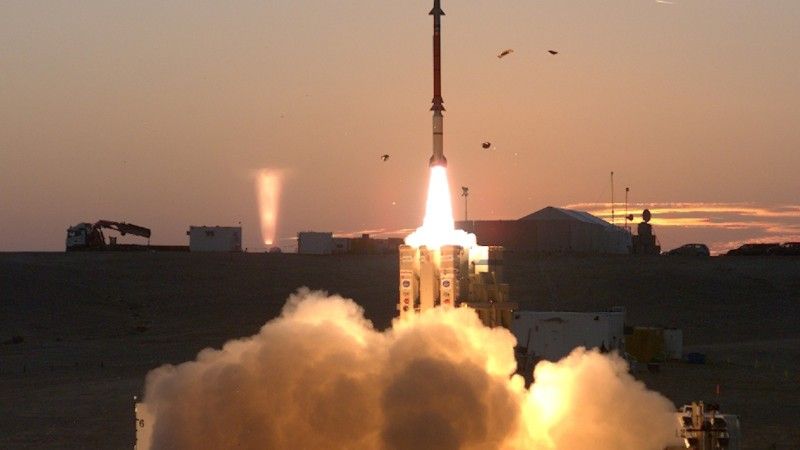
Photo. U.S. Missile Defense Agency / Wikimedia Commons
Greece is strengthening its deterrence capabilities by investing in cutting-edge military technology under the “Achilles’ Shield” programme. The authorities in Jerusalem, in turn, are supporting their own defence companies and building the image of a country that still has friends in Europe and, contrary to popular belief, is not entirely isolated in the international arena.
The bilateral contract signed in August, which includes the purchase of Israeli air and missile defence systems by Greece, is worth over $3 billion. Shared concerns regarding Turkey’s expansionist policies are the key element cementing this bond. For Greece, Turkey is a perennial rival, while for Israel, for some time now, it has been a country representing a threat comparable to the one Iran currently poses to stability in the Middle East.
Ankara, in turn, is watching with preoccupation and unease the strengthening ties between Athens and Jerusalem. The Turkish Foreign Minister even warns that such a policy of Kyriakos Mitsotakis’s government may lead to a war in this part of the world.

New battlefield, new technologies
The dynamically changing situation in the Middle East and the Eastern Mediterranean is pushing the region’s key players to seek new partners and enhance existing alliances. Competition for key raw materials, especially gas, crucial for the development of local economies, is also becoming increasingly important.
All these elements converge in Israel’s current policy towards its neighbours. Many of them have remained unchanged for decades, and some azimuths are stable, but today we are witnessing a slight shift towards the West and North. Indeed, Iran and Syria, located east of the Jordan River, are still the focus of attention for Israeli politicians, military officers, and planners. However, they are attaching increasing importance to developments along the Greece-Cyprus-Turkey-Lebanon-Saudi Arabia axis, seeing this as the source of current and escalating problems, but also as opportunities.
From this perspective, the most interesting developments are taking place in the Mediterranean, where Benjamin Netanyahu’s government attempts to reinforce a trilateral alliance with Athens and Nicosia. The Israel-Greece-Cyprus axis is intended to counterbalance Turkey’s growing influence, guarantee access to and protection of raw material deposits, secure supply chains, and—last but not least—constitute a “new opening” for Israeli exporters of arms and military equipment.
Jerusalem has reached another milestone in this area, signing an agreement with the government in Athens worth over $3 billion, providing for, among other things, the strengthening of Greece’s air and missile defences and, more broadly, its deterrence capabilities. This is one of the investments under the “Achilles’ Shield” programme, which is scheduled for completion within three years. In total, Kyriakos Mitsotakis’s cabinet has planned an increase in defence spending (by approximately $30 billion) until 2036.
The Greek Armed Forces will be equipped with Israeli missile defence systems. One of these is the “David’s Sling”, a system proven in Israel itself, which intercepts medium- and long-range cruise missiles and is capable of destroying targets within a radius of up to 300 kilometres. The “Spyder” system, in turn, is intended to shoot down enemy aircraft, helicopters, and drones. The most versatile is the “Barak MX”, which can engage all of the aforementioned targets. It has recently been purchased or commissioned (in various configurations) by countries such as the Netherlands, Colombia, Slovakia, Thailand, and Azerbaijan.
Greece secured a 25% share for its own industry in this project, as well as access to sensitive data and weapons source codes, which is a key topic in any negotiation regarding such contracts.
“Israel and Greece share common strategic interests and face similar regional challenges, at a time when actors with hegemonic ambitions are striving to expand their influence, thus undermining stability throughout the region,” said Israel Katz, Defence Minister in Benjamin Netanyahu’s government, after the signing of the agreement, suggesting quite clearly that he meant Turkey. His Greek counterpart, Nikos Dendias, pointed to the changing nature of the modern battlefield and warfare. “Modern conflicts are transforming the parameters of defence and deterrence. Ballistic missiles, satellite communications, unmanned systems, hybrid and cyber threats, and the need for increased inter-operational coordination – all of this is making our current thinking about tactics obsolete.”
See also 

Further problems, further wars
In many of the areas Minister Dendias mentioned, Israel is a leading global manufacturer and exporter. Last year, Israeli arms sales reached $19 billion – an increase of nearly one-third compared to the previous year. According to a report published in March by the Stockholm-based International Peace Research Institute, Israel overtook Great Britain in this ranking for the first time in history, becoming the seventh-largest exporter of military equipment in the world.
Greece also attracted interest from Israeli companies in the past. In June 2023, the Greek company Intracom Defence was acquired by Israel Aerospace Industries (transaction value: $65 million), allowing the Israeli giant to gain a foothold in Europe and access to EU funds. Meanwhile, the Israeli company Elbit opened a pilot training centre in Kalamata. Recall that back in 2015, Athens and Jerusalem signed a Status of Forces Agreement (SOFA), regulating the legal aspects of military cooperation and joint exercises, as well as enabling the stationing of troops on each other’s territory.
Overall trade between the two countries has also increased significantly in recent years – by 41% between 2023 and 2024, from approximately $920 million to $1.3 billion.
A common adversary, Turkey, has forced Greece and Israel to intensify these efforts. For years, Athens and Ankara have maintained, to put it mildly, frosty, or at best, cool relations, with the primary point of contention being, of course, the Turkish occupation of Northern Cyprus. In Israel’s case, relations with Turkey have deteriorated rapidly over the past decade or so. Prime Minister Netanyahu is now portraying Turkey as a country posing a threat to Israel almost as grave as Iran’s, accusing Recep Tayyip Erdoğan of stoking anti-Semitism and supporting Hamas. The Turkish president even became a protagonist in Netanyahu’s election campaign; he appeared on billboards alongside other alleged enemies of the Jewish State: Ayatollah Mojtaba Khamenei, Hezbollah Secretary General Naim Qassem, and New York Mayor Zohran Mamdani.
The Turkish president is returning the favour by comparing the Israeli prime minister to Adolf Hitler and accusing him of genocide in Gaza. “Just as Hitler was stopped by the alliance of all humanity, so too must Netanyahu and his criminal tentacles be stopped today by all humanity,” Erdoğan thundered during his speech at the UN headquarters in New York in September 2024. It’s no surprise, then, that the expansion of military cooperation between Israel and Greece was met with an immediate, sharp reaction from Ankara. “Greece is pursuing a very risky policy. It can only lead to further destabilisation in the region, further problems, and further wars,” warned Turkish Foreign Minister Hakan Fidan.
For Prime Minister Netanyahu, the agreement with Greece also has a strictly image-building aspect. Israel’s current standing in most countries is negative, both at the official level and among the public—especially in Europe. Criticism of the Netanyahu government and the IDF’s actions, both in the Gaza Strip and Southern Lebanon, is almost universal and extremely radical across the Old Continent. In Spain alone, over 80% of citizens agree that Israel is committing genocide. A serious crisis erupted after several EU countries imposed a ban on imports of products from the occupied territories in the West Bank. Recently, there was a near-boycott and cancellation of the football match between Israel and Ireland. In this situation, any evidence of normal, fruitful relations between Israel and EU member states is valuable to Netanyahu. This is the case with the arms deal with Greece, cooperation with Germany (the INS Drakon, a new Israeli Navy submarine built by the German company ThyssenKrupp, made its maiden voyage at the end of August), and with Slovenia (on September 9, Israel opened its embassy in Ljubljana, 34 years after establishing bilateral relations).

The Gaza burden
However, due to the war in Gaza (and in part because of the operation against Iran), even those governments striving to maintain good relations with Jerusalem must navigate between geopolitical pragmatism and the mood of their own voters. The situation in Greece is no different.
The Greek Prime Minister was the first foreign leader to visit Israel after October 7, 2023. “Mr. Prime Minister, dear Bibi,” said Kyriakos Mitsotakis on October 23 of that year in Jerusalem. “What happened was truly horrific. From the very beginning, Greece has defended and supported Israel’s right to self-defence in accordance with international law. We have made a very clear distinction between Hamas and the Palestinian people. We will continue to support you, and we hope that whatever happens, it will be without excessive humanitarian cost. However, you can count on our support, on our assistance.”
Mitsotakis’s government subsequently served as a loyal ally of Israel in the EU, often refusing to join declarations and initiatives aimed at the authorities in Jerusalem. Recently, however, under pressure from its own population, this has begun to change. Greece signed a statement, among others, criticising the expansion of illegal settlements in the so-called E1 zone in the West Bank, and Mitsotakis himself recently stated that Israel’s war in Southern Lebanon “is counterproductive,” adding that he feels compelled to “speak the bitter truth to his own friends.”
It should be added that anti-Israel and anti-American demonstrations occasionally occur in Greece, as in March of this year, when approximately one thousand people gathered in front of the US and Israeli embassies, demanding the closure of Greek military bases to aircraft bombing targets in Iran. In a poll conducted last summer, 35% of respondents believed that against the backdrop of the conflict in Gaza, Greece should condemn Israel, while only 11% expressed the opposite view (the majority, 55%, were in favour of maintaining neutrality).

After the parliamentary elections in Israel, scheduled for October 27th, Israeli-Greek relations will only deepen, regardless of the outcome. In this case, the bilateral military cooperation is a long-term project and its strategic importance is unquestionable. America’s blessing for this alliance is not to be underestimated either. And Turkey’s posture will probably not change in the foreseeable future, which means more investment in defence, both in Jerusalem and in Athens.


