












- WYWIADY
- WIADOMOŚCI
- WAŻNE
“We must produce warriors, not scientists”: Operational Commander Maj. Gen. Ireneusz Nowak talks with Defence24

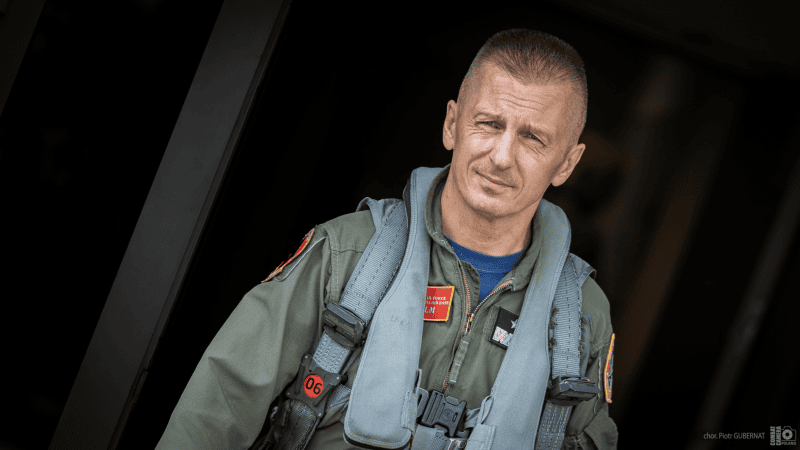
Photo. fot. chor. Piotr Gubernat / Combat Camera MON
Poland needs its own sovereign strategic airlift capabilities and aircraft fleet, as well as continued discussions on additional combat squadrons. In the second part of our interview with Maj. Gen. Ireneusz Nowak on the current situation and threats, we focus primarily on equipment.
Last year, the military considered Pilatus aircraft, Super Tucanos, Bryzas, and multirole combat aircraft for counter-drone missions. What conclusions have you reached, and what have you accomplished?
APKWS II rockets will definitely be available on the F-16 and FA-50PL. For obvious reasons, our main effort has focused on integration with aircraft we already operate, the F-16, with the FA-50PL to follow once it enters service with the Polish Armed Forces. I thought this would happen sooner for the F-16, but production is insufficient to meet global demand for these weapons, and deliveries have so far gone to the Middle East. We were supposed to receive fuzes obtained from the US Air Force. That service is now certifying an even more effective fuze, and rockets with those fuzes will ultimately come to Poland. APKWS II rockets are being procured under an urgent operational requirement. Our Sniper targeting pods have already been upgraded with software that enables APKWS II employment.
The AW149 helicopters, meanwhile, will receive an equivalent weapon manufactured by Thales, although that version is primarily intended for engaging ground targets. APKWS II for the AH-64E helicopters remains an open question. I would like them to have the capability to engage aerial targets as well, not just ground targets.
At this point, it is also worth mentioning that the Polish Armed Forces have begun serious analyses to identify a successor to the PZL-130 TC-II Orlik aircraft, which have their weaknesses and do not fully meet the training requirements for new platforms, such as fifth-generation aircraft or our F-16s following their midlife upgrade. This was one reason why demonstration flights and familiarisation with comprehensive training systems built around turboprop aircraft such as the A-29 Super Tucano and Pilatus PC-21 took place this year. We have drawn conclusions from our assessment of these two platforms, but I would rather not discuss the details here yet. Further decisive steps are certainly needed to incorporate these capabilities without delay into the “Polish Armed Forces Operational Capability Requirements for 2025–2039” and the Technical Modernisation Plan, so that this issue receives serious attention without further delay.

What about the Bryza?
I want to be clear. We cannot afford research and development efforts that take years. One Bryza will be equipped with guns. It may also receive a FLIR turret. However, it is already clear that the threats have moved ahead of us. While we have yet to develop an aircraft to counter Shahed-136s, faster, higher-flying jet-powered drones have already appeared.
This also shows that our military-civilian equipment procurement system is inefficient because of its complicated formal and legal procedures. Both sides bear responsibility, including industry. Under this approach, we will never receive modifications, new weapon systems, or new capabilities on time, because threats will always outpace us.
This system for procuring, modernising, and modifying military equipment must be brought up to date so that it reflects the times we live in, which are no longer times of peace.
So, as operational commander, you expect…
I expect rapid results, in the spirit of “fight tonight.” That is what General Grynkewich and our society expect of me. When the missile crashed in Tarnawa [the missile incident in August this year, editor’s note], the public asked how it could have spent six minutes in Polish airspace. I therefore need the tools to fight effectively in the near term.
You recently spoke about delays to the Barbara programme. How long are those delays, and how important is Barbara?
The delays have already exceeded a year, and I do not think we will see Barbara in 2027 either. This is a key system, an extremely important sensor that will buy me time to make decisions and act in critical situations, or detect a threat early enough to configure the air defence system effectively, in other words, to assign targets to individual elements of the system. Barbara would make this much, much easier. Without it, we are once again placed on the defensive. We will detect threats late and therefore act late.
The Russians are moving away from slow, low-flying drones toward higher-flying, jet-powered ones. Does that not, paradoxically, make Barbara somewhat less important than before?
No, because the greatest threat to us comes from cruise missiles—full-fledged, high-cost weapon systems such as the Kh-101. They follow low-altitude flight profiles, close to the ground, usually in weather conditions and at times that disadvantage the defenders.

Poland has joined an allied A400M Atlas transport aircraft programme. Will participation in such a multinational squadron be sufficient, or do we still need our own Atlases?
Poland participates in international programmes and bears the associated financial costs. There is, for example, the Strategic Airlift Capability, or SAC, programme operating C-17s in Hungary, and we have now signed a preliminary declaration to join a strategic airlift initiative based on the A400M.
However, this does not change our position that we should have our own sovereign fleet and capabilities. The scale of our participation in international programmes should be assessed, and that assessment should determine how many national assets we need.
We continue to believe that a frontline state facing difficult circumstances—defending its own territory—will immediately need large quantities of ammunition and spare parts delivered as quickly as possible, particularly those coming from the United States or South Korea.
We still need strategic airlift, meaning something roughly in the A400M class, but we have not forgotten the Drop programme to replace the Hercules either. Regarding the A400M, this is a European platform that falls within the scope of the SAFE instrument. It is an excellent opportunity that we, as the Armed Forces and as a country, should not squander, allowing us to acquire these operational capabilities by 2030.
Despite the declarations, there is still no contract for aerial refuelling aircraft…
An agreement has been signed between Poland and Spain, and that is a political declaration. We managed to secure a great deal here, because Spain’s goodwill has given us production slots guaranteeing deliveries before 2030. That makes the programme eligible for SAFE funding.
We now expect the framework agreement to be finalised and signed within days, followed by an implementation contract by the end of the year. I know the negotiating team is working and the process is moving forward. We are all keeping our fingers firmly crossed, because the implementation contract will guarantee that the programme gets underway. Considering that we are receiving Spanish production slots, the schedule looks reasonable, and we would have four tankers by 2030. It would be excellent if we could get this through.
See also 

NATO has selected GlobalEye as its airborne early warning and control aircraft. Poland also faces a decision on an aircraft in a similar class. What does the Alliance’s selection mean for us?
Poland will participate in this allied programme, just as it did in the previous one. We need NATO assets that serve everyone, the entire Alliance.
Nevertheless, as with strategic airlift, we are not abandoning the pursuit of our own independent solution.
From my perspective, NATO’s selection of GlobalEye does not mean anything for now, except perhaps that the waiting time has increased. These aircraft are not mass-produced. Their production process is lengthy, and their components are highly specialised. We remain open to any other solution, provided we receive a reliable tool reasonably quickly. It does not have to be the best or most expensive in the world, but it should fulfil its role in Poland’s air defence system. That means giving me situational awareness sooner and, importantly, enabling air battle management. In other words, it should be more than a flying sensor: it should also have onboard workstations for fighter controllers who will work directly with the fighters.
In the coming years, the Air Force and Land Forces, and possibly the Navy as well, will receive numerous new aircraft. As operational commander, are you confident that personnel will be available for all these investments? Information has recently emerged about changes to the pilot training system. How do you assess them?
The requirement to train large numbers of personnel is substantial, and this is a major challenge. We have tried to assess realistically and soberly where we stand and whether our current arrangements are the best and most effective.
We concluded that this could be done better and more efficiently. There is currently a conflict of interests between the educational, theoretical component, the Polish Air Force University, and the practical training component, the 4th Training Aviation Wing.
This system does not match the gravity of the times. Fortunately, both the new rector and the commander of the 4th Wing appear to have reached an understanding and recognise that they must address this issue.
Everything is moving toward finally replacing the alternating training system with a block-based approach: three and a half years of theoretical training for an officer cadet, followed by a year and a half of practical training, flying without unnecessary breaks, without losing established habits or currency. The aim is a continuous flight training process, because that is when it is most effective.
We can then ask whether our military education system, particularly aviation education, is too long and includes things that a young trainee or junior officer does not need. That discussion must take place.
Certain interest groups at military universities want as many academic hours, grants, and projects as possible. But we must decide whether we are producing a warrior or a scientist. And if we are producing scientists, who is supposed to defend us? Fight tonight…
I have to ask about the two additional combat squadrons. Is there any new information or any change in requirements?
Of course they are needed, because the figure of 160 combat aircraft was already a compromise, the minimum below which the Air Force cannot go.
This concerns the air defence system, but aviation will also perform entirely different missions. It will support the Land Forces and Navy and carry offensive weapons. This requirement stems from serious analyses and calculations of how many fighters, with or without tanker support, and how many air patrols are needed to ensure comprehensive coverage of Polish airspace.
A decision on the way forward is finally needed. Companies criticise us for discussing and signalling our requirements in the media while Poland takes no official steps.

There has been neither a serious market analysis nor a feasibility study. In fact, there has been no decision at all. This is dragging on, and we should remember that the companies offering those two additional squadrons came forward with very substantial economic proposals. These included packages covering industrial participation, aircraft maintenance, aircraft engine servicing, and even aircraft engine production in Poland.
These are areas of technology that we badly need, but there is a risk that the cooperation offers will become outdated and no longer be available. We should consider whether such a project ought to be an interministerial undertaking, for example, and whether the Ministry of State Assets should also be involved.
What about the Harpii Szpon programme?
As operational commander, I certainly see this as a direction we cannot avoid, and Collaborative Combat Aircraft, or CCA, are the future in the air domain. Competition in the market is currently very intense, as companies compete for contracts and develop their platforms.
Unfortunately, the Harpii Szpon programme is not included in the current Technical Modernisation Plan and has no allocated funding. Discussions on these capabilities have begun within the ministry and will continue. This certainly requires broader operational analyses, a national strategy for employing these capabilities, more precise definition in the “Polish Armed Forces Operational Capability Requirements,” and funding for their implementation under the Central Material Plans.
Leaving aviation aside, since that has been the focus of most of my questions, which programme is most urgently needed from the operational commander’s perspective? If you could have one wish granted?
I believe it would be an effective, multilayered counter-drone system. At present, there is no solution flexible enough to meet requirements across every segment, from individual protection and vehicle protection systems to area protection for troop formations or critical infrastructure.
This is an enormous challenge, because the requirements and specific characteristics of every branch of the Armed Forces must also be reconciled.
I would like counter-drone systems with effectors capable of remaining airborne for extended periods, for example, several hours at high altitudes. I expect this to be within the reach of current technology and that such solutions will emerge.
My second wish would be a substantial improvement in C2: communications and automated command systems. I would like them to be better integrated so that information can be exchanged seamlessly among all participants, not in a way that overwhelms everyone with excessive information, but so that each receives what is needed at a given moment. This can only be achieved using AI algorithms. All of it, of course, with appropriate cryptographic protection.
In modern conflict, time is always critical. Whoever reacts and acts faster is more effective.
Polish mechanised infantry still uses BWP-1 infantry fighting vehicles. Is that not another particularly glaring gap in the Armed Forces?
It is a gap, and it has been neglected for years. This is an area of the Land Forces that absolutely must be addressed. The BWP-1s must finally go to museums or be melted down. There is no doubt that we will try to make up for this shortfall.

There was recently a discussion about Strykers. But that is a controversial issue for other reasons…
I realise that many people criticise that option. This is a difficult problem to solve: we have been left with archaic equipment such as the BWP-1. We must remember that this is not just about the equipment itself, but about the people who fight in it. There is no doubt that infantry fighting vehicles are needed. General Jabłoński could certainly say more about the Land Forces. However, taking a holistic view of the Armed Forces, I also see this as a gap that will have to be closed.


